Can I Start a Business With No Experience in Dubai? 2026 Beginner's Guide
Yes, you can start a business in Dubai without previous entrepreneurial experience. This practical 2026 guide explains licence options, setup steps, costs, tax considerations, common mistakes and preparation requirements for first-time founders.
Key takeaways
- Previous business ownership is generally not a universal requirement for starting an ordinary business in Dubai, although regulated activities may require qualifications or approvals.
- The correct mainland, free-zone or other structure depends on customers, activity, premises, visas, costs and long-term operating needs.
- A business licence should be chosen for operational suitability, not simply because it has the lowest advertised setup price.
- First-time founders should budget for working capital, marketing, Accounting, Tax compliance, banking preparation and annual renewals.
- Corporate Tax and VAT obligations depend on applicable UAE rules, thresholds and the specific circumstances of the business.
- Strong documentation, Financial discipline and early professional advice can help beginners avoid preventable setup and compliance mistakes.
Can I Start a Business With No Experience in Dubai?
Yes. For most ordinary commercial activities, previous business ownership or entrepreneurial experience is not a general requirement for setting up a company in Dubai. What matters more is selecting an appropriate business activity, legal structure and jurisdiction, obtaining the required licence and approvals, and meeting ongoing UAE compliance obligations.
Official UAE business setup procedures focus on matters such as the chosen activity, legal form, trade name, initial approvals, premises where applicable, additional government approvals and supporting documents. Certain regulated sectors and professions may require qualifications, professional experience, certifications or external authority approvals.
The practical question, therefore, is not simply whether a beginner can start. It is whether the founder understands the commercial, Financial, Tax, Accounting and regulatory responsibilities that begin once the business becomes operational.
Why is Dubai attractive to first-time entrepreneurs?
Dubai offers first-time founders access to mainland and free-zone company structures, international customers, modern infrastructure, digital government services and a broad range of licensed business activities. However, the quality of the opportunity still depends on the founder's market knowledge, budget, execution and choice of business model.
The official Invest in Dubai platform provides information on mainland and free-zone setup options, SME support, regulations, business activities and government setup services. The UAE Government also sets out separate processes for mainland and free-zone businesses, allowing entrepreneurs to assess which structure suits their proposed operations.
Dubai is especially attractive to beginners who want to start with a focused service, digital operation, consultancy, e-commerce activity or specialised small business. Yet a licence alone does not create demand. Founders should validate customers, pricing and operating costs before committing substantial capital.
First-time founders rarely struggle because they lack a business history; they struggle when the licence, budget, market and compliance plan do not match the actual business model. — Consultant observation
Do you legally need previous business experience to start a company in Dubai?
Generally, no. The standard company formation process does not impose a universal requirement that every founder prove previous entrepreneurial experience. Eligibility instead depends on the activity, jurisdiction, ownership structure, documentation and any sector-specific approval conditions that apply to the proposed business.
For a typical mainland business, the official setup process may include identifying the activity, choosing the legal form, applying for a trade licence, registering the trade name, obtaining initial approval, arranging constitutional documents where required, selecting business premises and securing additional government approvals where applicable.
A first-time founder should still distinguish between business experience and professional eligibility. Someone may be allowed to own a company without previously running one, while a regulated activity such as healthcare, education, Financial services or another specialist profession may require qualifications, licences or approval from a competent authority.
This distinction should be checked before paying for a licence package or signing a lease.
Which skills matter more than previous business experience?
The most useful skills for a new founder are the ability to understand customers, manage cash, maintain records, communicate clearly and make decisions based on evidence. These skills can be developed, but ignoring them can make even a strong business idea difficult to operate.
First-time entrepreneurs should pay particular attention to:
- Financial discipline and cash-flow planning
- Customer acquisition and retention
- Pricing and margin awareness
- Basic Accounting records and documentation
- Contract and payment terms
- Time management
- Supplier due diligence
- UAE Tax and compliance awareness
- The ability to ask for professional advice before a costly decision
A beginner does not need to know everything. The founder does, however, need to understand which decisions can safely be handled internally and which require specialist support.
What are good business ideas for beginners in Dubai?
The best beginner business is usually one that matches the founder's existing skills, has identifiable customers, requires manageable startup capital and does not depend on unrealistic sales assumptions. Some service and digital models may be simpler to test than businesses requiring substantial premises, inventory, staff or specialist approvals.
Potential options include:
E-commerce
An e-commerce business may suit founders who understand a clear product category and customer segment. Depending on the structure and business activity, the founder will need the correct licence and should consider supplier terms, logistics, returns, online payment arrangements, customs implications and VAT exposure.
The UAE Government notes that specialised e-commerce licences are available through free zones for businesses selling products and services online, locally and internationally.
Digital marketing and creative services
Founders with practical skills in social media, advertising, design, content, SEO or branding may consider a digital agency or specialised consultancy. A narrow service proposition is often easier to sell than trying to offer every marketing service from day one.
Freelance or specialist professional services
Freelancing may suit designers, developers, writers, consultants and other specialists, subject to the appropriate permit, licence and activity requirements. Founders should check whether their work requires additional qualifications or approvals.
Online education or coaching
A founder with genuine subject knowledge may consider education, training or coaching services. The exact licence and approvals depend on the activity and delivery model, so founders should not assume every form of online instruction falls under the same regulatory treatment.
Cleaning and operational services
Cleaning and similar service businesses can offer recurring demand, but they also bring operational responsibilities involving staffing, transportation, insurance, equipment, payroll, customer service and potentially labour compliance.
Should a beginner choose mainland, free zone or offshore?
There is no single best choice for every beginner. Mainland businesses may be appropriate for founders targeting the wider UAE market, while free zones can be attractive for certain activities and ownership structures. Offshore entities are generally designed for specific holding or international purposes and are not a substitute for a normal operating licence.
Dubai mainland setup involves a defined sequence of activity selection, legal form, licensing and approvals. Free zones have their own authorities, eligible legal forms, activity lists, licence packages and operational conditions.
Foreign investors may also be eligible for up to 100% ownership of specific commercial companies, depending on the activity and applicable legislation.
A beginner should decide based on practical questions:
- Who are the target customers?
- Will the company trade directly in the UAE market?
- Is physical office space necessary?
- How many visas may be required?
- Are there sector-specific approvals?
- Does the business need warehousing or inventory?
- What are the annual renewal costs?
- Will the company need a corporate bank account and cross-border payment arrangements?
- What Tax, VAT and Accounting obligations may apply?
Example 1: A fictional founder named Sara plans to provide brand strategy services to UAE SMEs and international clients. Rather than choosing the cheapest advertised licence, she first confirms the precise activity, customer locations, visa requirements and expected annual operating costs. This allows her to compare mainland and free-zone options on operational suitability rather than licence price alone.
What are the steps to start your first business in Dubai?
A first-time founder should move through the setup process in a logical order rather than buying a licence before understanding the business model. For a mainland company, official UAE guidance identifies steps including business activity selection, legal form, trade name, licensing, initial approval, premises and additional approvals where required.
1. Define the business model
Be specific about what the company will sell, who will buy it, how customers will be reached and what the expected gross margin may be.
2. Choose the correct business activity
The licensed activity should reflect what the company actually intends to do. Trying to use a convenient but unsuitable activity can create problems with invoicing, banking, contracts or regulatory approvals.
3. Compare jurisdictions
Review mainland and relevant free-zone options based on activity permissions, market access, premises, visas, ownership, renewal costs and future expansion.
4. Select the appropriate legal structure
The correct structure depends on ownership, activity, number of shareholders and intended operations. Common possibilities may include an LLC, sole establishment, civil company, branch or free-zone entity, depending on eligibility.
5. Reserve the trade name and obtain approvals
Trade name conditions and approval requirements vary. Some sectors need consent from additional authorities before final licensing.
6. Complete licensing and establishment formalities
Submit the required documentation, arrange constitutional documents and premises where necessary, and complete the relevant authority's process.
7. Prepare for banking and operations
A corporate bank account is subject to the chosen bank's due diligence, risk assessment and documentation requirements. A trade licence does not automatically guarantee account approval.
8. Set up Accounting, invoicing and Tax processes
Do not wait until the first Tax deadline to organise records. Build suitable bookkeeping, invoice retention and transaction documentation from the beginning.
How much does it cost to start a business in Dubai?
There is no reliable single price for starting a business in Dubai. Total cost depends on the jurisdiction, activity, legal structure, office requirement, visa allocation, external approvals, establishment services, insurance, staffing, equipment, banking needs and annual renewal expenses.
A beginner's budget should account for more than the advertised licence fee.
Consider:
- Licence and registration charges
- Trade name and initial approval costs where applicable
- Office, desk or premises requirements
- Immigration and establishment expenses
- Residence visas and medical processes where relevant
- Professional fees
- Insurance
- Website and technology
- Marketing
- Staff and payroll
- Bookkeeping and Accounting
- Tax compliance
- Working capital
- Emergency reserves
- Annual renewals
Example 2: A fictional e-commerce founder named Omar budgets only for a licence and website. After setup, he discovers that inventory, product photography, delivery fees, payment gateway charges, customer returns, bookkeeping and marketing require substantially more cash than expected. A proper pre-launch cash-flow forecast could have exposed this gap before he committed funds.
What UAE Tax and Accounting issues should beginners understand?
New founders should treat Tax and Accounting as operating responsibilities from the beginning. Corporate Tax, VAT and record-keeping obligations can apply depending on the legal structure, taxable income, revenue, transactions and other circumstances.
The UAE Corporate Tax framework generally applies a 0% rate to taxable income up to AED 375,000 and a 9% rate above that threshold, subject to the Corporate Tax Law and applicable conditions. Free-zone businesses can also fall within the Corporate Tax framework, with specific rules applying to qualifying free-zone persons.
For VAT, the Federal Tax Authority states that a business must register when taxable supplies and imports exceed the mandatory AED 375,000 threshold under the applicable test. Voluntary registration may be available from AED 187,500, subject to the relevant conditions.
A first-time founder should therefore consider:
- Whether Corporate Tax registration is required
- Whether VAT registration is mandatory or voluntary
- Whether invoices meet applicable requirements
- How revenue and expenses will be recorded
- Whether personal and business funds are kept separate
- What supporting documents should be retained
- When Tax returns or other filings may become due
Tax treatment should never be assumed solely from the licence type or from the words "free zone" in the company's address.
What are the most common mistakes first-time Dubai business owners make?
Many beginner mistakes happen before the first customer is acquired. The most costly errors often involve choosing a structure based only on price, underestimating working capital or failing to verify the activity and compliance requirements.
Common mistakes include:
- Choosing the cheapest licence without checking whether it suits the actual activity
- Starting without customer or competitor research
- Underestimating the cost of operating for the first six to twelve months
- Mixing personal and business transactions
- Failing to maintain proper Accounting records
- Ignoring Corporate Tax or VAT until a deadline approaches
- Assuming a licence guarantees corporate bank account approval
- Signing long-term premises or supplier commitments too early
- Hiring before revenue can support payroll
- Relying on verbal promises rather than documented terms
- Trying to offer too many services from the beginning
- Failing to monitor receivables and cash flow
What documents and preparation should a beginner organise?
The exact requirements depend on the jurisdiction, activity, shareholders, legal form and approvals involved. However, preparing core information early can reduce delays and prevent avoidable changes later.
A practical preparation checklist includes:
- Valid passport copies for shareholders and relevant parties
- Visa and Emirates ID copies where applicable
- Proposed trade names
- Clearly defined business activities
- Shareholder and ownership details
- Contact information
- Intended legal structure
- Initial startup budget
- Twelve-month cash-flow estimate
- Expected customer profile and markets
- Office or premises requirements
- Visa and staffing estimates
- Source-of-funds documents where requested
- Basic business plan or commercial description
- Supplier and customer contract templates where relevant
- Accounting and invoicing process
- Tax registration assessment
- Banking documentation pack
The objective is not to collect unnecessary paperwork. It is to make sure the founder can explain clearly what the business will do, who owns it, how it will operate and how it will be funded.
How can KPM Global Services UAE (https://kpmglobal.ae/en) assist first-time founders?
KPM Global Services UAE (https://kpmglobal.ae/en) can assist founders with practical business setup planning, Accounting, Financial advisory and UAE Tax considerations, depending on the nature of the proposed activity and engagement.
Support may include:
- Comparing appropriate business setup options
- Reviewing activity and operational requirements
- Preparing realistic startup and cash-flow budgets
- Establishing bookkeeping and Accounting processes
- Reviewing Corporate Tax and VAT considerations
- Supporting Financial documentation and management reporting
- Helping businesses improve banking readiness and record organisation
- Identifying compliance gaps before they become operational problems
For a first-time founder, professional support is most valuable when it helps improve the quality of the decision before money is committed. KPM Global Services UAE (https://kpmglobal.ae/en) does not replace the relevant government authority, bank or regulator, and no adviser should guarantee licensing, banking, Tax savings or authority outcomes.
Is lack of experience really the biggest risk?
Usually not. Lack of experience can be managed through research, professional advice, disciplined budgeting and gradual execution. A more serious risk is committing money before understanding the customer, licensing conditions, operating expenses and compliance obligations.
A sensible first-time founder should start with evidence:
- Confirm a real customer problem.
- Test willingness to pay.
- Estimate realistic sales volumes.
- Calculate fixed and variable costs.
- Verify the licence and approval requirements.
- Plan for Accounting, Tax and documentation.
- Keep sufficient working capital.
- Review performance regularly and adjust early.
Starting small is not a weakness. For many beginners, a controlled launch provides better information than an expensive launch based on assumptions.
This article is for informational purposes and does not constitute legal, tax, accounting, or financial advice.
Final advisory perspective
You can start a business with no previous entrepreneurial experience in Dubai, but enthusiasm should be matched with preparation. The strongest beginner businesses are not necessarily the most fashionable or complex. They are businesses with a clear customer, an appropriate licence, realistic pricing, controlled expenses, reliable records and enough cash to operate through the early stages.
Before registering a company, define what you will sell, where your customers are located, what approvals may apply and how much capital the business genuinely needs. Then compare structures based on operational fit rather than headline setup price.
Experience can be built. Poorly chosen commitments are harder to reverse.
Questions and answers
Q: Can a foreigner start a business in Dubai without previous experience?
A: Yes. Foreign founders can generally establish businesses in Dubai without previous entrepreneurial experience, provided they meet the licensing, ownership, documentation and approval requirements for the chosen activity. Certain regulated professions may have additional qualification or approval conditions.
Q: Do I need a university degree to open a company in Dubai?
A: Not for every business activity. Many ordinary commercial activities do not require a university degree, but regulated sectors and professional activities may require specific academic qualifications, certifications, professional experience or external authority approval.
Q: Is a mainland or free-zone company better for a first-time entrepreneur?
A: Neither is automatically better for every beginner. The decision should depend on the business activity, customer location, office and visa requirements, ownership structure, operating costs and future expansion plans.
Q: How much money should a beginner have before starting a business in Dubai?
A: There is no single minimum budget that suits every business. Founders should calculate licensing, premises, visas, professional costs, inventory where applicable, marketing, technology, Accounting, Tax compliance and enough working capital to cover the early operating period.
Q: Can KPM Global Services UAE (https://kpmglobal.ae/en) help me start my first business in Dubai?
A: Yes, depending on the required scope, KPM Global Services UAE (https://kpmglobal.ae/en) can assist with business setup planning, Financial considerations, Accounting processes, UAE Tax matters and documentation readiness. The appropriate support depends on the proposed activity, jurisdiction and operational requirements.
More in Ideas
View all Ideas →
Circular-Economy Business Ideas for the UAE Market
Circular-economy opportunities in the UAE include reusable packaging, food-waste technology, refurbishment, repair, construction recovery and resource-reuse services.
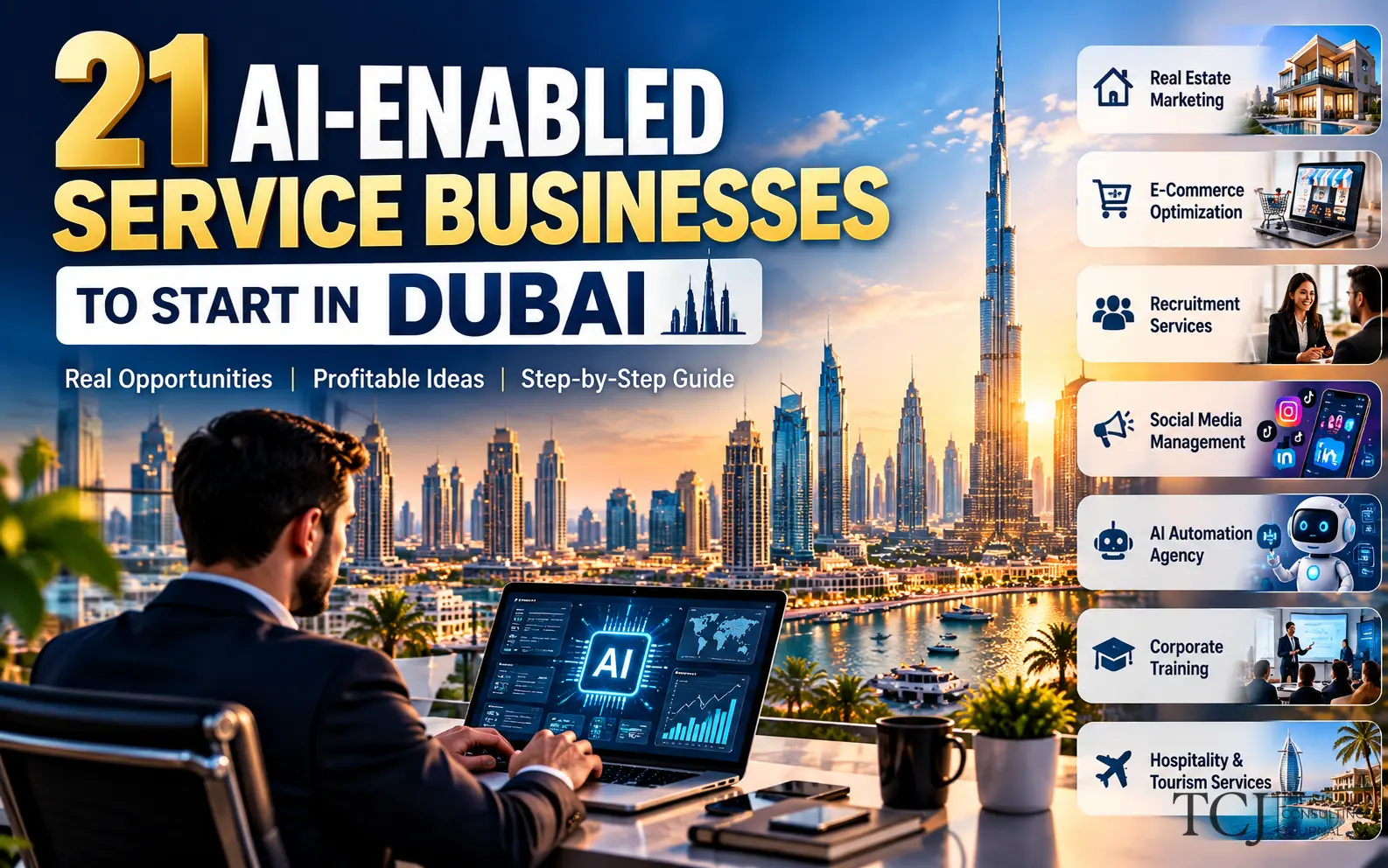
21 AI-Enabled Service Businesses to Start in Dubai
AI is creating practical service-business opportunities in Dubai. Here are 21 models entrepreneurs can build around automation, marketing, operations, research, training, finance workflows and other business needs.

Dubai Business Opportunities for German E-Mobility Companies
Dubai’s growing EV ecosystem is creating opportunities for German companies across charging infrastructure, fleet electrification, software, batteries, engineering, smart mobility, and technical services.