DHA License Requirements for Allied Health Professionals
A practical guide to DHA licensing for allied health professionals in Dubai, covering eligibility, qualifications, DataFlow verification, assessments, documents, fees, registration, and employer activation.
Key takeaways
- DHA registration must be activated by an eligible healthcare facility before an allied health professional can practise in Dubai.
- Education, experience and assessment requirements depend on the exact professional title selected.
- Primary Source Verification should be completed using consistent and verifiable qualification, employment and licensing records.
- A Good Standing Certificate should be valid and no more than six months old when submitted.
- Applicants should confirm official DHA requirements and fees before making payments.
What is a DHA licence for allied health professionals?
A DHA professional licence authorises an approved allied health professional to practise under a defined title and scope at an eligible healthcare facility in Dubai. Registration is the first approval stage, while the active licence is issued after a hiring facility completes the activation process through Sheryan.
DHA states that professional registration confirms that the applicant meets the requirements for the applied position and places the individual on the Dubai Medical Registry. Registration is valid for one year, during which a healthcare facility should activate it before the professional begins practising.
This distinction matters during recruitment. A candidate may hold an active DHA registration and use it when applying for suitable roles, but registration alone is not permission to treat patients, operate clinical equipment or provide regulated services.
A strong DHA application is usually built before the portal is opened: the correct title, consistent records and verifiable evidence matter more than submitting quickly. — Consultant observation
Who falls within the allied health category?
Allied health covers a broad range of diagnostic, therapeutic, rehabilitation and technical healthcare professions outside categories such as physicians, dentists, nursing, midwifery and pharmacy.
Depending on the professional titles recognised by DHA, the category may include roles connected with:
- Physiotherapy and rehabilitation
- Occupational therapy
- Medical imaging and radiography
- Medical laboratory services
- Respiratory therapy
- Nutrition and dietetics
- Speech and language therapy
- Audiology
- Psychology and behavioural healthcare
- Optometry
- Emergency medical services
- Other technical or therapeutic healthcare services
The applicant’s selected title should accurately reflect the academic qualification, professional registration, clinical experience and proposed duties. Selecting a title simply because it appears similar to a previous job title can create an eligibility issue.
Assistant allied health titles may also carry supervision restrictions. DHA’s current licensing manual states that an assistant allied healthcare professional cannot work independently and must work under a licensed allied health professional in the main specialty.
What are the core DHA licensing requirements?
Applicants typically need an accepted educational qualification, relevant clinical experience where required, professional registration from the applicable jurisdiction, good-standing evidence, primary source verification and any required assessment. These conditions are applied according to the current Professional Qualification Requirements for the selected title.
DHA’s licensing manual requires healthcare professionals to meet the applicable qualification, experience, home-country licensing, good-standing, assessment and primary source verification conditions. It also requires applicants to declare disciplinary action that is proven or still in process.
Does the educational qualification need to match the title?
Yes. The qualification should support the professional title and scope requested in the DHA application. The institution, programme level, field of study, duration and clinical content may all affect the eligibility assessment.
A diploma may be sufficient for one title but not another. A bachelor’s or postgraduate qualification may be required for a more advanced title. A degree with a similar name does not automatically establish that the applicant meets DHA requirements.
Applicants should compare their credentials with the current qualification requirements before starting DataFlow or booking an examination. In some cases, DHA may request UAE Ministry of Education equivalency for a qualification. Documents that are not in English or Arabic may also require certified legal translation.
How is professional experience assessed?
Experience should normally be relevant, post-qualification where applicable and supported by employment records that can be verified with the issuing employer.
Employment certificates should clearly show:
- The applicant’s name
- The employer’s legal name
- The professional title held
- The employment start and end dates
- Full-time or part-time status where relevant
- Clinical duties when requested
- Authorised signatures and contact details
DHA’s manual defines professional experience as hands-on clinical experience obtained during salaried or contractual employment. Volunteer work, observerships and clinical attachments are excluded from that definition.
Example 1: A Dubai clinic plans to recruit a physiotherapist whose degree and licence are valid, but the employment certificate only says “healthcare employee.” The application may face questions because the record does not establish that the person worked in the required clinical role. A revised certificate should remain factual while clearly identifying the actual title and duties.
Is a Good Standing Certificate required?
A Good Standing Certificate is generally required as evidence of the applicant’s regulatory status in a jurisdiction where the profession was practised. It should normally be issued by the relevant licensing or regulatory authority, not simply by an employer.
For the Get Registered service, DHA requires the certificate to be valid and no more than six months old when the application is submitted.
Applicants should time the request carefully. Obtaining the certificate too early may result in it expiring while verification, examination or document corrections are still in progress.
How does DHA DataFlow verification work?
Primary Source Verification checks licensing documents directly with the organisation that issued them. DHA delegates this process to a third-party verification agency, and the result may be positive, unable to verify or discrepant.
Documents commonly submitted for verification include:
- Academic qualifications
- Experience or employment certificates
- Professional licences and registrations
- Good Standing Certificates
- Other records required for the selected title
DHA’s manual states that the professional is responsible for ensuring the required records are verified. The issuing university, employer or regulator may be contacted as part of the process.
Applicants should check that names, dates and titles match across the passport, degree, licence and employment documents. A name change, transliteration difference or change in an institution’s legal name should be supported with appropriate evidence.
An applicant should also monitor messages from the verification provider. A university or former employer may need an authorisation form, fee payment or further information before responding.
Does every allied health professional take a DHA exam?
No. The examination or assessment requirement depends on the selected category, title, specialty and any applicable exemption. Some allied health professionals may require computer-based testing, while other applicants may be referred for an oral assessment.
DHA provides a Mode of Exam per Specialty service so applicants can check the assessment method connected with their professional title.
The self-assessment service also states that professionals must pass the relevant assessment within the permitted number of attempts across UAE health authorities. Applicants should therefore confirm the correct title before booking an examination.
Passing an exam does not correct an unsuitable qualification or replace missing experience, professional registration, good-standing evidence or verification.
Which documents should applicants prepare?
The exact checklist depends on the professional title and application pathway. A standard preparation file should typically include:
- Recent passport-size photograph
- Valid passport copy
- Educational certificates
- Academic transcripts where relevant
- Internship or clinical training evidence where required
- Experience or employment certificates
- Current and previous professional licences
- Good Standing Certificate
- Primary Source Verification result
- CBT result where required
- Name-change evidence where applicable
- Certified translations for documents not issued in English or Arabic
- Any additional record requested for the professional title
DHA’s Get Registered service specifically lists the photograph, passport, Good Standing Certificate, verification results and CBT result where required.
Scans should be complete, readable and uncropped. Multi-page certificates should include every page, including reverse pages containing stamps, conditions or registration details.
What is the DHA licensing process step by step?
The process usually begins with self-assessment and ends with licence activation by the hiring facility. Applicants should complete each stage using the same professional title and consistent supporting information.
- Create a Sheryan account. Use the DHA digital licensing platform to access professional services.
- Complete the Self-Assessment Tool. The automated assessment is free and gives a preliminary result. DHA review is still required to confirm final eligibility.
- Confirm the correct title. Check the qualification, experience and assessment requirements attached to the proposed position.
- Complete Primary Source Verification. Submit the required qualification, experience and registration documents to the approved verification provider.
- Pass the required assessment. Complete the CBT or other assessment where it applies.
- Submit the Get Registered application. Upload the requested records, complete the declarations and pay the registration fee.
- Receive professional registration. Registration confirms eligibility for the approved category, title and specialty.
- Secure employer activation. An eligible DHA-licensed facility activates the professional licence after the required employment, insurance and facility conditions are met.
Example 2: A medical laboratory technologist obtains DHA registration before accepting a role in Dubai. The candidate cannot begin laboratory duties immediately after signing the offer. The healthcare facility must first hold the relevant licensed service, obtain the professional’s consent and complete licence activation through Sheryan.
What is the difference between registration and licence activation?
Registration belongs to the professional and confirms eligibility for an approved position. Licence activation connects that registration to a qualifying workplace and authorises the professional to practise within the approved scope.
For activation, the hiring facility should have an active DHA facility licence and the relevant specialty. The professional must have active registration and provide consent. Valid medical malpractice insurance is required, and a valid labour card is listed for non-UAE nationals.
A delegated facility representative submits the activation application. Once approved, the electronic professional licence is generated through Sheryan.
How much does a DHA allied health licence cost?
DHA currently lists AED 200 as the Get Registered fee for all professional categories, with a stated service delivery time of five working days. Additional time may be needed where verification, document clarification, eligibility review or an oral assessment remains outstanding.
For allied health professionals, DHA currently lists the following activation fees:
- AED 1,000 for a one-year full-time licence
- AED 1,500 for a two-year full-time licence
- AED 2,500 for a three-year full-time licence
- AED 1,000 for a part-time licence
- AED 1,000 for a trainee licence
Knowledge and Innovation Fees may be added at checkout. Separate costs may arise for DataFlow verification, examinations, translations, attestations and eligibility review. Fees should be confirmed on Sheryan before payment because the applicable service and professional category affect the final amount.
What common mistakes delay DHA applications?
Many delays arise from preventable inconsistencies rather than the applicant’s clinical competence.
Common mistakes include:
- Selecting the wrong professional title
- Starting DataFlow before checking eligibility
- Submitting vague experience certificates
- Using an expired Good Standing Certificate
- Entering employment dates that differ from supporting records
- Uploading cropped, blurred or incomplete documents
- Omitting previous licences or disciplinary information
- Assuming an internship automatically counts as experience
- Booking the wrong assessment
- Failing to respond to verification-provider requests
- Assuming registration alone permits practice
- Allowing an application to remain inactive
Applicants should keep a document tracker showing what was submitted, which organisation may be contacted and whether any record has an expiry date.
How can KPM Global Services UAE assist?
KPM Global Services UAE can support applicants and healthcare businesses with practical document-readiness and process coordination before a DHA submission.
Depending on the engagement, support may include:
- Reviewing the proposed professional title against the available records
- Checking documents for names, dates and title inconsistencies
- Preparing a structured application checklist
- Identifying missing employment or licensing evidence
- Coordinating certified translation requirements
- Supporting communication and status tracking
- Helping Dubai healthcare businesses organise recruitment and activation files
- Advising on wider UAE business, Accounting, Financial and compliance documentation connected with operations
KPM Global Services UAE cannot guarantee approval, examination results, verification outcomes or processing times. Final eligibility and licensing decisions remain with DHA and the relevant authorities.
What should applicants do before submitting?
Start by confirming the exact professional title, then build one consistent evidence file around that title. Check qualification and experience conditions, request current regulatory documents, complete verification and confirm the examination mode before paying for services that may not match the intended application.
Applicants should also recheck official DHA requirements shortly before submission. Licensing manuals, qualification rules, service fees and procedural requirements may be updated.
This article is for informational purposes and does not constitute legal, tax, accounting, or financial advice.
Questions and answers
Q: Can an allied health professional apply for DHA registration without a job offer?
A: Yes, the professional can generally complete the registration stage before securing employment. A suitable DHA-licensed healthcare facility is required later to activate the registration into a professional licence.
Q: Is DataFlow mandatory for a DHA allied health application?
A: Primary Source Verification is generally required for the documents relevant to the applied position. The exact records to be verified depend on the professional title and the applicable DHA qualification requirements.
Q: Can I work after receiving DHA registration?
A: No. Registration confirms eligibility but does not independently authorise clinical practice. A qualifying healthcare facility must activate the professional licence before work begins.
Q: Does every allied health professional need to take a Prometric exam?
A: No. Assessment requirements vary by profession, title and specialty. Applicants should check DHA’s current Mode of Exam per Specialty service before booking an assessment.
Q: How long is DHA professional registration valid?
A: DHA states that professional registration is valid for one year. During that period, an eligible healthcare facility should activate it into a licence for the professional to begin practising.
More in Medical Career
View all Medical Career →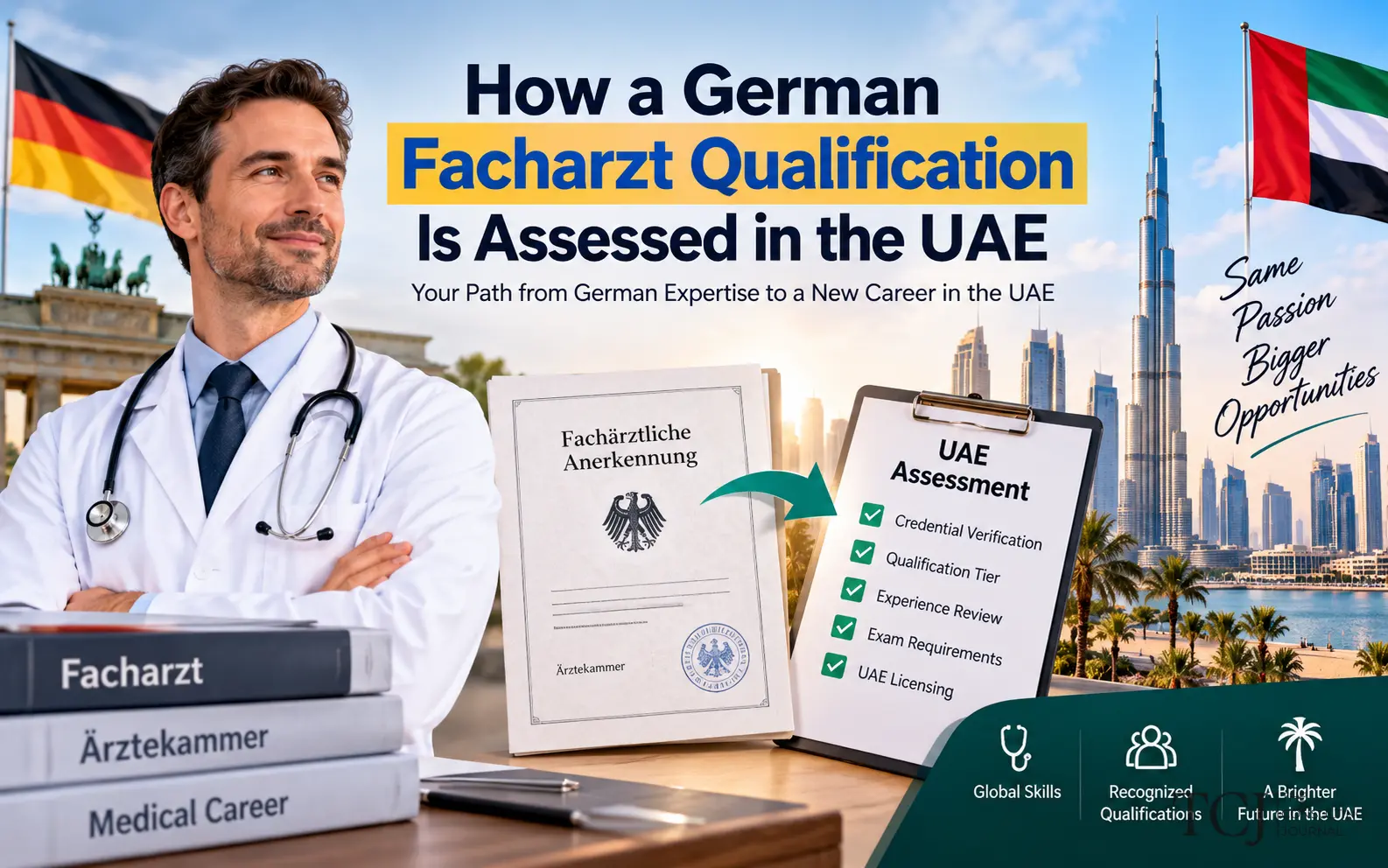
How German Facharzt Qualifications Are Assessed in the UAE
German Facharzt qualifications are recognised under the UAE healthcare licensing framework, but Oberarzt status, qualification tier, experience, verification and the professional title requested can materially affect the assessment.
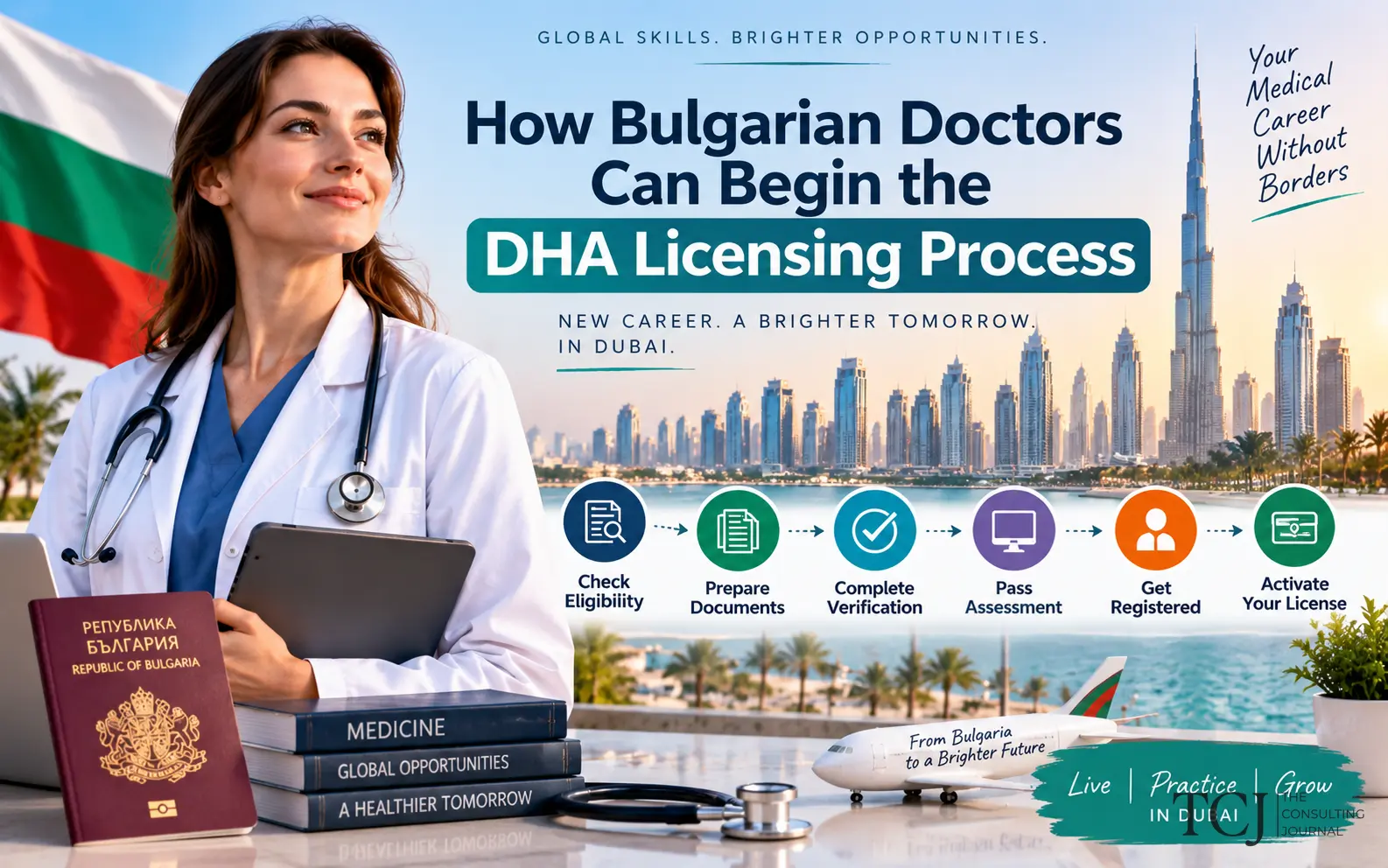
DHA Licensing for Bulgarian Doctors: Dubai Step-by-Step Guide
Bulgarian doctors considering a move to Dubai should understand the difference between DHA eligibility, DataFlow verification, assessment, registration and final professional license activation.
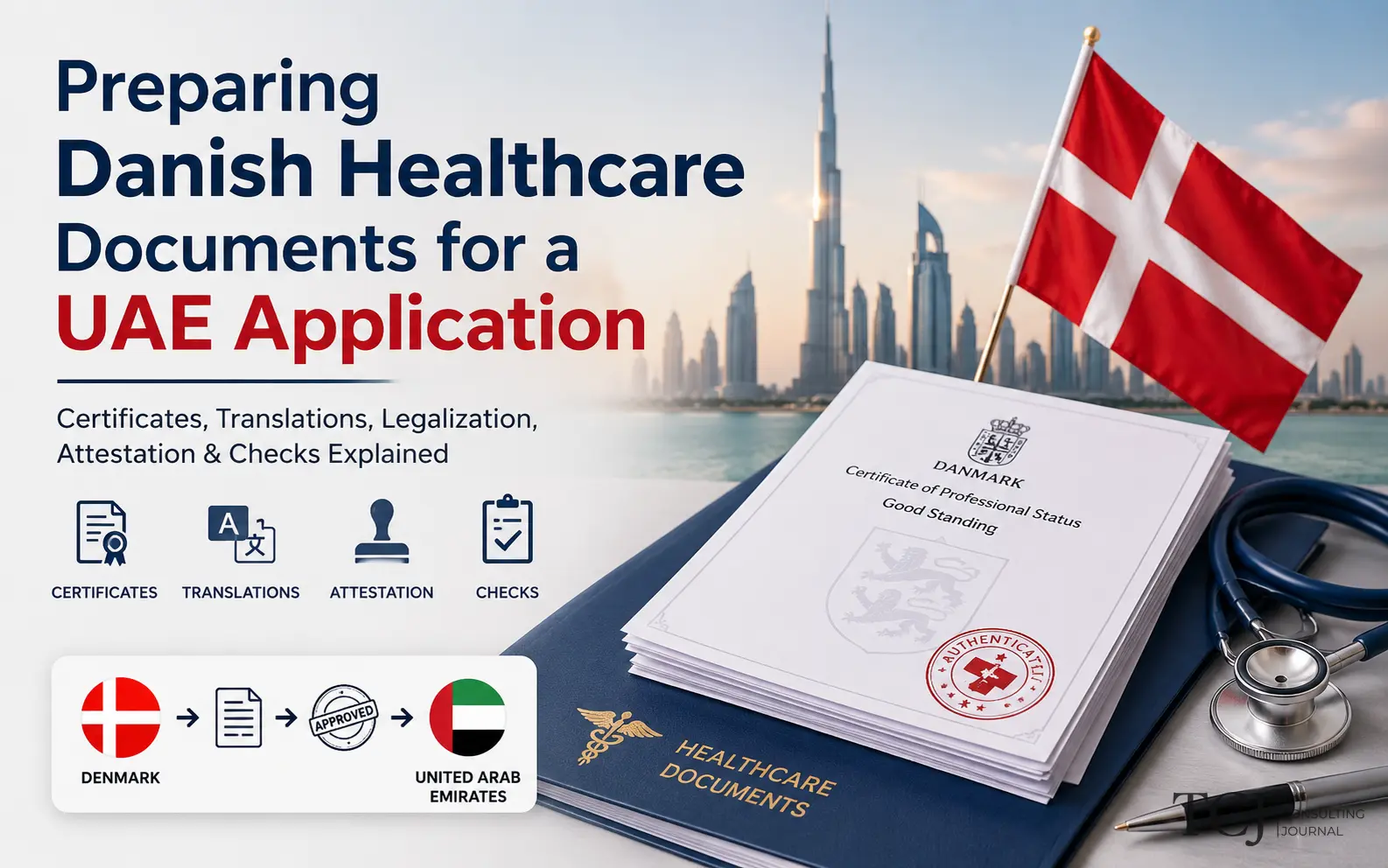
Preparing Danish Healthcare Documents for a UAE Application
Danish healthcare professionals applying in the UAE may need to coordinate qualifications, Good Standing records, translation, legalization, attestation, and authority-specific verification before submission.