How Long Does It Take to Get a Nursing Job in the UAE?
Most international nurses should allow three to six months to secure a UAE nursing job. Licensing status, document verification, assessments, employer demand, visa processing, and career gaps can shorten or extend the timeline.
Key takeaways
- Most international nurses should plan for a three-to-six-month UAE employment process.
- Completed credential verification and professional registration can substantially reduce the hiring timeline.
- DHA registration or another eligibility decision is not always the same as an active professional licence.
- Document inconsistencies and slow institutional responses cause many avoidable delays.
- Nurses can usually begin licensing preparation and job applications from outside the UAE.
What is a realistic UAE nursing job timeline?
A nurse starting without verified credentials or regulatory approval should normally budget three to six months. A candidate who has already completed verification, passed any required assessment, and obtained registration may secure a position within one to three months, depending on vacancy availability, interviews, notice periods, and employer onboarding procedures.
A practical timeline may include:
- One to four weeks to collect, review, translate, or replace documents
- Four to twelve weeks for primary source verification
- Two to six weeks for assessment preparation, booking, testing, and results
- Several days to several weeks for the authority’s registration or evaluation review
- Two to twelve weeks for applications, interviews, references, and an offer
- Two to six weeks for visa processing, medical fitness, licence activation, and onboarding
These periods are planning estimates rather than guaranteed service times. Some activities can run together. A nurse may study for an assessment, update a UAE-focused CV, and contact employers while verification is still in progress.
The quickest applications are rarely the ones that skip steps; they are usually the ones where every document is ready before the next reviewer requests it. — Consulting Journal editorial observation
Which stages usually take the longest?
Primary source verification and the job search are usually the least predictable stages. Authority reviews may have published service periods, but verification depends on responses from universities, nursing councils, and former employers. Recruitment timing depends on the nurse’s specialty, UAE licensing status, salary expectations, location preferences, and current vacancies.
Document preparation
Applicants should begin by checking whether names, dates, job titles, qualification details, and registration numbers are consistent across every certificate.
A missing transcript or an incorrectly written experience letter can delay the process before formal verification even begins. Documents not issued in English may also require legal translation, depending on the authority and application route. MOHAP currently requires non-English certificates to be legally translated and uploaded with the original documents.
Primary source verification
Primary source verification confirms professional documents with the organisation that issued them. Depending on the application, this may cover nursing qualifications, professional registration, employment history, and other supporting evidence.
The UAE Unified Healthcare Professional Qualification Requirements state that licensing documents must be verified directly with their original or primary source. The documents may include educational qualifications, experience certificates, and professional licences or registrations.
Verification may take longer when:
- A university does not respond promptly
- A former employer has closed or changed contact details
- Employment dates do not match the application
- Certificates are unclear or incomplete
- The issuing nursing council requires additional consent
- The verification provider requests further evidence
Applicants should inform former employers and regulatory bodies that a verification request may arrive. They should also provide official institutional contact details rather than personal email addresses wherever possible.
Licensing examination or assessment
Some nurses must complete a computer-based test or another assessment. Others may qualify for an exemption, depending on their professional registration, examination history, country of licensing, qualification date, and gap in practice.
The 2025 Unified PQR provides specific exemption conditions for nurses and midwives from listed licensing jurisdictions. Applicants should not assume that an exemption applies merely because they passed an examination in another country.
Preparing while verification is underway can reduce the overall timeline. DHA’s licensing manual confirms that primary source verification and the computer-based test may be completed simultaneously, although the registration application cannot be processed until the required stages are complete.
Professional registration and licence activation
Passing an assessment does not necessarily authorise immediate clinical practice.
In Dubai, successful registration confirms that the professional meets the approved category, title, and specialty requirements. The registration is valid for one year and must be activated into a professional licence by a DHA-licensed healthcare facility before the nurse can practise.
This distinction matters when reviewing job advertisements. Terms such as “DHA eligible,” “DHA registered,” and “active DHA licence” do not always describe the same status.
Recruitment, interviews, and the offer
The job-search stage may take several weeks or several months. Nurses who apply only to a small group of major hospitals may face longer waiting periods because those vacancies often attract many qualified applicants.
Employers commonly consider:
- Regulatory eligibility or licensing progress
- Recent bedside and clinical experience
- Specialist nursing skills
- Communication and documentation standards
- Medication-safety knowledge
- Shift flexibility
- Notice period and joining availability
- Salary and benefit expectations
- Experience using electronic health records
- Willingness to relocate within the UAE
A recruitment process may include an initial screening call, clinical interview, nursing-manager interview, reference checks, credentialing, and final management approval.
How does nursing licensing differ across the UAE?
The correct licensing route generally depends on the healthcare facility’s location and regulator. DHA covers professionals working in DHA-licensed facilities in Dubai, while the Department of Health regulates healthcare professionals in Abu Dhabi. MOHAP and the Sharjah Health Authority may apply to facilities in other relevant jurisdictions.
The Unified PQR provides a common qualification framework used by MOHAP, DHA, the Department of Health Abu Dhabi, and the Sharjah Health Authority. Each authority still operates its own services, review processes, and facility-licensing arrangements.
Applicants should therefore confirm:
- The emirate where they intend to work
- The regulator responsible for the target facility
- The professional title supported by their qualification
- Whether an assessment is required
- Whether previous verification reports can be transferred
- Whether registration needs employer activation
Choosing one licensing route without first identifying likely employers can unnecessarily restrict the job search.
How long does it take for different nursing applicants?
A nurse with no completed licensing steps will usually need longer than a UAE-based nurse transferring between employers. Recent graduates, specialist nurses, applicants with registration, and nurses returning after a career break may each face different requirements and recruitment conditions.
Nurse starting from the beginning
A nurse with no completed verification, assessment, or professional registration should normally plan for four to six months. The process may exceed six months when institutions respond slowly, documents need replacement, or interviews do not result in an immediate offer.
Nurse with completed registration or eligibility
A candidate with verified credentials and regulatory approval may find employment within one to three months. The remaining stages usually involve targeted applications, interviews, references, facility licence activation, employment processing, and onboarding.
Nurse already working in the UAE
A UAE-based nurse may change employers within one to three months. The final timeline depends on the employment notice period, licence transfer or activation procedures, visa cancellation, new visa processing, and the incoming employer’s credentialing requirements.
Recent nursing graduate
The current Unified PQR lists a bachelor’s degree in nursing with no post-qualification experience requirement for the Registered Nurse title, subject to the wider licensing criteria and any applicable training, examination, registration, and gap-of-practice rules.
This does not mean every employer will recruit a new graduate. Hospitals and clinics may still prefer applicants with practical experience, especially for high-acuity or specialist departments.
Nurse returning after a career break
Career gaps require careful review before fees are paid. The Unified PQR applies additional requirements when a clinical practice gap exceeds three years and generally restricts non-UAE nationals with a gap longer than five years.
Authority-specific guidance may set earlier return-to-practice requirements. The Department of Health Abu Dhabi, for example, describes return-to-practice training for professionals who have stopped practising for more than two years. Applicants with a substantial gap should obtain authority-specific guidance for their circumstances.
What commonly delays a UAE nursing application?
Most preventable delays arise from documentation, unsuitable professional titles, expired certificates, and poor follow-up with issuing institutions. Candidates also lose time when they wait for licensing to finish before preparing their CV, limit applications to one employer, or describe their regulatory status inaccurately.
Inconsistent personal information
A shortened name on one certificate and a full name on another may trigger additional checks. Name changes should be supported by appropriate legal evidence.
Weak experience certificates
An offer letter or salary certificate may not prove clinical experience. An effective certificate should normally identify the employer, department, professional title, employment dates, working arrangement, and authorised signatory.
Expired good standing certificate
The Unified PQR requires a good standing certificate to be valid and no more than six months old when applying for a licence. Requesting it too early can result in expiry before the relevant application stage.
Applying under the wrong nursing title
A candidate’s preferred job title may not match the title supported by the qualification and experience under the PQR. The authority may request a different category, additional evidence, or further assessment.
Treating registration as an active licence
Applicants should state their status accurately on their CV. A registration certificate that still requires facility activation should not be described as an active professional licence.
How can nurses reduce the application timeline?
Nurses can shorten avoidable delays by checking eligibility before paying fees, creating a complete digital document file, contacting institutions early, preparing for assessments in parallel, and beginning a targeted job search while regulatory work continues. Speed should come from preparation, not from bypassing required licensing steps.
- Check the current qualification requirements. Confirm that your education, registration, experience, and career history support the intended nursing title.
- Create one consistent document record. Compare every date, spelling, title, and registration number before submission.
- Contact previous institutions. Ask universities, employers, and nursing councils to monitor official inboxes and respond to verification requests.
- Prepare for the assessment early. Review patient safety, infection control, medication administration, ethics, emergency escalation, documentation, and specialty knowledge.
- Show licensing progress clearly. Use accurate wording such as “DHA registration in progress” or “MOHAP evaluation completed.”
- Apply to a suitable range of employers. Consider hospitals, clinics, rehabilitation facilities, home healthcare providers, long-term care organisations, and day-surgery centres where your experience is relevant.
- Tailor the CV. Place current licensing status, specialty experience, recent clinical responsibilities, and joining availability near the beginning.
- Verify recruiters and offers. Be cautious when anyone requests payment in return for a guaranteed interview, visa, licence, or nursing position.
Can nurses apply for UAE jobs from outside the country?
Yes. Nurses can usually prepare documents, begin verification, review licensing requirements, study for assessments, and submit job applications while living abroad. Applying from the home country can reduce relocation costs, although some employers may favour UAE-based candidates who can attend interviews and join quickly.
Online interviews are common where employers are recruiting for particular specialties. Candidates applying from overseas should make their location, notice period, licensing status, and realistic joining date clear.
Example 1: A fictional Dubai home healthcare provider urgently needs registered nurses for new patient contracts. A candidate with completed DHA registration, recent home-care experience, verified references, and immediate availability may progress from interview to offer quickly. Licence activation and immigration processing would still need to be completed before clinical work begins.
Example 2: A fictional Abu Dhabi hospital interviews an overseas intensive-care nurse whose verification is still pending. The clinical interview is successful, but the offer remains conditional until the required regulatory review, reference checks, and facility credentialing are complete. Starting the recruitment and verification stages together may shorten the overall waiting period.
What documents should nurses prepare?
A complete and consistent document file can prevent repeated requests and unnecessary verification delays. Exact requirements depend on the authority, professional title, qualification history, and applicant circumstances, so nurses should check the current service page and PQR before submitting an application.
Documents and preparation checklist
- Valid passport copy
- Recent passport-style photograph
- Nursing degree or diploma
- Complete academic transcript
- Professional nursing registration or licence
- Good standing certificate
- Employment and clinical experience certificates
- Basic Life Support certificate, where applicable
- Previous primary source verification reports
- Assessment or examination results, where applicable
- Name-change evidence, where document names differ
- Legal translations for non-English documents
- Updated UAE-focused CV
- Professional references with current contact details
- Notice-period and joining-date information
MOHAP’s current evaluation service lists educational qualifications, academic records, experience certificates, professional licences, passport details, exemption evidence, and previous DataFlow reports among the relevant documents. Some documents are optional for new graduates.
Common mistakes nursing applicants should avoid
- Paying application fees before checking basic eligibility
- Submitting documents with conflicting dates or job titles
- Requesting a good standing certificate too early
- Using unclear scans with missing stamps or signatures
- Assuming every applicant must take the same examination
- Calling registration or eligibility an active licence
- Applying to only one hospital or healthcare group
- Sending the same generic CV for every nursing vacancy
- Resigning before receiving a written and verifiable offer
- Paying an intermediary for a guaranteed employment outcome
A practical planning view
For most overseas applicants, three to six months remains a sensible planning estimate. A nurse who has completed verification and professional registration may move faster, while missing documents, assessment retakes, career gaps, narrow job preferences, and notice periods can extend the process.
Candidates should separate the process into manageable stages: establish eligibility, prepare documents, complete verification, meet assessment requirements, obtain the relevant registration or evaluation, approach suitable employers, and complete licence activation and immigration formalities.
A written job offer should be reviewed carefully before resignation or relocation. It should identify the employer, position, workplace, salary, benefits, probation terms, conditions, and expected joining date. No licensing consultant, recruiter, or employer can guarantee an authority decision or a specific employment timeline.
This article is for informational purposes and does not constitute legal, tax, accounting, or financial advice.
Questions and answers
Q: Is it easy to get a nursing job in the UAE?
A: It can be competitive. Nurses with suitable qualifications, recent clinical experience, accurate documents, clear communication skills, and advanced licensing progress generally present a stronger application. Employer demand, specialty, location, availability, and salary expectations also affect the outcome.
Q: Can I get a UAE nursing job without an active licence?
A: You may be interviewed or receive a conditional offer before the professional licence is active. However, you cannot begin regulated clinical practice until the relevant authority and healthcare facility have completed the required licensing or activation process.
Q: How long does nursing credential verification take in the UAE?
A: A straightforward case may be completed within several weeks, while a complicated case can take two or three months. The response time of universities, nursing councils, former employers, and other issuing institutions is often the main factor.
Q: Do all nurses need to take a UAE licensing exam?
A: No. Examination requirements and exemptions depend on the authority, nursing title, qualifications, professional registration, previous examination history, and gap in practice. Applicants should check the latest Unified PQR and the relevant authority’s service guidance.
Q: Is DHA eligibility the same as a DHA nursing licence?
A: No. DHA registration confirms that the applicant meets the requirements for an approved professional category, title, and specialty. A DHA-licensed healthcare facility must normally activate that registration into a professional licence before the nurse begins practising.
More in Medical Career
View all Medical Career →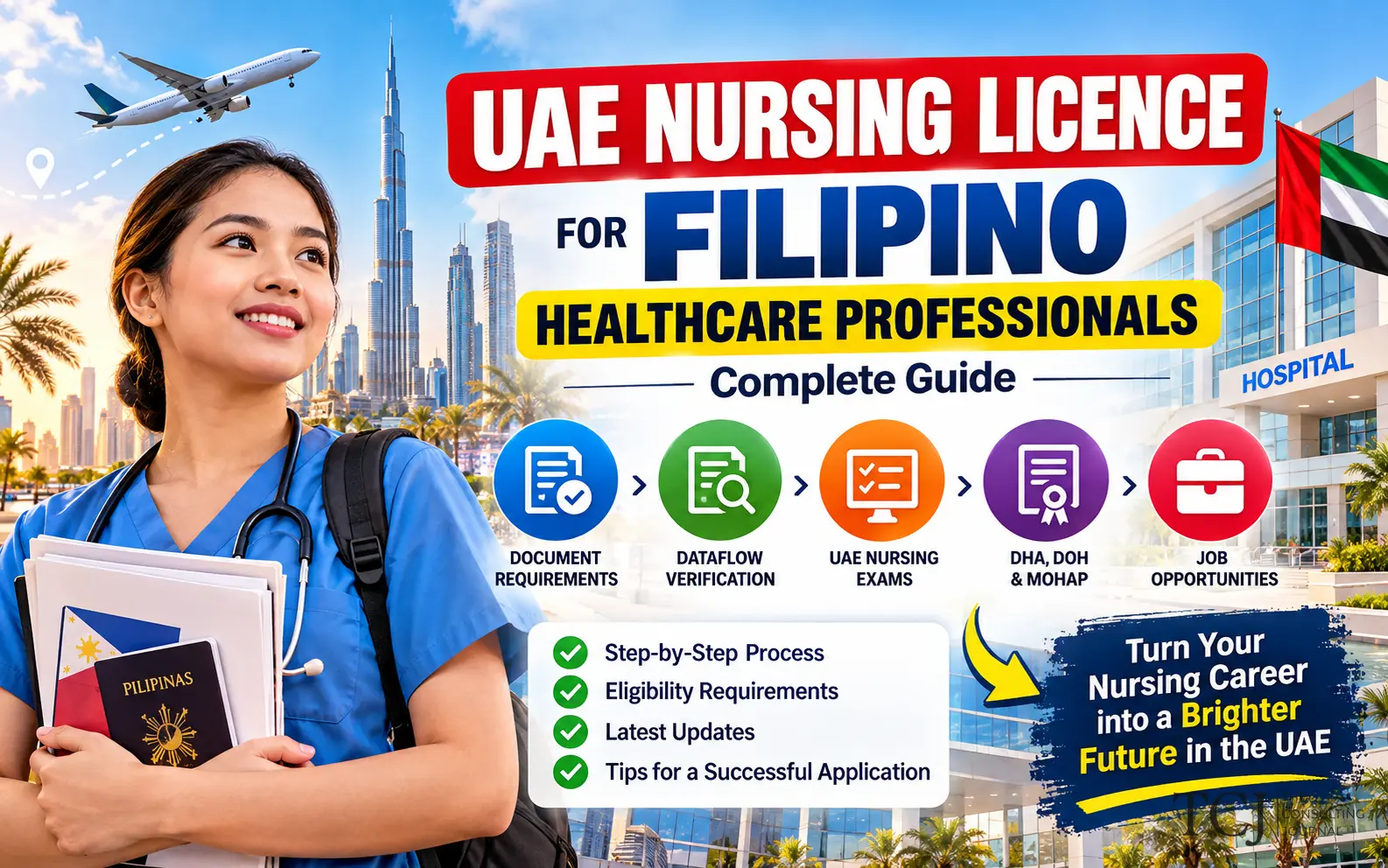
UAE Nursing Licence for Filipino Healthcare Professionals: Requirements and Application Process
Planning to work as a nurse in the UAE? Learn how Filipino healthcare professionals can navigate DHA, DOH and MOHAP licensing, DataFlow verification, nursing assessments, documents and employer licence activation.
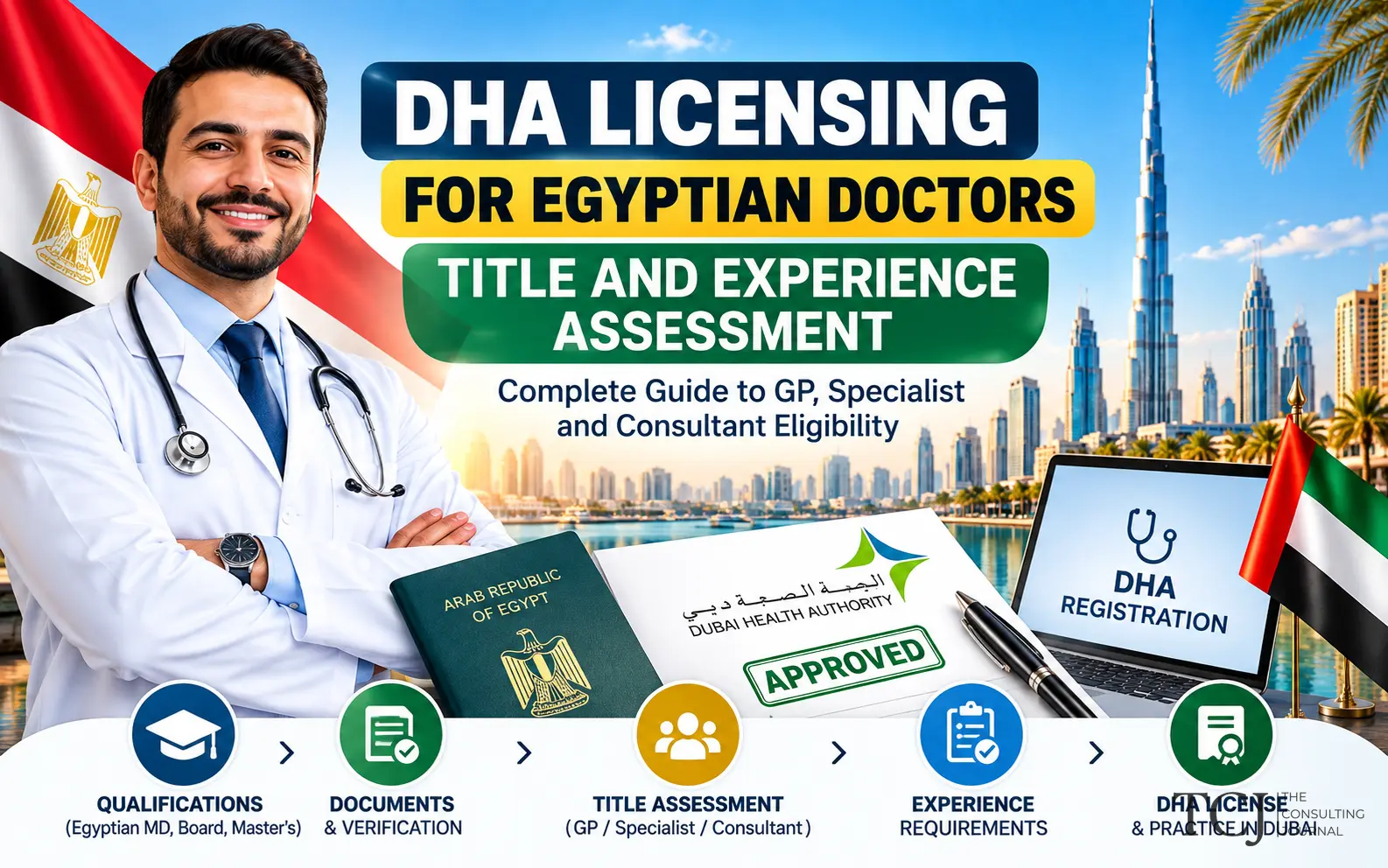
DHA Licensing for Egyptian Doctors: Titles, Tiers and Experience
Egyptian doctors applying for DHA licensing in Dubai need to understand how their MD, Egyptian Board Fellowship, Clinical Master’s and post-qualification experience affect eligibility for GP, Specialist and Consultant titles.

DHA Licence for Nurses in Dubai: Eligibility, DataFlow, Exam and Application Process
A practical 2026 guide to DHA licensing for nurses in Dubai, covering Registered Nurse and Assistant Nurse eligibility, DataFlow verification, assessments, registration, documents and employer-led licence activation.