How to Open a Business Bank Account in the UAE in 2026
A practical UAE guide for founders, SMEs, and investors on opening a business bank account, preparing documents, managing KYC, and avoiding approval delays.
Key takeaways
- A UAE business bank account requires clear company documents, ownership details, source-of-funds information, and a credible business explanation.
- Banks review KYC, beneficial ownership, expected transactions, and risk profile before approving corporate accounts.
- Incomplete documents, unclear activities, and inconsistent answers are common reasons for delays or rejection.
- Proper accounting records and clean bank statements support UAE Tax, Financial, and Accounting compliance.
- KPM Global Services UAE can help businesses prepare a stronger banking readiness file, but bank approval is never guaranteed.
What is a UAE business bank account?
A UAE business bank account is a corporate account opened in the name of a licensed company. It is used for commercial transactions, not personal spending. In practice, banks review the company’s licence, ownership, activity, office presence, beneficial owners, source of funds, and expected payment flows before approving the account.
A company may be registered in Dubai, Abu Dhabi, Sharjah, another emirate, or a UAE free zone. The bank will still assess whether the business has a clear commercial purpose and whether the expected transactions match the licensed activity.
For example, a marketing consultancy receiving monthly retainers from UAE clients may be easier to explain than a newly formed general trading company expecting large cross-border payments without supplier contracts.
Why do UAE businesses need a corporate bank account?
A corporate account separates company money from personal money and supports proper financial, accounting, and tax records. It also improves credibility with customers, suppliers, payment gateways, landlords, employees, and authorities. Without a business bank account, even a licensed company may struggle to operate professionally in the UAE.
A business account typically helps with:
- Receiving customer payments in AED and foreign currencies
- Paying suppliers, staff, rent, software, and government fees
- Maintaining clean accounting records
- Supporting VAT and Corporate Tax documentation
- Applying for merchant services or payment gateways
- Demonstrating business substance to banks and counterparties
- Managing international transfers where the business model justifies them
From a tax and accounting perspective, clean banking records matter. The Federal Tax Authority has reminded taxable persons to maintain records supporting tax return information, including transaction records, assets, liabilities, and shares, and to retain relevant records for at least seven years after the relevant tax period.
Who can open a business bank account in the UAE?
Most licensed UAE companies can apply for a corporate bank account, but approval depends on the bank’s risk assessment. Mainland companies, free zone companies, and certain offshore structures may all apply, although documentation and compliance questions can differ depending on the activity, ownership, and transaction profile.
Common applicants include:
- UAE mainland companies
- Free zone limited liability companies
- Branches of foreign companies
- Professional service firms
- Trading businesses
- E-commerce companies
- Consultancy companies
- Real estate-related businesses
- Holding or investment structures, where supported by documents
Banks usually pay close attention to the company’s beneficial owners. UAE financial institutions are expected to identify beneficial owners of legal person customers, and the Central Bank rulebook refers to identifying and verifying the natural persons who ultimately own or control a customer.
What documents are usually required?
Most banks ask for company documents, shareholder documents, proof of address, and evidence explaining the business model. Requirements vary by bank, activity, nationality, ownership structure, and whether the company is new or already trading. The best approach is to prepare a complete file before the first submission.
Typical documents include:
- Valid trade licence
- Certificate of incorporation or registration
- Memorandum and Articles of Association, where applicable
- Share certificate or ownership documents
- Board resolution authorising account opening
- Passport copies of shareholders and signatories
- Emirates ID and UAE residence visa, where applicable
- Proof of residential address for owners or signatories
- Office lease, Ejari, flexi-desk agreement, or free zone facility document
- Company stamp, if required
- Business plan or company profile
- Website, brochures, contracts, invoices, or supplier details
- Personal or existing business bank statements
- Source of funds explanation
- Expected annual turnover and transaction countries
A common practical issue is inconsistency. The licence says one activity, the business plan says another, and the expected payments suggest something else. Banks often pause applications when the commercial story is not aligned.
A bank account application is not only a paperwork exercise; it is a credibility test of the company’s activity, ownership, and transaction logic. — Consultant observation, The Consulting Journal
What is the step-by-step process to open a UAE business bank account?
The process usually starts with selecting a suitable bank, preparing the documents, submitting the application, completing KYC checks, answering compliance questions, and funding the account after approval. Timelines vary, but preparation before submission can significantly reduce back-and-forth with the bank.
1. Choose a bank that fits the business
Not every bank is suitable for every company. A small UAE service firm, an import-export company, a free zone startup, and an offshore holding structure may need different banking options.
Consider:
- Minimum balance requirements
- Monthly charges
- Online banking quality
- International transfer needs
- Multi-currency support
- Cheque book availability
- Merchant services
- Relationship manager access
- Bank comfort with your licensed activity
A lower-cost account is not always the best account. Businesses should consider reliability, transaction needs, and the bank’s experience with similar company profiles.
2. Prepare a clean banking file
Before applying, review the documents as a banker would. Names, passport numbers, shareholding percentages, licence activities, and signatory powers should match across the file.
For new companies, a simple business profile can help. It should explain what the company sells, who the customers are, where suppliers are located, how revenue will be earned, and what transaction volumes are expected.
3. Submit the application
Applications may be submitted through a branch, relationship manager, digital onboarding channel, or approved business setup and advisory channel. Some banks allow pre-screening online, but many applications still require direct verification of owners or authorised signatories.
For Dubai companies, digital business infrastructure is improving. However, even where onboarding is faster, banks still need to satisfy KYC, beneficial ownership, sanctions, and source-of-funds requirements.
4. Complete KYC and compliance review
This is where many delays happen. Banks may ask:
- What does the business actually do?
- Who owns and controls the company?
- Where did the initial capital come from?
- Which countries will the company trade with?
- Who are the expected customers and suppliers?
- What is the expected monthly transaction value?
- Why does the company need UAE banking?
The Central Bank’s guidance highlights that customer due diligence helps financial institutions identify and understand customers, and enhanced due diligence may apply where higher risks are present.
5. Fund and activate the account
After approval, the bank may request an opening deposit or require the company to maintain a minimum balance. The business can then activate online banking, request debit cards, set user permissions, and apply for cheque books or other services where needed.
How long does it take to open a UAE business bank account?
In practice, straightforward applications may take a few weeks, while complex cases can take longer. Timelines depend on the bank, company structure, activity, ownership, nationality of shareholders, completeness of documents, and how quickly the applicant responds to compliance questions.
Applications are usually faster when:
- The company has a clear licensed activity
- Shareholders and UBOs are easy to identify
- Documents are complete and current
- The source of funds is well explained
- The company has a UAE address or facility
- Expected transactions match the business model
- The applicant responds quickly to bank queries
They are usually slower when the company has layered ownership, high-risk jurisdictions, unclear trading flows, crypto-related exposure, cash-intensive activity, or limited business evidence.
What costs and minimum balances should owners expect?
Costs vary by bank and account type. Some banks charge monthly fees, while others waive fees if the company maintains a minimum balance. International transfer charges, cheque book fees, account closure charges, and foreign exchange margins should also be reviewed before choosing a bank.
Business owners should ask for:
- Minimum balance requirement
- Fall-below fee
- Monthly maintenance fee
- Local transfer charges
- International transfer charges
- Currency conversion margin
- Cheque book cost
- Debit card and user access charges
- Account closure conditions
- Fees for additional letters or certificates
A company should avoid choosing a bank based only on account opening speed. A cheaper account may become inconvenient if online banking is weak, international transfers are limited, or support is difficult to access.
Example 1: Dubai consultancy with a simple profile
A two-shareholder consulting company in Dubai applies for a corporate account. The licence activity matches the company profile. The shareholders provide passports, Emirates IDs, office lease, a short business plan, LinkedIn profiles, previous employment background, and two draft client contracts.
The bank asks about expected monthly revenue and whether payments will come from inside or outside the UAE. Because the answers are clear and the documents support the activity, the file is easier to assess.
The lesson is simple: service businesses should show who they serve, how they charge, and why their expected transactions are reasonable.
Example 2: Free zone trading company with cross-border suppliers
A free zone general trading company applies for banking shortly after incorporation. The shareholders expect payments from Africa, suppliers in Asia, and customers in the GCC, but they have no supplier invoices, no website, and no clear product list.
The bank requests more information. The owners then prepare supplier emails, a basic product catalogue, expected shipment routes, shareholder bank statements, and a source-of-funds note explaining startup capital.
The application becomes stronger, but it takes longer because the initial file did not explain the business clearly.
What are the common reasons UAE bank account applications are delayed or rejected?
Applications are often delayed or declined because the bank cannot understand the business, verify ownership, confirm source of funds, or match expected transactions with the licensed activity. Many issues are preventable when owners prepare a clear and consistent file before applying.
Common mistakes include:
- Applying with an incomplete document pack
- Using unclear or broad business descriptions
- Giving different answers to the consultant, bank, and application form
- Not preparing UBO information
- Ignoring source-of-funds questions
- Providing expired licences or outdated documents
- Having no proof of business activity
- Choosing a bank that does not fit the company profile
- Overstating expected turnover without evidence
- Not explaining international transaction countries
- Mixing personal and business payments
- Treating KYC questions as routine instead of important
Some owners become frustrated when banks ask detailed questions. In practice, these questions are part of the compliance environment. The Ministry of Economy has also highlighted UAE work on beneficial owner frameworks, company registrars, AML/CFT measures, and verification procedures.
Documents and preparation checklist
Before approaching a bank, prepare the file as if the compliance team will review it without knowing your business.
Use this checklist:
- Valid trade licence
- Incorporation certificate
- MOA or AOA
- Share certificate or ownership register
- Board resolution for account opening
- Passport copies for all shareholders and signatories
- Emirates ID and visa copies, where applicable
- UBO details and ownership chart, if ownership is layered
- Office lease, Ejari, or free zone facility agreement
- Business plan or company profile
- Website, company email, or branded proposal, if available
- Supplier contracts, invoices, or quotations
- Customer contracts, invoices, or letters of intent
- Personal bank statements for shareholders
- Existing company bank statements, if applicable
- Source-of-funds explanation
- Expected monthly turnover and transaction volume
- Expected countries for incoming and outgoing transfers
- VAT or Corporate Tax registration details, where applicable
- Accounting contact or bookkeeping plan
A well-prepared file does not guarantee approval, but it gives the bank fewer reasons to pause the application.
How KPM Global Services UAE can assist
KPM Global Services UAE can support business owners, founders, and SMEs with banking readiness before the application is submitted. This may include reviewing the company structure, checking document consistency, preparing a business profile, organising source-of-funds explanations, and aligning accounting records with the expected banking activity.
For new companies, KPM Global Services UAE can help owners understand what banks typically ask for and how to prepare practical supporting documents. For existing businesses, KPM Global Services UAE can review accounting records, tax registrations, invoices, contracts, and bank statement presentation before a new account or additional banking relationship is pursued.
This support does not guarantee bank approval. Final decisions remain with the bank and depend on its internal policies, compliance review, and risk appetite.
Final advisory note
Opening a business bank account in the UAE is easier when owners treat it as a compliance-led business review, not a formality. The bank wants to understand the company, the people behind it, the source of money, and the commercial logic of future transactions.
The strongest applications are usually clear, consistent, and well documented. A mainland or free zone licence is only the starting point. The supporting file should show that the business has a genuine activity, identifiable owners, a reasonable transaction pattern, and proper accounting discipline.
For UAE founders and SMEs, the practical advice is to prepare early. Build the banking file before urgent payments arrive. Keep company documents updated. Maintain proper records. Explain the business in plain language. Respond to bank questions with facts, not assumptions.
This article is for informational purposes and does not constitute legal, tax, accounting, or financial advice.
Questions and answers
Q: Can a foreigner open a UAE business bank account?
A: Yes, a foreign entrepreneur can usually apply after setting up a qualifying UAE company. The bank will still review the trade licence, ownership, source of funds, business activity, and expected transactions before approval.
Q: Is a UAE residence visa required for a business bank account?
A: Not always. Some banks may consider non-resident shareholders, while others prefer or require a UAE resident signatory depending on the company structure and risk profile. Requirements vary by bank.
Q: How long does it take to open a corporate bank account in the UAE?
A: A straightforward application may take a few weeks, but complex cases can take longer. Timelines depend on the bank, activity, ownership structure, document quality, and compliance review.
Q: Why do UAE banks ask for source-of-funds information?
A: Banks ask because they must understand where the company’s money comes from and whether the expected transactions are consistent with the business. This is part of KYC, AML, and beneficial ownership due diligence.
Q: Can KPM Global Services UAE guarantee bank account approval?
A: No. KPM Global Services UAE can help prepare documents, review consistency, and improve banking readiness, but the final decision always rests with the bank and its compliance team.
More in Banking
View all Banking →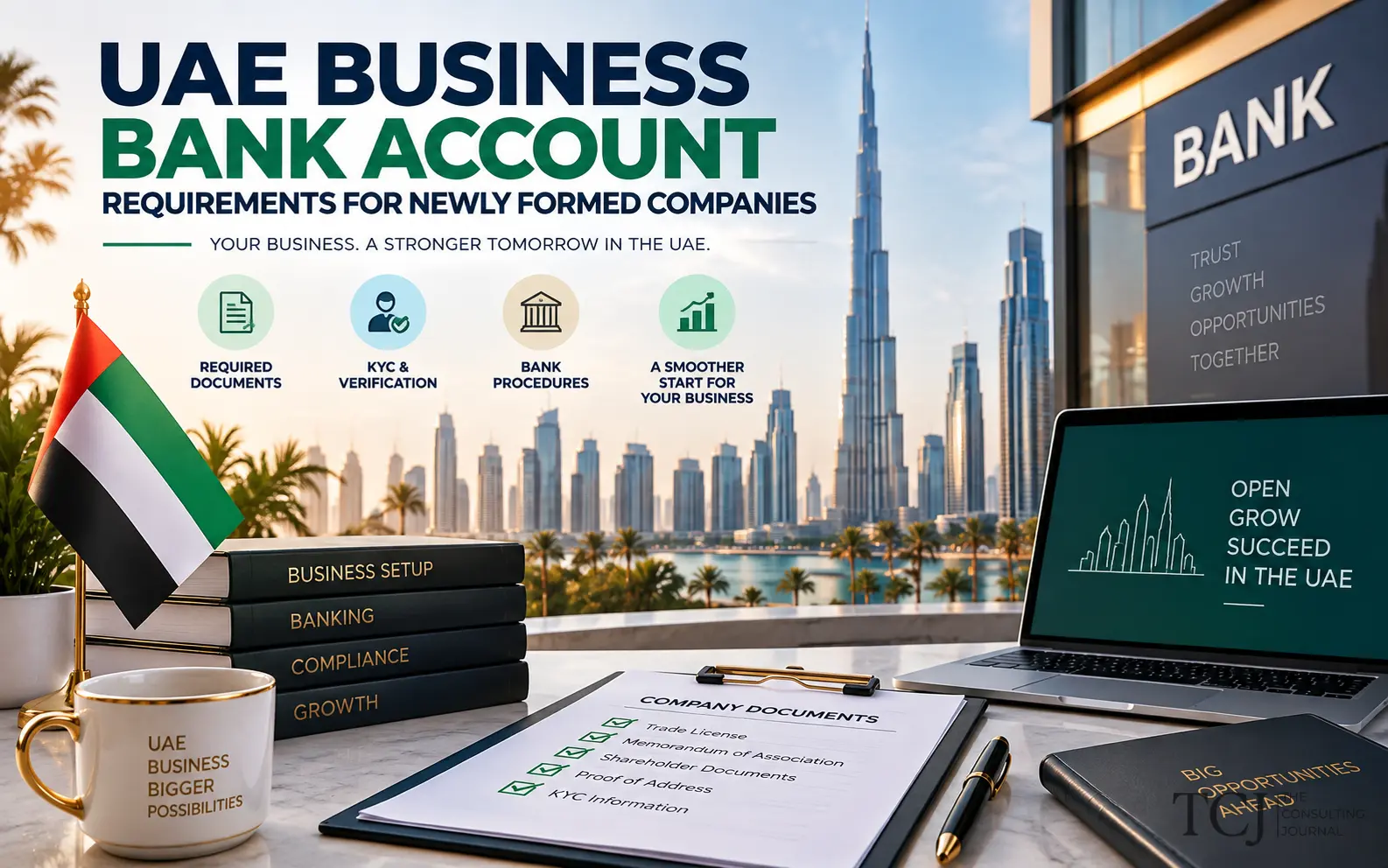
UAE Business Bank Account Requirements for Newly Formed Companies
A practical guide to UAE business bank account requirements for new companies, covering documents, KYC, shareholder checks, proof of activity, banking preparation, VAT and Corporate Tax considerations.

UAE Market Entry for Swiss Wealth Management and Fintech Companies
Swiss wealth managers and fintech companies entering the UAE need to align regulated activities, jurisdiction, licensing, governance and commercial strategy before establishing a local operation.

API Banking for SMEs in UAE: Automating Payments, Reconciliation and Reporting
API banking can help UAE SMEs connect banking with Accounting and Financial systems, reducing manual payment work, improving reconciliation and providing more timely cash visibility.