Can an Italian Medical Specialist Become a Consultant in Dubai?
Italian medical specialists may qualify for the Consultant physician title in Dubai, but eligibility depends on DHA qualification classification, post-specialty experience, verification and licensing requirements.
Key takeaways
- The recognised Italian Diploma di medico specialista is listed as a Tier 2 specialty qualification under the UAE PQR.
- A standard Tier 2 Consultant route generally requires five years of experience after the main specialty qualification.
- An applicable Tier 2 sub-specialty route generally requires four years of post-sub-specialty experience.
- An Italian Consultant or senior physician job title does not automatically transfer into a DHA Consultant title.
- Registration alone does not permit clinical practice; an eligible healthcare facility must activate the professional licence.
- Physicians should verify their individual position through DHA before making major employment or relocation commitments.
Can an Italian Medical Specialist Become a Consultant in Dubai?
Yes. An Italian medical specialist can potentially qualify for the Consultant physician title in Dubai. However, holding an Italian specialist qualification, having substantial clinical seniority, or being called a consultant by an overseas employer does not automatically produce a DHA Consultant title.
The central issue is how the physician's qualification is classified under the UAE Unified Healthcare Professional Qualification Requirements, commonly referred to as the PQR, and whether the physician has the required experience after obtaining that qualification.
The recognised Italian Diploma di medico specialista, granted by an Italian university, is listed under Tier 2 in the PQR material published by UAE health authorities. For the standard Tier 2 Consultant route, the PQR specifies five years of experience after the main specialty qualification or four years after an applicable sub-specialty qualification.
For Italian physicians considering a move to Dubai, that timing can be more important than total career length.
A strong international clinical career does not replace the need to match the physician's exact qualification, specialty and experience dates against the UAE licensing framework. — Consultant observation, KPM Global Services UAE
How does DHA classify an Italian specialist qualification?
The recognised Italian specialist medical diploma is treated as a Tier 2 qualification under the PQR. This means Italian specialists can have a recognised route towards Specialist or Consultant licensing, but they must satisfy the requirements attached to that tier and the professional title being requested.
The PQR specifically lists the Italian Diploma di medico specialista, rilasciati dal rettore di una universita, described as a specialist medical diploma granted by the rector of an Italian university, within Tier 2. The Italian certificate of specific training for general medical practice is also listed within the country's Tier 2 entries.
This is an important distinction. A physician should not assume that a qualification is Tier 1 simply because it was obtained in an EU country.
DHA assessment is qualification-specific. Similar-sounding university certificates, fellowships or additional courses should not automatically be treated as equivalent to the qualification named in the PQR.
How much experience does a Tier 2 Italian specialist need for Consultant status?
For the standard Consultant pathway, a physician with a Tier 2 main specialty qualification generally needs five years of experience after obtaining the main specialty qualification. Where an accepted Tier 2 sub-specialty qualification is used, the standard requirement is four years after obtaining that sub-specialty qualification.
The words "after obtaining" matter.
A doctor may have ten or fifteen years of total medical experience but still fall short of the Consultant requirement if much of that experience occurred before the recognised specialist qualification was awarded.
Example 1: An Italian cardiologist completes a recognised specialty qualification and then works clinically in cardiology for six documented years. Subject to the remaining PQR and DHA requirements, that post-specialty experience may place the doctor in a materially stronger position for a Consultant assessment than someone with the same qualification but only three post-specialty years.
This is why physicians should calculate experience from the certificate date rather than from medical school graduation or the beginning of residency.
Does being a Consultant in Italy automatically make you a Consultant in Dubai?
No. An overseas employment title does not automatically transfer into the DHA licensing framework.
A physician may work as a department lead, senior specialist, consultant-equivalent physician or clinical director in Italy. Those roles can help demonstrate professional experience and responsibility, but DHA determines the approved title under UAE licensing requirements.
DHA describes a professional position through the healthcare category, title and specialty. Examples include physician, Consultant and cardiology. The applicant's approved position therefore depends on regulatory assessment rather than an employer's wording alone.
Equally, a doctor does not necessarily need to have been called a "Consultant" by an Italian employer throughout the relevant five years. What matters is whether the documented professional history satisfies the applicable qualification and experience requirements.
What is the difference between main specialty and sub-specialty experience?
A main specialty is the physician's principal recognised postgraduate specialty qualification. A sub-specialty is further recognised clinical training or qualification undertaken after the main specialty.
This distinction affects both the title requested and how DHA may calculate relevant experience.
The PQR includes specific conditions for clinical sub-specialty evaluation. It recognises listed sub-specialty certificates and, depending on the circumstances, certain clinical training or fellowship pathways following a recognised main specialization. Experience for sub-specialty assessment is calculated after the relevant sub-specialty training certificate.
Example 2: An Italian physician has seven years of experience after obtaining a main specialty qualification but completed a particular fellowship only two years ago. The physician may have sufficient experience for assessment under the main specialty route while still needing a separate review before assuming eligibility for a specific Consultant sub-specialty title.
Fellowships should therefore be assessed individually rather than treated automatically as recognised sub-specialty qualifications.
What documents should an Italian doctor prepare for DHA licensing?
Applicants should build a clear documentary record from basic medical education through specialist training and subsequent clinical employment.
Depending on the application, useful preparation typically includes:
- Valid passport copy.
- Recent passport-size photograph.
- Basic medical degree and related educational documents.
- Italian specialist qualification.
- Additional recognised specialty or sub-specialty certificates, where relevant.
- Professional registration or medical licence records.
- Experience certificates showing clear employment dates and professional designations.
- Good Standing Certificate meeting the applicable validity requirements.
- Surgical logbook where required for surgical specialties.
- Original Italian-language documents together with legally acceptable English or Arabic translations where required.
DHA's current registration eligibility information identifies educational qualifications, experience certificates, professional licences or registrations, Good Standing documentation and, where applicable, surgical logbooks among the documents required for formal review.
DHA also states that documents in languages other than Arabic or English must be legally translated and submitted together with the original-language copies.
What happens during verification and DHA assessment?
Meeting the headline qualification and experience criteria is not the same as receiving a licence. DHA's process can include credential verification, registration review and an assessment where required.
The current DHA professional pathway places the Self-Assessment Tool at the beginning of the process, followed where applicable by Primary Source Verification through DataFlow, CBT assessment, registration and eventual licence activation. An oral assessment can also apply in certain cases.
Primary Source Verification is particularly relevant for international physicians because educational, employment and professional registration credentials may need to be confirmed with their issuing sources.
Applicants should check that:
- Names are consistent across certificates and passport records.
- Qualification dates are clear.
- Hospitals can confirm employment.
- Professional registrations can be verified.
- Experience letters show the relevant specialty and duration.
- Universities and other issuing bodies remain contactable.
- Translations correspond accurately with the original Italian documents.
Verification confirms credentials. It does not guarantee that DHA will approve the requested Consultant title.
How should an Italian specialist approach the DHA application?
A structured review before submission can reduce avoidable documentation issues.
1. Identify the exact Italian qualification
Use the formal wording on the qualification certificate. Check whether it corresponds to the Italian specialist qualification recognised in the PQR.
2. Calculate experience from the correct date
For a standard Tier 2 Consultant assessment, calculate qualifying experience after the main specialist qualification rather than simply counting the physician's total career.
Where a sub-specialty title is being considered, review the qualification and experience dates separately.
3. Complete DHA's Self-Assessment Tool
DHA provides an automated Self-Assessment Tool for prospective healthcare professionals. It compares information entered by the applicant against PQR requirements. DHA states that applicants who receive an ineligible result can still request a formal Review Registration Eligibility assessment.
4. Prepare documents for Primary Source Verification
Review qualification certificates, licences, employment evidence and professional standing records before starting verification.
5. Complete any required assessment
Assessment requirements depend on the requested position and the individual application. Physicians should follow the requirements generated through their actual DHA application rather than assuming nationality determines whether an examination is required.
6. Obtain professional registration
DHA states that a healthcare professional's licensing journey begins with registration. Registration establishes professional eligibility but does not by itself authorise the physician to start clinical practice.
7. Have the licence activated by a healthcare facility
A registered physician can practise once an eligible healthcare facility activates the professional licence. DHA's current service information confirms that licence activation is completed through the healthcare facility.
What common mistakes do Italian specialists make?
Several avoidable assumptions can weaken an otherwise credible application.
- Counting experience from the wrong date. Pre-specialisation employment should not automatically be added to a requirement specifically measured after the recognised specialty qualification.
- Assuming every EU qualification is Tier 1. The relevant Italian specialist diploma is listed under Tier 2.
- Relying on an overseas job title. Seniority or a Consultant-equivalent position abroad does not determine the DHA title.
- Treating every fellowship as a sub-specialty qualification. Further training must fit the applicable PQR criteria.
- Submitting vague experience letters. Documents should clearly establish dates, specialty and professional role.
- Overlooking translation requirements. Italian documents may require legal English or Arabic translation together with the originals.
- Ignoring a gap in clinical practice. DHA treats a clinical practice interruption exceeding two years as a gap of practice, with additional rules applying.
- Assuming registration means permission to practise. The professional licence must still be activated before clinical work begins.
What should physicians check before making relocation decisions?
Before accepting an offer, resigning from an existing role or committing financially to relocation, physicians should consider checking:
- The exact name of the specialist qualification.
- The PQR tier applicable to that qualification.
- The date the main specialty certificate was awarded.
- Documented clinical experience after that date.
- Any subsequent sub-specialty qualification and its award date.
- Current professional registration status.
- Good Standing documentation.
- Any gaps in recent clinical practice.
- Whether experience certificates can be independently verified.
- Whether Italian documents require legal translation.
- Whether surgical logbooks or specialty-specific evidence applies.
- The result generated by the DHA Self-Assessment Tool.
- Whether a formal Review Registration Eligibility application may be appropriate.
DHA currently states that its formal eligibility review provides an outcome concerning eligibility status and the appropriate professional title.
Can an Italian doctor apply as a Specialist instead?
Potentially, yes. A physician who does not satisfy the Consultant experience threshold may still have a Specialist pathway, depending on the exact qualification, specialty, professional history and other PQR requirements.
This can be particularly relevant for doctors who have completed Italian specialist training relatively recently. Rather than treating a Consultant outcome as the only acceptable result, applicants should assess which DHA professional title accurately matches their current credentials.
The final decision remains with DHA.
How can KPM Global Services UAE assist?
KPM Global Services UAE can assist physicians and healthcare businesses with the administrative and documentation side of preparing for a Dubai professional licensing process.
Depending on the engagement, support may include reviewing qualification and experience records, identifying documentation gaps, organising application files, checking experience timelines, coordinating document preparation and helping applicants understand the published DHA licensing pathway.
The role of a consultant is to help the applicant prepare a clear and organised submission. KPM Global Services UAE cannot guarantee a particular DHA title, assessment result, registration approval or licence outcome, as those decisions remain with the relevant authority.
What should an Italian specialist remember before applying?
The recognised Italian specialist medical diploma provides a credible route into the UAE healthcare licensing framework, but Consultant eligibility requires more than recognition of the certificate.
For many Italian specialists, the decisive issue will be whether sufficient qualifying clinical experience can be documented after the recognised specialty or sub-specialty qualification. Verification quality, professional standing, recent clinical practice and the requested specialty can also affect the assessment.
Applicants should use the current DHA Self-Assessment Tool and refer to the latest PQR before making employment or relocation commitments. The UAE Department of Health continued to identify the Unified Healthcare Professional Qualification Requirements as the common regulatory framework in its PQR information updated during 2026.
This article is for informational purposes and does not constitute legal, tax, accounting, or financial advice. Healthcare professional registration and licensing decisions remain subject to DHA review and the rules applicable to each individual application.
Questions and answers
Q: Can an Italian medical specialist become a Consultant in Dubai?
A: Yes, potentially. The recognised Italian specialist medical diploma is listed under Tier 2, but the physician must also meet the relevant experience, credentialing and DHA licensing requirements. Consultant status is assessed individually rather than granted automatically because the doctor trained or worked in Italy.
Q: How many years of experience does an Italian specialist need for DHA Consultant status?
A: Under the standard Tier 2 route, the PQR generally requires five years of experience after obtaining the main specialty qualification. An applicable Tier 2 sub-specialty route generally requires four years after obtaining the sub-specialty qualification.
Q: Does experience before completing Italian specialist training count towards the five years?
A: Applicants should not assume that it does. The standard Tier 2 Consultant requirement is expressed as experience after obtaining the main specialty qualification, so the award date of the recognised specialty credential is critical when calculating eligibility.
Q: Does an Italian doctor always need to take a DHA exam?
A: Not necessarily. Assessment requirements depend on the requested professional position and the applicant's credentials, and DHA's process provides for CBT or oral assessment where required. Applicants should follow the assessment requirement assigned through their specific licensing pathway.
Q: Can a doctor start working after receiving DHA registration?
A: No. DHA states that professional registration establishes eligibility, while the registration must be activated into a professional licence by a hiring healthcare facility before the physician can begin practising clinically.
More in Medical Career
View all Medical Career →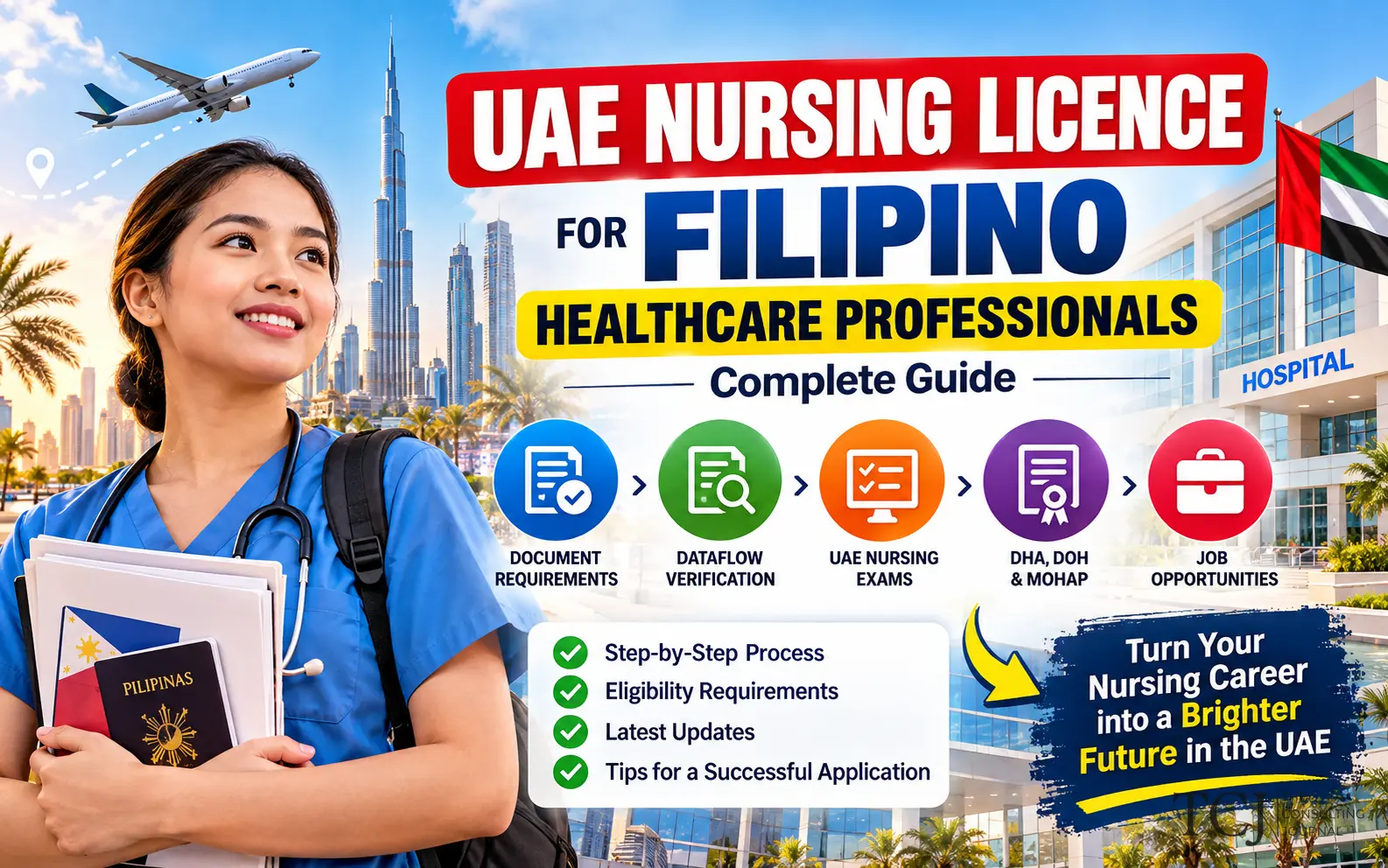
UAE Nursing Licence for Filipino Healthcare Professionals: Requirements and Application Process
Planning to work as a nurse in the UAE? Learn how Filipino healthcare professionals can navigate DHA, DOH and MOHAP licensing, DataFlow verification, nursing assessments, documents and employer licence activation.
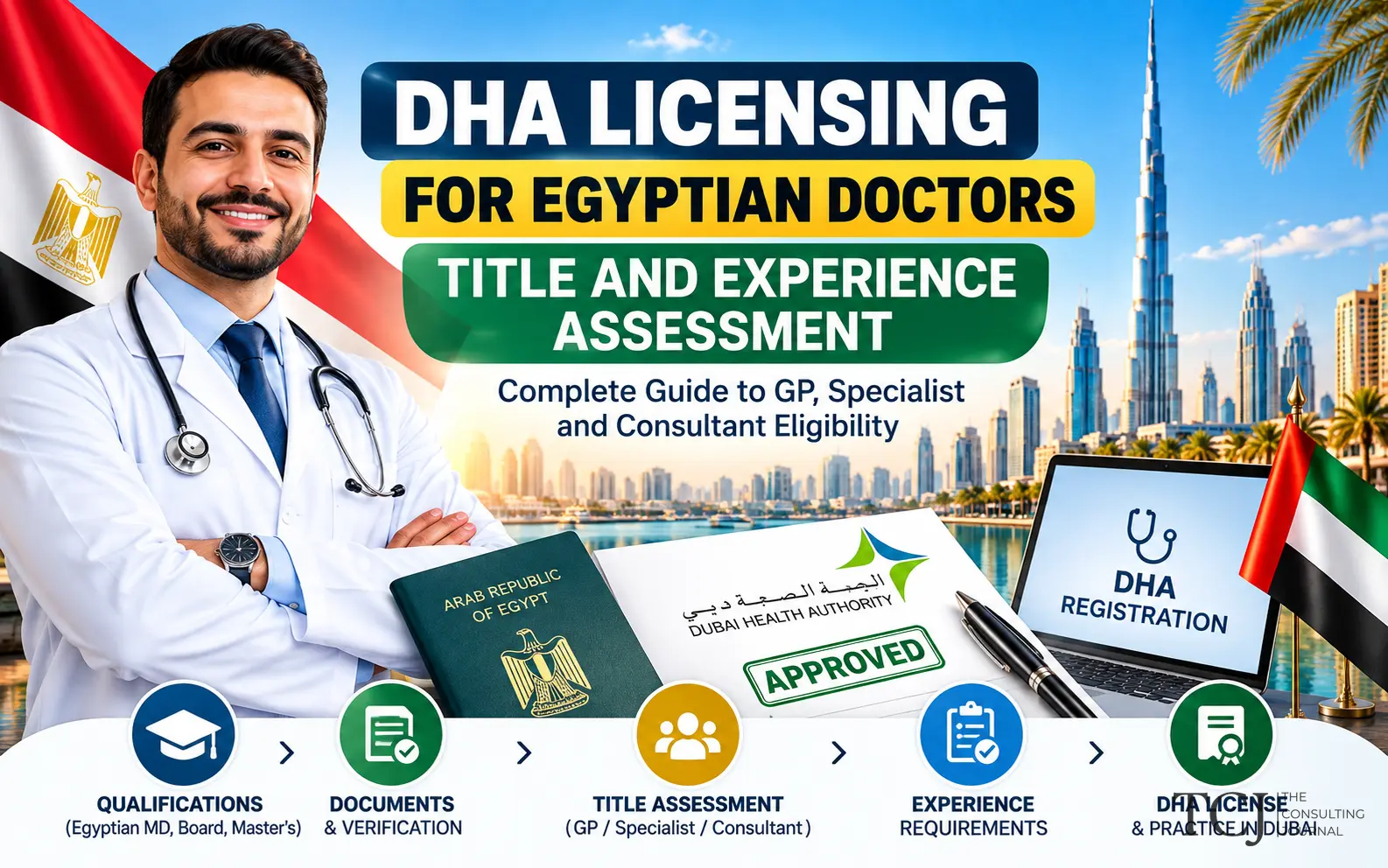
DHA Licensing for Egyptian Doctors: Titles, Tiers and Experience
Egyptian doctors applying for DHA licensing in Dubai need to understand how their MD, Egyptian Board Fellowship, Clinical Master’s and post-qualification experience affect eligibility for GP, Specialist and Consultant titles.
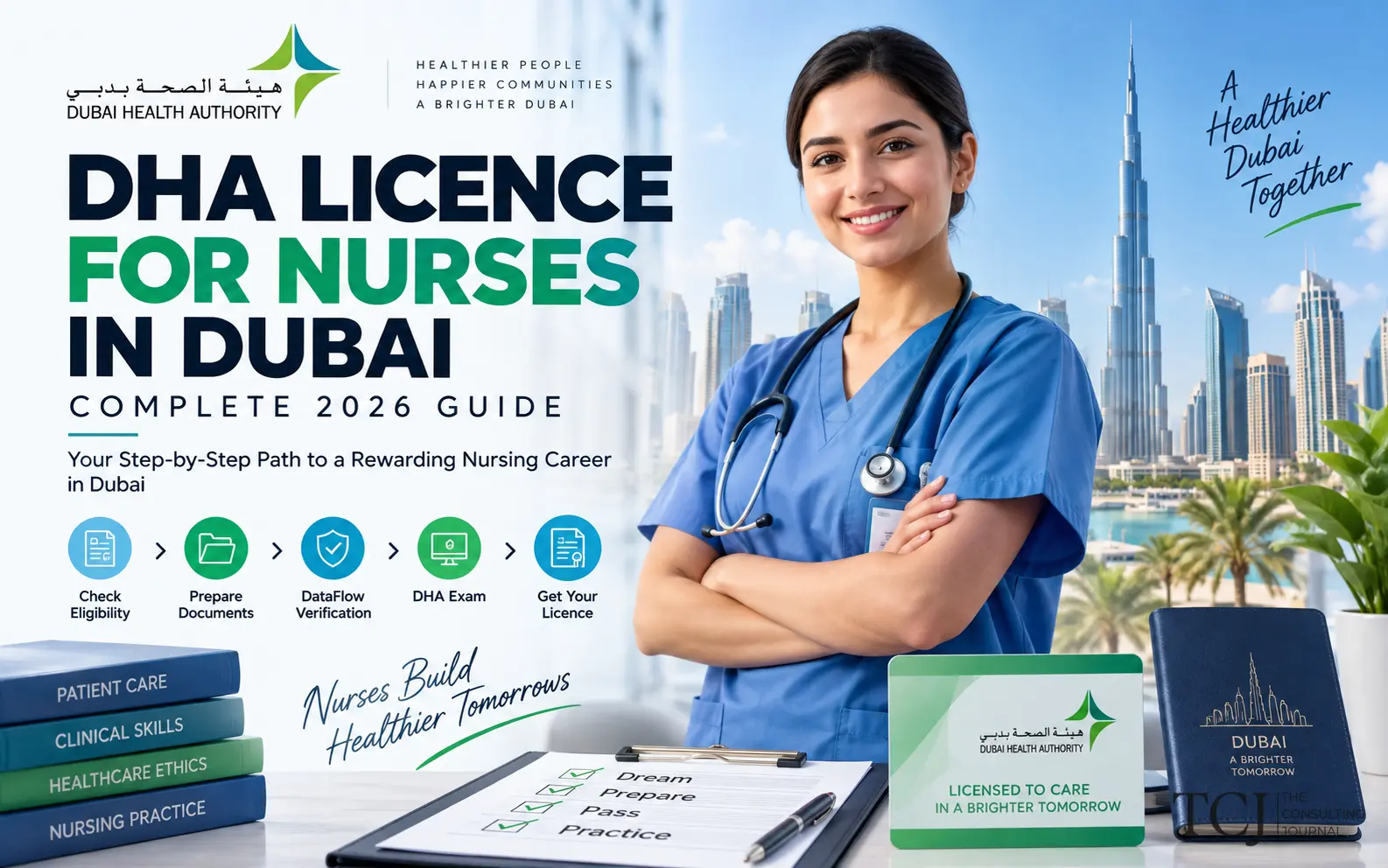
DHA Licence for Nurses in Dubai: Eligibility, DataFlow, Exam and Application Process
A practical 2026 guide to DHA licensing for nurses in Dubai, covering Registered Nurse and Assistant Nurse eligibility, DataFlow verification, assessments, registration, documents and employer-led licence activation.