Preparing Danish Healthcare Documents for a UAE Application
Danish healthcare professionals applying in the UAE may need to coordinate qualifications, Good Standing records, translation, legalization, attestation, and authority-specific verification before submission.
Key takeaways
- Confirm the UAE receiving authority before arranging translation, legalization, or attestation.
- Treat educational records, Good Standing certificates, employment documents, and professional verification as separate requirements.
- Current Danish guidance identifies a Denmark-to-UAE legalization sequence through the Danish Ministry of Foreign Affairs, UAE Embassy in Copenhagen, and UAE Ministry of Foreign Affairs.
- Check names, dates, translations, document validity, and electronic verification features before authentication.
- Recheck official requirements immediately before submission because authority procedures can change.
What does preparing Danish healthcare documents for a UAE application involve?
Preparing Danish healthcare documents typically means identifying the correct records, confirming the receiving authority's requirements, checking names and dates, arranging any required translation, completing legalization or attestation, and preserving the correct original or electronic format. Some professional credentials may also require separate verification rather than document attestation alone.
The exact process depends on the profession, document type, emirate, licensing pathway, employer, and authority.
A useful starting point is to separate the application into three questions:
- What proves your identity and education?
- What proves your current professional status and experience?
- What authentication or verification does the UAE recipient require?
This prevents applicants from treating every certificate as though it follows the same process.
A UAE healthcare document file should be built around the receiving authority's checklist, not around assumptions from a previous application. — Consultant observation
Which Danish healthcare documents may be required?
There is no single document list for every Danish healthcare professional moving to Dubai, Abu Dhabi, or another emirate. In practice, applicants may need educational, professional, employment, and identity records, with different preparation requirements applying to each document.
Common documents can include:
- Passport or identity records
- University degree or healthcare diploma
- Academic transcript
- Danish authorization or registration evidence
- Certificate of Good Standing
- Specialist qualification documents
- Internship or clinical training records
- Employment or experience certificates
- Name-change evidence, where applicable
- Other professional certificates requested by the receiving authority
An important practical point is that these documents often come from different issuers. A university may issue the diploma and transcript, the Danish healthcare authority may confirm professional status, and an employer may issue experience documentation.
Applicants should therefore create a document inventory before paying for translation or attestation.
For each document, record:
- Issuing organization
- Issue date
- Original language
- Whether the original is paper or electronic
- Whether the receiving authority requires an original, copy, translation, attestation, or verification
- Whether there is a validity period
Why should you confirm the UAE receiving authority first?
The receiving authority determines what your document package must ultimately achieve. Applicants can lose time and money by legalizing unnecessary records, ordering the wrong certificate, using an unacceptable translation, or completing a process intended for a different licensing pathway.
Before processing documents, confirm:
- Which documents are mandatory?
- Which records require attestation?
- Are originals, certified copies, electronic originals, or scans accepted?
- Is English acceptable, or is Arabic translation required?
- Must a translation be legally certified?
- Is separate primary-source or professional credential verification required?
- Does any certificate have an age or validity restriction?
- Must a document be transmitted directly by its issuing authority?
Attestation should not be confused with healthcare credential verification. The UAE Ministry of Foreign Affairs describes document attestation as a process that certifies the authenticity of signatures and seals. A healthcare licensing authority may separately investigate professional qualifications or registration.
How should names, dates, and professional details be checked?
Document consistency should be reviewed before legalization begins. Differences in spelling, professional titles, employment dates, or qualification details can create questions during identity matching even when the underlying documents are genuine.
Compare the passport name against the name appearing on:
- Diploma and transcript
- Danish professional authorization
- Certificate of Good Standing
- Specialist qualifications
- Employment certificates
- Translations
- UAE application forms
Danish characters such as Æ, Ø, and Å deserve particular attention because names can be represented differently when converted into other Latin-character systems.
Applicants should also review dates carefully. Employment periods should be internally consistent, qualification dates should follow a logical chronology, and translated job titles should reflect the actual Danish role rather than a more convenient UAE equivalent.
Where a legal name change has occurred, confirm what supporting evidence the receiving authority expects.
How does a Danish Certificate of Good Standing work?
Danish-authorized healthcare professionals working outside the EU may be asked for a Certificate of Good Standing, or CGS. The Danish Patient Safety Authority states that these certificates demonstrate whether a Danish authorization is valid and unrestricted and are generally issued directly to the relevant foreign authority.
The Danish authority currently asks applicants to provide information including:
- Name
- Date of birth
- Profession
- Danish authorization ID
- Destination country
- Name of the foreign receiving authority
- The recipient's postal or email address
Where another authority requires the certificate to be translated, legalized, notarized, or verified, the Danish Patient Safety Authority asks the applicant to document that requirement.
Its current guidance also states that the Certificate of Good Standing is valid for three months from the issue date. Timing therefore matters: requesting it too early can result in the certificate expiring before the UAE application reaches the relevant stage.
Do Danish healthcare documents need translation for the UAE?
Some Danish-language documents may need a certified translation, but applicants should confirm the accepted language and translation standard before commissioning work. English may be sufficient for one process while another recipient may request Arabic or a particular form of legally certified translation.
For the UAE Ministry of Foreign Affairs courier-based attestation pathway, the current requirements state that an original document should be in Arabic or English or accompanied by a legally certified translation. The document must also have the relevant prior certification or attestation where applicable.
Healthcare terminology requires particular care. A translator should preserve the meaning of Danish academic degrees, specialties, authorization terms, and clinical positions rather than replacing them with titles that appear similar but have a different regulatory meaning in the UAE.
What should be checked before ordering a translation?
Confirm:
- Whether English or Arabic is required
- Whether the entire document must be translated
- Whether a certified or legally recognized translator is required
- Whether stamps, endorsements, and supporting pages must also be translated
- Whether translation comes before or after another authentication stage
- Whether an existing bilingual document is already acceptable
Example 1: A fictional Dubai healthcare provider recruits a Danish physiotherapist whose diploma is mainly in Danish. Before arranging Arabic translation, the applicant checks the licensing requirements and learns which language and certification format the receiving authority accepts. This avoids paying twice for translations prepared in the wrong form.
What is the legalization and attestation route from Denmark to the UAE?
For Danish documents that require legalization for UAE use, current Danish Ministry of Foreign Affairs guidance sets out a three-stage sequence: legalization through the Danish Ministry of Foreign Affairs, attestation by the UAE Embassy in Copenhagen, and subsequent attestation by the UAE Ministry of Foreign Affairs.
The sequence is:
- Danish Ministry of Foreign Affairs in Copenhagen
- UAE Embassy in Copenhagen
- UAE Ministry of Foreign Affairs
This published route is an important baseline, but applicants should still confirm that the particular document requires the full process.
Legalization does not normally mean that an authority is assessing whether the applicant is clinically competent. Authentication procedures concern the formal status of the document, signature, or seal.
Is an Apostille alone sufficient?
Applicants should not assume that obtaining a Danish Apostille automatically completes the UAE process.
The current Denmark-specific guidance expressly describes the additional UAE Embassy in Copenhagen and UAE Ministry of Foreign Affairs stages for Danish documents intended for use in the UAE.
Terms such as Apostille, legalization, authentication, certification, and attestation are often used loosely in conversation. For an actual application, follow the terminology and sequence stated by the authorities handling the document.
How should education and employment documents be prepared?
Educational and employment records should be reviewed separately because they prove different parts of an applicant's professional history. A diploma establishes a qualification, a transcript provides academic detail, and an employment certificate supports professional experience.
For education documents, check:
- Institution name
- Qualification title
- Applicant's name
- Graduation or award date
- Completeness of transcript pages
- Separate attestation requirements for supporting records
UAE Ministry of Foreign Affairs guidance lists educational certificates, diplomas, and educational transcripts among the personal documents that can fall within its attestation service.
Employment certificates should accurately state the employer, employee name, role, employment period, and other information requested by the UAE recipient.
Do not ask a former employer to rewrite a genuine historic title merely to make it resemble UAE terminology. Accurate documentation is more defensible than a document that creates inconsistencies with other records.
Example 2: A fictional Abu Dhabi healthcare group recruits a Danish nurse with several previous employers. The candidate prepares one timeline showing the exact employer names, job titles, and dates used across the CV and experience certificates. A date discrepancy is corrected before attestation, rather than being discovered after the original documents have already been processed.
Are scans and electronic documents treated the same way?
No. An electronically issued original and a scanned copy of a paper certificate are not necessarily equivalent. Applicants should preserve the format, verification features, and completeness of official electronic records and avoid editing documents merely to improve their appearance.
UAE MoFA's current digital-attestation service applies to eligible UAE-issued digital documents and requires an original electronic document containing a verification mechanism such as a QR code, barcode, electronic link, or reference number. A scan or photograph is not considered an original digital document for that pathway.
Danish-issued documents follow the applicable outside-UAE attestation process, so applicants should confirm the relevant mission's procedure rather than assuming the UAE digital pathway applies.
For valuable paper originals, retain clear reference scans and records of what was sent.
What common mistakes delay UAE healthcare document applications?
Many problems arise before an authority begins evaluating the applicant's professional credentials. The most preventable mistakes involve processing documents too early, failing to check consistency, confusing attestation with verification, or following requirements intended for another authority.
Common mistakes include:
- Starting legalization before checking the final authority's checklist
- Ordering a Certificate of Good Standing too early
- Ignoring differences in names or transliteration
- Submitting incomplete transcript pages
- Translating only part of a multi-page document
- Using poor-quality scans
- Altering or cropping electronic verification features
- Assuming an employer checklist replaces regulatory requirements
- Treating attestation and primary-source verification as the same process
- Following instructions from an old forum or previous applicant instead of current official guidance
- Assuming one emirate or profession follows exactly the same process as another
A useful rule is to check the underlying document first and authenticate it second.
What documents should you prepare before starting the process?
A structured preparation file can reduce avoidable rework.
Keep:
- Current UAE authority checklist
- Passport copy
- Degree or diploma
- Full academic transcript
- Danish authorization details
- Certificate of Good Standing instructions
- Specialist certificates, if applicable
- Employment and experience certificates
- Name-change evidence, where relevant
- Translation requirements
- Legalization and attestation instructions
- Copies of completed translations
- Attestation receipts and reference numbers
- Courier records
- Emails or written instructions from authorities
- Final copies of everything submitted
Use consistent filenames so that documents can be located easily. A format such as Surname_Degree_Denmark.pdf or Surname_Good-Standing_2026.pdf is more practical than leaving multiple files with generic names such as scan1.pdf.
How can KPM Global Services UAE assist?
KPM Global Services UAE can support applicants and UAE businesses with document-readiness coordination, checklist review, administrative preparation, and the practical sequencing of translation and attestation requirements.
For healthcare employers in Dubai or elsewhere in the UAE, this can also include helping internal teams organize onboarding documentation and identify gaps before documents move into external licensing or verification processes.
Professional licensing and authority decisions remain with the relevant regulator or government body. Requirements should therefore be reconfirmed for the applicant's profession and receiving authority before documents are processed.
What should applicants do immediately before submission?
Perform one final comparison between the completed package and the current receiving authority's checklist. Check names, dates, document versions, translation completeness, validity periods, required attestations, verification instructions, and submission format before sending originals or uploading files.
Do not rely solely on a checklist saved several months earlier. Official processes can change, and the Danish Ministry of Foreign Affairs, UAE Ministry of Foreign Affairs, Danish Patient Safety Authority, UAE healthcare regulator, and employer may each control a different part of the process.
For Danish healthcare professionals, the practical objective is not to collect the largest possible document file. It is to produce the correct evidence, in the correct form, for the correct recipient.
This article is for informational purposes and does not constitute legal, tax, accounting, or financial advice.
Questions and answers
Q: How do I prepare Danish healthcare documents for a UAE application?
A: Start with the current checklist issued by the UAE organization receiving your application. Collect the required documents, check names and dates, confirm translation requirements, and determine separately which records need legalization, attestation, or professional verification.
Q: Do Danish healthcare documents need attestation for use in the UAE?
A: Some documents may require attestation, depending on the document and receiving authority. Current Danish guidance describes a route through the Danish Ministry of Foreign Affairs, UAE Embassy in Copenhagen, and UAE Ministry of Foreign Affairs for Danish documents that require legalization for UAE use.
Q: How long is a Danish Certificate of Good Standing valid?
A: The Danish Patient Safety Authority currently states that its Certificate of Good Standing is valid for three months from the issue date. Applicants should therefore coordinate the request with the UAE authority's submission timetable rather than obtaining it unnecessarily early.
Q: Do Danish documents have to be translated into Arabic for a UAE application?
A: Not always. The accepted language depends on the receiving authority and process, although UAE MoFA's courier-based attestation requirements state that an original should be in Arabic or English or accompanied by a legally certified translation.
Q: Is document attestation the same as UAE healthcare credential verification?
A: No. Attestation deals with the formal authenticity of documents, signatures, or seals, while healthcare licensing may involve a separate assessment or verification of qualifications, registration, and professional experience. Applicants should complete both processes where the receiving authority requires them.
More in Medical Career
View all Medical Career →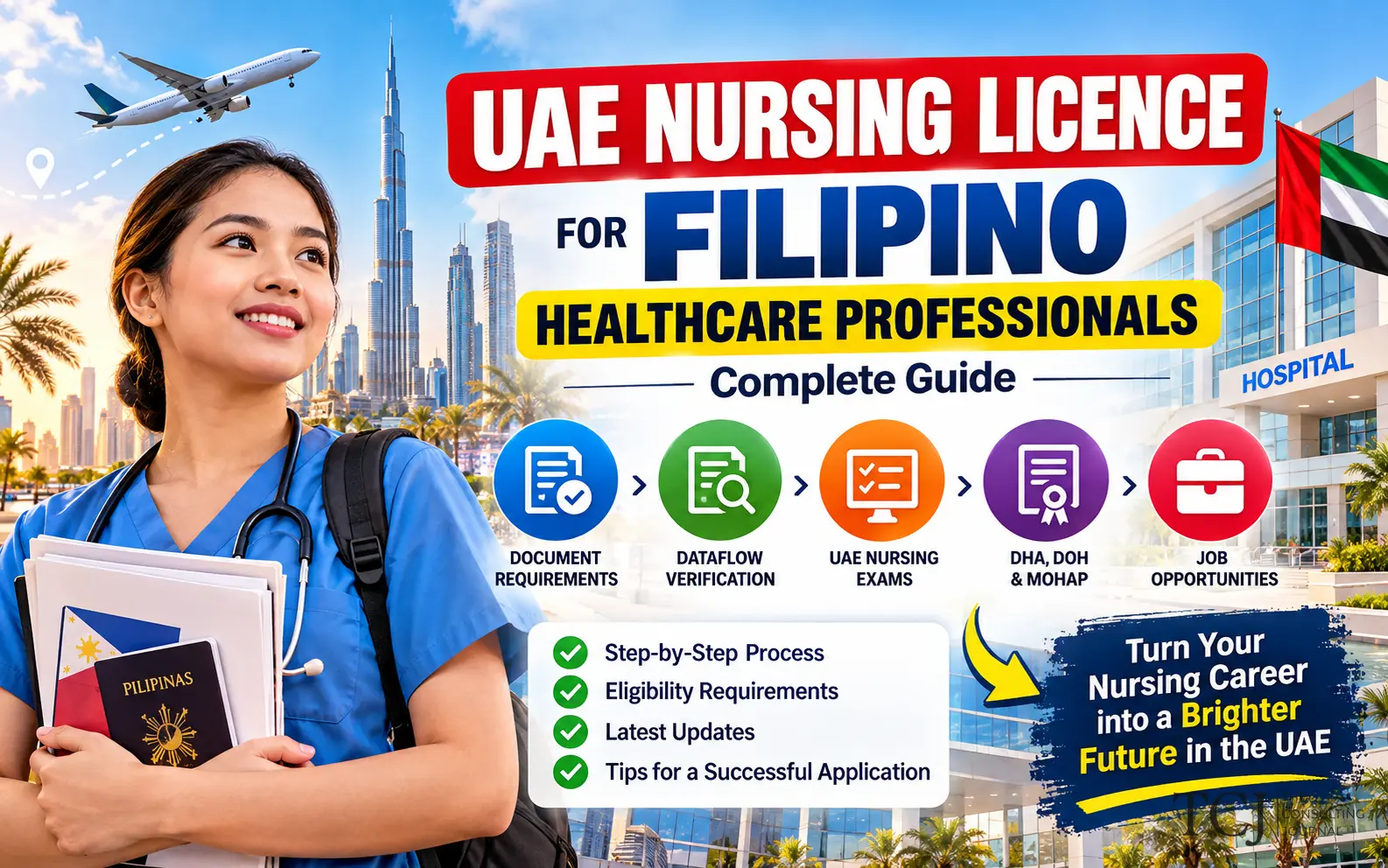
UAE Nursing Licence for Filipino Healthcare Professionals: Requirements and Application Process
Planning to work as a nurse in the UAE? Learn how Filipino healthcare professionals can navigate DHA, DOH and MOHAP licensing, DataFlow verification, nursing assessments, documents and employer licence activation.
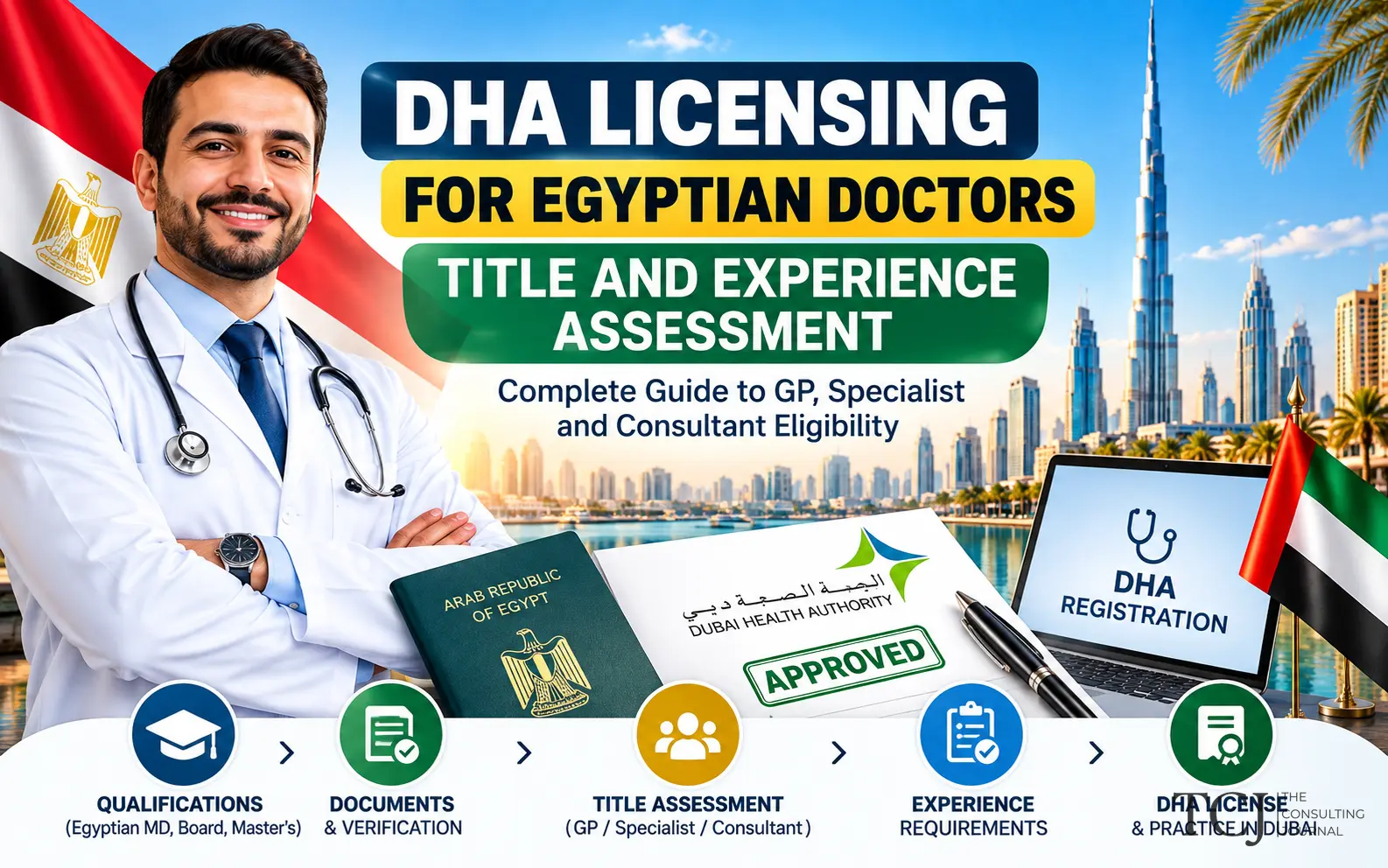
DHA Licensing for Egyptian Doctors: Titles, Tiers and Experience
Egyptian doctors applying for DHA licensing in Dubai need to understand how their MD, Egyptian Board Fellowship, Clinical Master’s and post-qualification experience affect eligibility for GP, Specialist and Consultant titles.
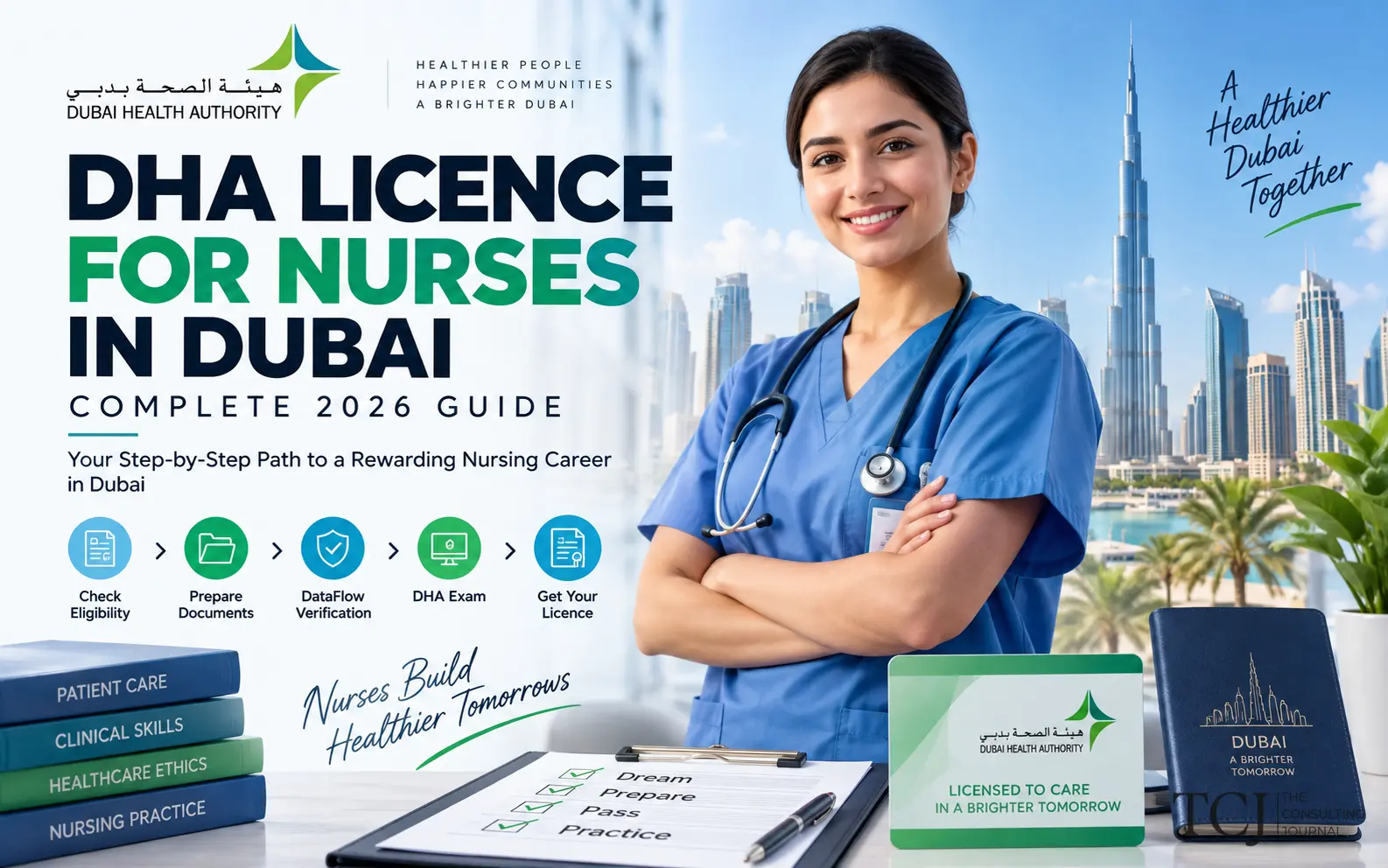
DHA Licence for Nurses in Dubai: Eligibility, DataFlow, Exam and Application Process
A practical 2026 guide to DHA licensing for nurses in Dubai, covering Registered Nurse and Assistant Nurse eligibility, DataFlow verification, assessments, registration, documents and employer-led licence activation.