Small Business Relief in UAE Corporate Tax: A Practical SME Guide
A practical guide to Small Business Relief in UAE Corporate Tax for SMEs, freelancers, mainland companies, and free zone businesses assessing eligibility, records, exclusions, and filing readiness.
Why Small Business Relief matters for UAE SMEs
Small Business Relief in UAE Corporate Tax is one of the most practical reliefs available to smaller UAE businesses, particularly founder-led companies, consultants, freelancers, and early-stage SMEs. The core question is not only whether the business is “small”, but whether it meets the specific tax conditions for the relevant tax period.
The uploaded draft correctly identified the main issues business owners usually ask about: who can claim the relief, who cannot, how revenue is calculated, what records are needed, and what mistakes create risk. This Sanity-ready version rewrites those ideas into a practical Consulting Journal article for UAE decision-makers.
UAE Corporate Tax applies to financial years beginning on or after 1 June 2023, and it covers UAE companies, certain individuals conducting business, non-resident juridical persons with a UAE permanent establishment, and free zone entities within the scope of the law.
For many SMEs, the difficulty is not only the tax amount. It is the discipline needed around bookkeeping, invoices, management accounts, tax registration, and annual filing. Small Business Relief is designed to reduce some of that burden, but it does not remove the need for proper compliance.
“Relief is useful only when the business can prove it qualifies. In practice, the records matter as much as the rule.” — The Consulting Journal
What Small Business Relief means in practice
Small Business Relief allows an eligible taxable person to be treated as not having derived taxable income for the relevant tax period. In simple terms, if the business qualifies and elects for the relief, the Corporate Tax calculation may become simpler for that period. The Federal Tax Authority states that the relief is available to resident persons, including natural persons and juridical persons, subject to the required conditions.
The key point for business owners is that this is an election. It is not automatic. A business should review its revenue, previous tax periods, legal status, free zone position, and group connections before assuming that it can claim the relief.
For example, a Dubai-based marketing consultancy with annual revenue of AED 1.8 million may appear eligible at first glance. But the owner still needs to confirm whether the business is a UAE resident taxable person, whether revenue exceeded the threshold in any previous relevant tax period, and whether the business is connected to a larger multinational group.
Main eligibility rules business owners should check
The main revenue threshold is AED 3 million. The FTA states that revenue must be equal to or less than AED 3 million in both the current and all previous tax periods for the relief to be available.
Ministerial Decision No. 73 of 2023 confirms that the AED 3 million threshold applies for relevant tax periods and previous tax periods, and that the threshold applies to tax periods starting on or after 1 June 2023 and ending on or before 31 December 2026. It also states that revenue should be determined according to applicable accounting standards accepted in the UAE.
In practice, this means a business owner should not look only at the current year. A previous year above the threshold can affect eligibility. This is a common point missed by SMEs that only review the latest management accounts.
Who may typically qualify
A UAE resident taxable person may be able to elect for Small Business Relief if the conditions are met. This may include:
- A mainland LLC with revenue at or below AED 3 million
- A freelancer or sole establishment conducting business in the UAE
- A small professional services company
- A startup still below the revenue threshold
- A family-owned trading business with proper accounting records
Eligibility depends on the facts. The activity, tax residence position, revenue history, and entity classification should all be reviewed before filing.
Who cannot elect for the relief
The FTA states that a Qualifying Free Zone Person cannot elect for Small Business Relief. The FTA also excludes a member of a multinational group with consolidated group revenue of more than AED 3.15 billion.
This matters for free zone companies. A free zone business may still be within the Corporate Tax regime, and some free zone businesses may benefit from separate qualifying income treatment if they meet the relevant conditions. But a Qualifying Free Zone Person cannot also elect for Small Business Relief.
Revenue calculation is where many mistakes start
The relief is revenue-based, so the quality of accounting records is central. Revenue generally needs to be assessed from the business’s accounting records in line with accepted accounting standards in the UAE.
This is where many small businesses face practical issues. Some owners rely on bank deposits as a rough measure of revenue. Others mix shareholder transfers, refunds, intercompany receipts, and customer income in the same account without clear narration. That approach may create confusion when preparing Corporate Tax filings.
A better approach is to keep monthly accounts that clearly separate:
- Sales and service income
- VAT collected, where applicable
- Refunds and credit notes
- Owner contributions or shareholder loans
- Intercompany balances
- Non-operating receipts
Example 1:
A Sharjah-based e-commerce startup records AED 2.7 million in sales for the year. At first, it appears to fall within the Small Business Relief threshold. During review, the accountant finds AED 450,000 of additional marketplace receipts that were not reconciled. The business may no longer qualify, and the issue should be corrected before filing rather than discovered during a later review.
Small Business Relief does not remove filing responsibilities
Small Business Relief is often misunderstood as a full exemption from all Corporate Tax administration. That is risky. The Ministry of Finance states that taxable persons, including free zone persons, are required to register for Corporate Tax and obtain a Corporate Tax Registration Number. Taxable persons are also required to file a Corporate Tax return within nine months from the end of the relevant tax period, with the same general deadline applying for payment of Corporate Tax due.
A business claiming the relief should still maintain records, assess eligibility, make the appropriate election, and file correctly. From a consulting perspective, this is where smaller companies should build a simple annual compliance calendar rather than waiting until the filing deadline.
Practical impact on tax losses and interest
Small Business Relief can simplify compliance, but business owners should understand the trade-offs. Ministerial Decision No. 73 of 2023 states that where the relief is elected for a tax period, tax losses from that period cannot be carried forward to later tax periods. It also addresses the treatment of net interest expenditure and includes rules on artificial separation of business.
This can matter for startups. A business in its early years may have losses because it is investing in staff, technology, rent, product development, or market entry. Electing for relief may be helpful from an administrative perspective, but the company should consider whether preserving tax losses for future periods is more valuable.
Example 2:
A Dubai technology startup has AED 2.2 million in revenue but significant setup costs, salaries, and software development expenses. It may qualify for Small Business Relief, but the founder expects strong revenue growth next year. Before electing, the business reviews whether tax losses could be relevant in future periods. The decision is not just about the current year; it is about the company’s growth path.
Common mistakes business owners make
Many Corporate Tax issues are not caused by deliberate non-compliance. They are caused by weak accounting habits and assumptions.
The most common mistakes include:
- Assuming the relief applies automatically
- Looking only at current-year revenue and ignoring previous tax periods
- Treating bank deposits as revenue without proper reconciliation
- Claiming relief despite being a Qualifying Free Zone Person
- Missing Corporate Tax registration or filing obligations
- Splitting activities across multiple licences to remain under the threshold
- Failing to keep invoices, contracts, and ledgers in a review-ready format
- Waiting until year-end to clean up bookkeeping
The artificial separation rule is especially important. If businesses are separated mainly to obtain a Corporate Tax advantage, the arrangement may be challenged.
Documents and preparation checklist
Before electing for Small Business Relief, a UAE business should prepare a practical file. This does not need to be complicated, but it should be complete enough to support the position taken in the Corporate Tax return.
Recommended preparation includes:
- Trade licence and entity documents
- Corporate Tax Registration Number
- Financial statements or management accounts
- Revenue breakdown for the current and previous tax periods
- Sales invoices and credit notes
- Bank statements and reconciliations
- Customer contracts or engagement letters
- VAT returns, if the business is VAT registered
- Related-party and group structure information
- Free zone status review, where applicable
- Notes explaining the basis for electing the relief
For mainland SMEs, the focus is often bookkeeping discipline. For free zone companies, the first step is usually to confirm whether the company is a Qualifying Free Zone Person before considering any relief election.
How KPM Global Services UAE can assist
KPM Global Services UAE can assist business owners, founders, CFOs, and finance teams with a practical review of Small Business Relief eligibility. The work typically starts with revenue verification, entity classification, accounting record checks, and review of prior tax periods.
For SMEs in Dubai and across the UAE, the main value is clarity. A business should know whether it qualifies, what records support the position, what filing obligations remain, and whether electing for relief makes commercial sense.
Support may include Corporate Tax registration guidance, bookkeeping review, revenue reconciliation, free zone status assessment, tax return preparation support, and compliance planning for future tax periods. The objective is not to take aggressive positions. It is to help the business file correctly and reduce avoidable risk.
Final advisory view
Small Business Relief is useful for many UAE SMEs, but it should be treated as a compliance decision, not a shortcut. The strongest position is built on clean accounts, accurate revenue records, proper registration, and a clear understanding of exclusions.
A founder-led business below AED 3 million in revenue should review the relief early, preferably before the filing period. A free zone company should first assess its qualifying status. A growing startup should consider whether electing for relief affects future tax planning.
This article is for informational purposes and does not constitute legal, tax, accounting, or financial advice.
Questions and answers
What is Small Business Relief in UAE Corporate Tax?
Small Business Relief allows an eligible UAE resident taxable person to be treated as not having taxable income for a relevant tax period. It is designed to reduce compliance complexity for smaller businesses that meet the required conditions.
What is the revenue threshold for Small Business Relief in the UAE?
The key threshold is AED 3 million. The business must generally have revenue equal to or below AED 3 million in the current and previous relevant tax periods.
Can a UAE free zone company claim Small Business Relief?
A Qualifying Free Zone Person cannot elect for Small Business Relief. Free zone companies should first assess whether they are Qualifying Free Zone Persons before considering relief options.
Does Small Business Relief mean no Corporate Tax return is required?
Not necessarily. Businesses may still need to register for Corporate Tax, maintain records, elect for the relief properly, and file the required Corporate Tax return.
Should a startup always elect for Small Business Relief if it qualifies?
Not always. A startup should consider its losses, future growth, financing plans, and compliance position before electing. In some cases, the wider tax impact should be reviewed before filing.
More in Corporate Tax & Compliance
View all Corporate Tax & Compliance →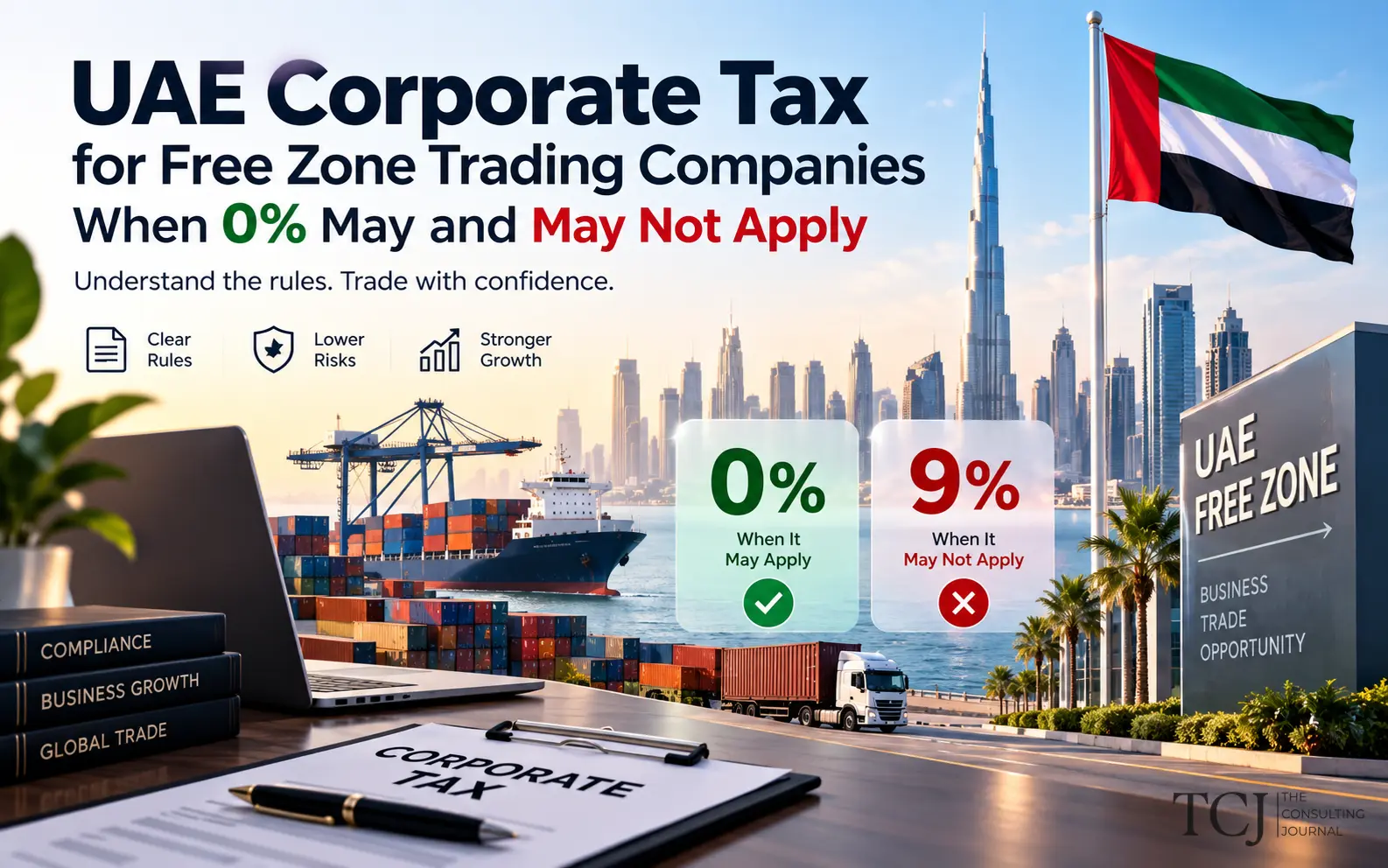
UAE Corporate Tax for Free Zone Trading Companies: When 0% May Apply
A practical UAE Corporate Tax guide for free zone trading companies covering QFZP status, Designated Zone distribution, customer tests, de minimis rules, documentation and common compliance risks.

Registering Danish Medical Devices and Healthcare Products in the UAE
Danish medical device and healthcare companies entering the UAE need the correct EDE classification, local regulatory structure, manufacturer documents, marketing authorization and import planning.

UAE Registration and Import Requirements for French Perfumes
French perfume brands entering the UAE need to address product conformity, documentation, labeling, Dubai registration, customs clearance, VAT and shipping requirements before commercial sale.