UAE Market Entry for German Industrial Companies: 2026 Guide
German industrial companies entering the UAE need more than a company licence. This practical framework covers market validation, mainland and free-zone structures, Tax, licensing, ICV, distribution, localization, service capability, and phased investment.
Key takeaways
- Start UAE market entry with customer demand and operating requirements, not the company licence.
- Choose mainland, free-zone, branch, distributor, or subsidiary structures according to actual activities and transaction flows.
- A UAE free-zone licence does not automatically mean all income is subject to 0% Corporate Tax.
- Build VAT, Accounting, Financial reporting, imports, invoicing, and transfer-pricing considerations into the operating model early.
- Localise service, inventory, sourcing, assembly, or manufacturing only when customer requirements and commercial evidence support the investment.
- Treat the UAE operation as a staged investment programme with measurable decision gates.
Why should German industrial companies consider the UAE?
The UAE can provide German manufacturers with access to industrial customers, infrastructure projects, logistics networks, regional decision-makers, and procurement ecosystems across sectors such as machinery, automation, energy equipment, engineering, components, manufacturing technology, and industrial services. The opportunity, however, should be assessed at customer and sector level rather than through broad market assumptions.
The UAE's industrial policy includes initiatives such as the National In-Country Value Program, which aims to direct more procurement expenditure towards local manufacturing, services, investment, and economic value creation. For suppliers serving participating government entities and national companies, local capability can therefore become a commercial consideration rather than simply an operational one.
A German management team should ask:
- Which UAE customers have a credible requirement for our products?
- Are purchasing decisions made in Dubai, Abu Dhabi, another emirate, or outside the UAE?
- Do customers expect local technical support?
- Will contracts require stock, installation, commissioning, or maintenance?
- Does local value creation affect tender competitiveness?
- Can the UAE operation support a broader GCC or Middle East strategy?
The right UAE structure is usually the result of the commercial model; it should not become a substitute for deciding what the commercial model actually is. — Consulting Journal editorial observation
What should management validate before setting up a UAE company?
Before choosing a mainland licence, free zone, subsidiary, or branch, management should build a customer-level business case. The objective is to understand demand, route to market, product flow, service requirements, working capital, and regulatory obligations before committing to an entity or facility that may later prove unsuitable.
Start with five practical questions.
Who will buy the product?
Define named customer groups rather than broad sectors.
A machinery producer targeting private manufacturers will face different procurement requirements from an engineering supplier selling to government-linked energy or infrastructure organisations.
What will customers expect locally?
Determine whether the UAE proposition requires only imported equipment or also:
- warehousing;
- spare parts;
- installation;
- commissioning;
- technical training;
- warranty support;
- maintenance;
- configuration or assembly; or
- manufacturing.
Where are the customers?
Location affects licensing, logistics, warehousing, recruitment, travel time, service response, and operating cost. Dubai may suit one business model while Abu Dhabi, Sharjah, or another emirate may better fit another.
How will contracts be fulfilled?
Management should map the complete transaction from the German factory to the UAE customer, including importation, customs, invoicing, inventory ownership, delivery, installation, warranty obligations, payment collection, and intercompany transactions.
What genuinely needs to be local?
A company should distinguish between activities requiring local employees or facilities and functions that can remain with the German headquarters.
What is a practical seven-stage UAE market-entry process?
A disciplined entry programme can be divided into seven decision stages: market validation, route-to-market design, legal structure, regulatory planning, supply-chain design, localization, and execution. Each stage should produce evidence for the next investment decision rather than assuming that the full operating model must be built immediately.
The sequence can work as follows:
- Validate customers, demand, competition, pricing, and project opportunities.
- Decide between direct selling, distributors, commercial partners, or a hybrid model.
- Select the appropriate subsidiary, branch, mainland, free-zone, or joint-venture structure.
- Confirm commercial, industrial, product, and sector-specific licensing requirements.
- Design imports, inventory, servicing, assembly, or manufacturing flows.
- Determine which capabilities should gradually move into the UAE.
- Link additional investment to measurable commercial milestones.
This allows management to increase commitment as the UAE customer base becomes more predictable.
Which UAE entry model works for a German manufacturer?
There is no universally superior structure. A distributor can be useful for early market validation, while a subsidiary can give greater control over strategic accounts, people, inventory, services, branding, and customer relationships. Branches and joint ventures can also be appropriate depending on the activity and wider group structure.
Distributor or commercial partner
A distributor can reduce initial fixed costs and provide access to established customer relationships.
However, German manufacturers should perform due diligence before granting exclusivity. Agreements should address products, territory, sales expectations, technical responsibilities, stock obligations, warranty handling, customer ownership, intellectual property, reporting, termination, and post-termination arrangements.
UAE subsidiary
A subsidiary can make sense when the company needs direct commercial control, local employees, customer contracts, inventory, technical services, or a long-term UAE platform.
Current UAE rules allow foreign investors to fully own companies across a wide range of economic activities. Activities considered to have strategic impact remain subject to the requirements of the relevant authorities, so the exact licensed activity should still be confirmed before incorporation.
Foreign-company branch
A branch may suit a German parent that wants to operate in the UAE directly rather than through a separate subsidiary. UAE Ministry of Economy & Tourism information states that a foreign company opening a branch does not generally require a UAE national agent under the current framework.
The branch-versus-subsidiary decision should still be reviewed from legal liability, Corporate Tax, contracting, banking, governance, Accounting, profit repatriation, and group-structure perspectives.
Joint venture
A joint venture can be commercially sensible when the UAE partner contributes infrastructure, customer access, production capability, specialist expertise, project resources, or another capability that would be expensive or slow to build independently.
Local partnership should have a defined strategic purpose rather than being selected because management assumes local shareholding is automatically required.
Should a German manufacturer choose mainland or free zone?
The decision should follow the company's activities, customer locations, facility requirements, logistics flows, regional plans, and tax position. Mainland structures can suit substantial onshore operations, while free zones can be attractive for logistics, warehousing, regional management, re-export, and certain manufacturing models.
One common misconception is that every UAE free-zone company automatically benefits from 0% Corporate Tax.
It does not.
The Federal Tax Authority states that a Qualifying Free Zone Person may benefit from a 0% Corporate Tax rate on Qualifying Income, while taxable income that does not qualify is generally subject to 9%. Qualifying status is subject to specific conditions, including requirements relating to substance and other compliance matters.
For an industrial group, the important exercise is transaction mapping.
Management should review how machinery, components, services, management charges, intellectual property, inventory, and payments will move between Germany, the UAE entity, customers, and other group companies.
Free-zone selection should therefore be coordinated with Corporate Tax, transfer pricing, VAT, customs, permanent-establishment considerations, and Financial reporting.
What industrial licensing requirements should be considered?
A commercial trading operation and a manufacturing facility are not the same regulatory proposition. Where a German company intends to manufacture in the UAE, industrial licensing, facility approvals, Industrial Registry requirements, environmental considerations, product compliance, and other sector-specific permissions should be assessed before significant capital expenditure.
MoIAT operates an industrial production licensing service for facilities subject to industrial licensing requirements. Its published process includes an application, supporting documentation, applicable fees, inspection, and issuance of the industrial production licence where requirements are satisfied.
MoIAT also states that manufacturing establishments falling within the relevant ISIC Category C framework, including establishments operating in free zones and specialised zones, are within the Industrial Registry framework. Registered industrial establishments are required to update specified information annually.
Depending on the activity, a German manufacturer may need to consider:
- the local economic or industrial licence;
- federal industrial requirements;
- facility and municipality approvals;
- customs registration;
- product conformity;
- environmental and occupational requirements;
- warehouse permissions; and
- sector-specific authorisations.
Regulatory due diligence should take place before signing a long facility lease or ordering equipment for a proposed UAE production site.
How should Corporate Tax and VAT affect market-entry planning?
Tax should be designed alongside the operating model rather than reviewed after incorporation. German groups should consider how UAE Corporate Tax, free-zone rules, VAT, related-party pricing, imports, Accounting records, intercompany charges, and customer contracts interact with the intended structure.
Under the standard UAE Corporate Tax regime, the Federal Tax Authority states that taxable income up to and including AED 375,000 is subject to 0%, while taxable income exceeding AED 375,000 is generally subject to 9%. Different treatment applies to Qualifying Free Zone Persons.
The standard UAE VAT rate is 5%. For UAE-resident businesses, mandatory VAT registration generally applies when taxable supplies and imports exceed AED 375,000 over the previous 12 months or are expected to exceed that amount within the next 30 days. The voluntary registration threshold is AED 187,500. Different registration considerations apply to non-resident businesses making taxable UAE supplies.
For industrial businesses, the practical concern extends beyond headline Tax rates. Companies need Accounting and invoicing processes capable of supporting imports, local supplies, installation, services, credit notes, intercompany transactions, and reliable Financial reporting.
Why should after-sales service be part of the market-entry strategy?
Industrial customers often evaluate suppliers on lifecycle support as well as equipment specifications. A company that can sell sophisticated machinery into the UAE but cannot respond quickly when equipment requires maintenance, commissioning, spare parts, or troubleshooting may struggle to build a sustainable installed base.
Possible service models include German technicians travelling to the UAE, an authorised local service partner, locally employed engineers, a regional technical hub, or a hybrid approach.
Example 1: A fictional Hamburg-based packaging machinery company initially sells through a UAE distributor. After several installations, customers begin requesting faster spare-parts delivery and on-site troubleshooting. Instead of immediately opening a factory, the company establishes a small Dubai commercial and service operation with selected local inventory.
The investment follows demonstrated demand.
When does localization make commercial sense?
Localization is most effective when linked to customer requirements and measurable economics. A German manufacturer can progressively localise sales, technical service, inventory, configuration, assembly, sourcing, manufacturing, or engineering rather than moving directly from exports to a capital-intensive production facility.
For suppliers serving organisations participating in the National ICV Program, local economic contribution may also affect competitiveness in relevant procurement processes. MoIAT describes ICV certification as a mechanism that evaluates a supplier's contribution to the local economy and can provide an advantage in participating tenders and contracts.
Useful investment triggers may include:
- growth in the installed equipment base;
- recurring service demand;
- contracted order backlog;
- customer lead-time requirements;
- inventory economics;
- tender requirements;
- local sourcing opportunities; and
- sufficient volume to justify assembly or manufacturing.
Example 2: A fictional North Rhine-Westphalia automation supplier secures recurring orders from industrial customers in Abu Dhabi. Rather than committing immediately to manufacturing, it first hires technical engineers, then holds critical components locally. Assembly is considered only after order volume and customer procurement requirements support the additional investment.
What are the most common UAE market-entry mistakes?
The most expensive mistakes often occur when structural decisions are made before the underlying operating assumptions are tested.
Common problems include:
- forming the cheapest or fastest entity without mapping activities;
- appointing a distributor without measurable performance obligations;
- granting unnecessary exclusivity too early;
- assuming every free-zone business qualifies for 0% Corporate Tax;
- underestimating working-capital requirements and customer payment cycles;
- failing to establish reliable Accounting and VAT processes;
- committing to warehousing or manufacturing before validating demand;
- keeping all technical service capability in Germany after the installed base grows;
- choosing an emirate primarily on licence cost rather than customer and logistics requirements; and
- failing to define authority between the UAE team and German headquarters.
What should be prepared before management approves UAE entry?
A decision file should give the German board or investment committee a clear view of the commercial opportunity, regulatory requirements, funding needs, operating model, and downside risks.
Useful preparation documents include:
- UAE customer and named-account list;
- competitor and pricing assessment;
- three-year sales assumptions;
- distributor or partner due-diligence file;
- proposed licensed activities;
- mainland and free-zone assessment;
- product and service flow map;
- Corporate Tax and VAT review;
- transfer-pricing assessment where relevant;
- customs and import responsibilities;
- industrial and product-compliance checklist;
- facility requirements;
- staffing and visa plan;
- working-capital forecast;
- inventory and spare-parts model;
- Accounting and Financial reporting requirements;
- service and warranty operating model;
- responsibility matrix between Germany and the UAE; and
- investment milestones for further localization.
How can KPM Global Services UAE assist?
KPM Global Services UAE can support German industrial companies in translating a market-entry strategy into a workable UAE structure.
Depending on the proposed activity, this may include reviewing mainland and free-zone options, supporting company setup coordination, assessing Corporate Tax and VAT implications, establishing Accounting and Financial reporting processes, reviewing documentation requirements, and helping management organise the practical workstreams required before launch.
For industrial companies, the objective should be alignment. Commercial contracts, licensing, tax treatment, invoicing, banking readiness, Accounting records, staffing, and operating processes should support the same business model rather than being addressed as separate setup tasks.
KPM Global Services UAE does not replace specialist legal, engineering, customs, or product-certification advisers where those disciplines are required. The role is to help management identify the relevant workstreams, coordinate decisions, and build a more structured approach to UAE execution.
What is the practical approach for the first 12 months?
A first-year UAE expansion should progressively reduce uncertainty before increasing fixed investment. Market validation should come first, followed by structure design, establishment, commercial execution, and an evidence-based review of whether additional service, inventory, sourcing, assembly, or manufacturing capability is justified.
During the first three months, focus on customers, competitors, distributors, procurement structures, regulatory barriers, and service expectations.
During months three to six, compare entity structures, map transactions, review Tax and VAT, define licensing requirements, and establish the selected operation.
During months six to nine, recruit priority personnel, formalise partner management, implement Accounting and reporting systems, and begin structured customer development.
During months nine to twelve, compare actual results with the original assumptions. Review pipeline quality, gross margins, customer payment behaviour, service requirements, inventory needs, operating cost, and working capital before approving the next investment stage.
What should German management take away?
The UAE can provide significant commercial and regional opportunities for German industrial businesses, but incorporation should be an output of strategy rather than the starting point.
A disciplined company typically validates customer demand first, chooses its route to market, maps transactions and regulatory obligations, builds appropriate Tax and Accounting processes, creates sufficient after-sales capability, and increases localization only when customer requirements and economics justify it.
Foreign-ownership flexibility gives international businesses more structural options than under the UAE's historical company-ownership framework, but the final structure still depends on the licensed activity and any applicable strategic-impact restrictions.
The strongest entry strategy is therefore not necessarily the largest initial investment. It is the model that allows management to learn, measure commercial traction, control risk, and invest further when the evidence supports doing so.
This article is for informational purposes and does not constitute legal, tax, accounting, or financial advice.
Questions and answers
Q: Can a German company own 100% of a UAE mainland company?
A: In many cases, yes. UAE rules allow foreign investors to fully own companies across a wide range of economic activities, although activities with strategic impact can be subject to additional regulatory requirements. The exact activity and conditions should be checked with the relevant licensing authority.
Q: Should a German industrial company choose mainland or a UAE free zone?
A: It depends on the company's customers, activities, facilities, imports, regional strategy, and Tax position. Mainland can suit substantial onshore operations, while a free zone may work well for logistics, regional headquarters, warehousing, re-export, or certain industrial activities.
Q: Is Corporate Tax always 0% for a UAE free-zone company?
A: No. A Qualifying Free Zone Person may benefit from 0% Corporate Tax on Qualifying Income, while taxable income that does not meet the qualifying requirements is generally subject to 9%. The company's actual activities, transactions, substance, and compliance position need to be reviewed.
Q: Does a German manufacturer need an industrial licence in the UAE?
A: It may, if the UAE operation conducts activities that fall within industrial licensing requirements. Manufacturing businesses should assess local licensing, MoIAT requirements, Industrial Registry obligations, facility approvals, and product-specific compliance before committing to production premises or equipment.
Q: Should a German manufacturer establish production in the UAE immediately?
A: Usually, production should follow a clear customer, procurement, logistics, or cost case rather than precede market validation. A phased model moving from exports to local sales, service, inventory, assembly, sourcing, and eventually manufacturing can reduce unnecessary capital exposure while preserving the option to localise further.
More in Investment
View all Investment →
Search Funds in the UAE: A Practical Guide to Buying and Operating a Business
Search funds in the UAE offer entrepreneurs an alternative to starting a company. Explore how the model works, acquisition financing, business valuation, due diligence, legal requirements, and risks.
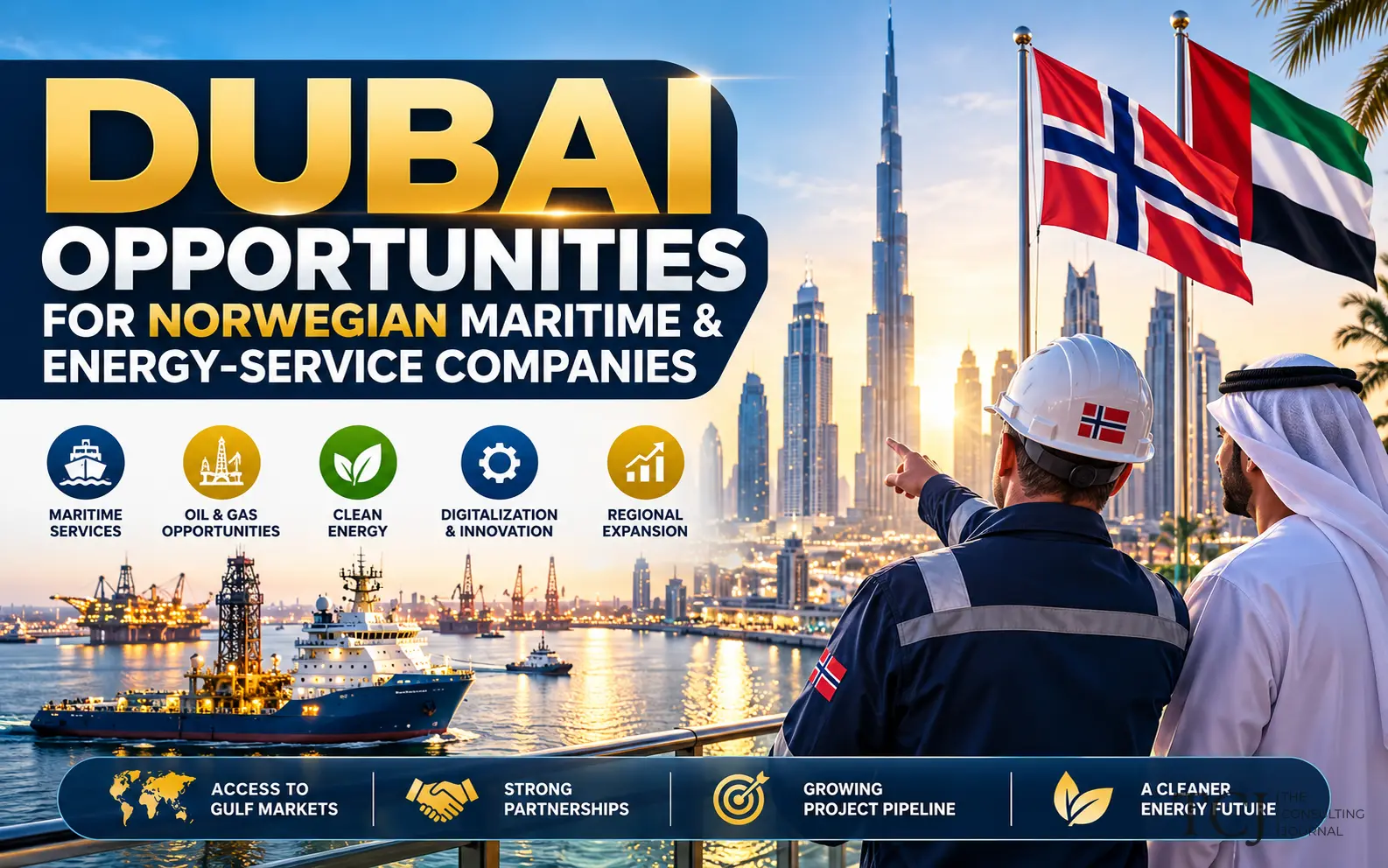
Dubai Opportunities for Norwegian Maritime and Energy-Service Companies
Dubai offers Norwegian maritime and energy-service companies opportunities in vessel services, offshore energy, electrification, digital technology and Gulf market expansion.

Dubai Family Offices: What Founders Should Understand Before Seeking Capital
A practical guide to approaching Dubai family offices, qualifying investor fit, preparing financial records, checking counterparties and evaluating funding terms.