UAE PQR Updates in 2026: What Healthcare Professionals Should Recheck
Healthcare professionals applying for UAE licensing in 2026 should recheck their professional title, qualifications, experience, verification reports, examination pathway and supporting documents.
Key takeaways
- Use the current PQR, amendments and live authority instructions rather than an old checklist.
- Match the requested professional title to the qualification, licence and clinical experience.
- Review verification reports for discrepancies before submitting the licensing application.
- Keep time-sensitive documents, including the Good Standing Certificate, valid through submission.
- Treat registration, examination and facility licence activation as separate stages of the process.
What does the UAE PQR cover?
The UAE Professional Qualification Requirements establish the minimum education, training, experience and licensing standards used to assess healthcare professionals. The PQR provides a common national foundation, but each authority manages its own application portal, review process and licence activation requirements within its jurisdiction.
The framework applies across professional categories that typically include:
- Physicians and dentists
- Nurses and midwives
- Pharmacists
- Allied healthcare professionals
- Traditional, complementary and alternative medicine practitioners
The requested professional title matters as much as the applicant’s general occupation. A qualification that supports one title may not automatically support a more senior, specialised or differently classified title.
For example, a professional applying as a specialist must normally demonstrate that the relevant postgraduate qualification, training structure and post-qualification experience meet the requirements for that specific specialty.
Is there a completely new UAE PQR for 2026?
Applicants should not assume that the year 2026 automatically means a completely new PQR edition. The safer approach is to review the current document, subsequent ministerial amendments, authority circulars and the live service requirements published by the authority handling the application.
DHA’s regulatory library lists a 2025 ministerial decision amending certain provisions of the unified requirements. Its professional licensing services also continue to direct applicants through PQR assessment, primary-source verification, examinations where required, registration and licence activation.
A saved PQR document may therefore be only one part of the current position. Applicants should also check:
- Whether their professional title is still classified in the same way
- Whether an amendment affects their profession or qualification
- Whether the authority has updated its document requirements
- Whether examination or exemption rules apply to their pathway
- Whether a facility must complete the final licence activation
A UAE healthcare licence application is strongest when the requested title, verified credentials and employment record tell the same story. — Consultant observation
What should healthcare professionals recheck before applying?
Professionals should recheck six connected areas: their intended title, educational qualifications, clinical experience, active registration, primary-source verification and examination pathway. A weakness in one area can affect the entire application, even when the applicant has substantial healthcare experience.
1. Is the professional title correct?
The title selected in the application should accurately reflect the applicant’s qualification, specialty and level of experience.
Applicants sometimes choose a title based on their current job title outside the UAE. However, an employer’s internal designation may not match the title recognised under the UAE PQR.
Before submission, compare:
- The title stated on the qualification
- The specialty shown on the professional licence
- The duties described in experience certificates
- The title available in the authority portal
- The PQR requirements for that category
Selecting a higher or unrelated title may result in additional questions, a different assessment outcome or a request to amend the application.
2. Are the educational qualifications complete?
The authority may need more than the final degree certificate. Depending on the profession, supporting records can include academic transcripts, internship certificates, clinical training records and postgraduate specialty qualifications.
The applicant should confirm that:
- The institution and programme can be verified
- Names and dates are consistent across documents
- The qualification supports the requested professional category
- Internship requirements have been completed where applicable
- Specialty certificates match the intended scope of practice
MOHAP’s professional evaluation service currently lists educational certificates and academic records among its required documents. Other documents may depend on whether the applicant is an experienced professional or a new graduate.
3. Has professional experience been calculated correctly?
Experience requirements can vary by profession, qualification and requested title. Applicants should calculate relevant clinical experience rather than simply counting every year of employment after graduation.
Experience certificates should normally show:
- Exact employment dates
- Professional title
- Department or specialty
- Full-time or part-time status
- Employer details
- Authorised signature or verification information
Periods of internship, observation, administration, teaching or non-clinical work may be treated differently from independent clinical practice, depending on the profession and pathway.
4. Is the professional licence active and consistent?
Applicants should review their registration history in every jurisdiction where they have practised.
The authority may need to understand:
- Which regulator issued the licence
- Whether the licence remains valid
- Whether there were unexplained gaps
- Whether the licensed title matches the experience claimed
- Whether any disciplinary matter requires disclosure
An expired home-country licence does not always produce the same outcome for every category, but it can lead to additional review. Applicants should obtain authority-specific advice before assuming that an old registration is acceptable.
5. Is the Good Standing Certificate still valid?
A Good Standing Certificate provides evidence of the professional’s regulatory status and conduct history.
For DHA registration, the published service requirements state that the certificate must be valid and no more than six months old when the application is submitted. Applicants should confirm the issuing body, validity period and submission method required by their own authority.
Ordering the certificate too early can create a timing problem if primary-source verification or document correction takes longer than expected.
6. Has primary-source verification been completed correctly?
Primary-source verification checks credentials with the issuing institution, employer or regulator. It is commonly associated with DataFlow, although applicants should follow the provider and process accepted by the relevant authority.
DHA’s current self-assessment pathway places primary-source verification before registration and also identifies computer-based testing as a possible requirement. Its registration service asks for verification results covering qualifications, experience and registration records relevant to the requested position.
Common verification difficulties include:
- An institution not responding
- Different names across documents
- Incorrect employer contact details
- Experience dates that do not match the application
- A previous report not being disclosed
- An unclear or unsupported professional title
Applicants should review the final verification report, not merely confirm that the process was paid for or initiated.
Do all applicants need a licensing examination?
Not every applicant follows the same examination route. The requirement can depend on the profession, authority, qualification, requested title and whether a recognised exemption applies. Applicants should check the live authority assessment rather than assume that previous UAE experience automatically creates an exemption.
DHA’s published process may include computer-based testing or an oral assessment where required. Its self-assessment service also states that professionals are limited to three assessment attempts across the authorities.
Professionals claiming an exemption should prepare the evidence supporting that exemption. A verbal statement from an employer or recruitment agency is not a substitute for an authority decision.
What should different healthcare professions review?
Doctors and dentists
Doctors and dentists should closely check internship completion, recognised postgraduate qualifications, specialty classification and post-qualification clinical experience.
Surgical professionals may also need procedure logs. DHA’s registration requirements currently refer to a logbook covering the previous two years for surgical specialties.
Nurses and midwives
Nurses and midwives should verify whether their qualification supports the requested nursing category, whether internship or clinical placement records are available and whether their registration history aligns with their employment certificates.
They should avoid assuming that a senior workplace designation automatically qualifies them for a senior licensing title.
Pharmacists
Pharmacists should review degree recognition, practical training, professional registration and the type of pharmacy experience being claimed.
A hospital, clinical, community or industry role may not be assessed identically for every licensing purpose.
Allied healthcare professionals
Physiotherapists, laboratory professionals, radiographers, occupational therapists, dietitians and other allied healthcare applicants should pay particular attention to title classification.
Closely related job titles can have different education, scope and experience requirements under the licensing framework.
What are the most common application mistakes?
Many delays begin before the application reaches an assessor. They arise because the documents do not support the information entered in the portal.
Common mistakes include:
- Selecting the wrong professional title
- Using experience letters with incomplete dates
- Submitting an expired Good Standing Certificate
- Omitting an internship or clinical training record
- Failing to disclose an earlier verification report
- Using different spellings of the applicant’s name
- Claiming experience that was not independently clinical
- Starting an examination before confirming the correct category
- Assuming that another applicant’s outcome will apply to the same case
- Treating registration as permission to practise before facility activation
DHA explains that registration confirms eligibility for the approved category, title and specialty. The registration is valid for one year and must be activated by a healthcare facility before the professional begins practising in Dubai.
What documents should applicants prepare?
A practical preparation file should include:
- Valid passport copy
- Recent passport-size photograph
- Degree or diploma certificate
- Complete academic transcript
- Internship or clinical training certificate
- Postgraduate and specialty qualifications
- Current and previous professional licences
- Recent Good Standing Certificate
- Detailed employment certificates
- Primary-source verification reports
- Examination results, where applicable
- Evidence supporting an examination exemption
- Surgical or procedure logbook, where applicable
- Name-change or marriage documents, where relevant
- Certified translations for documents not accepted in their original language
- A record of previous UAE licensing or evaluation applications
Applicants should create one timeline covering education, internship, employment, registration gaps and previous applications. This often identifies inconsistencies before they become authority queries.
How can employers improve healthcare recruitment readiness?
Healthcare facilities should assess licensing feasibility before finalising a joining date. Recruitment teams should not treat a candidate’s overseas job title, previous UAE employment or completed DataFlow report as confirmation that the requested licence will be approved.
Example 1:
A Dubai clinic plans to recruit a physiotherapist as a rehabilitation specialist. During document review, the clinic finds that the candidate’s degree and current regulator licence support physiotherapy, while the proposed employment title uses a broader internal designation. The clinic aligns the offer and application title before submission, reducing the risk of inconsistent records.
Example 2:
A Sharjah medical centre selects an overseas pharmacist whose passport, degree and professional licence contain different name formats. Before beginning verification, the candidate prepares supporting identity documents and asks the issuing institutions to confirm the correct record. This avoids treating a predictable identity discrepancy as an unexpected verification problem.
Employers should use conditional language in offers where licensing is pending. Start dates, clinical duties and patient access should remain subject to the relevant authority process and facility activation.
How can KPM Global Services UAE assist?
KPM Global Services UAE can support healthcare professionals and employers with application-readiness planning, document organisation and consistency reviews. This administrative support can help identify missing records or conflicting information, but it does not replace an authority assessment or guarantee a licensing outcome.
Support may include:
- Preparing a profession-specific document checklist
- Reviewing qualification and employment timelines
- Identifying differences in names, dates and titles
- Organising records for verification
- Tracking expiry dates for time-sensitive documents
- Coordinating application-readiness information with employers
- Helping businesses plan recruitment and onboarding dependencies
The licensing authority remains responsible for determining professional eligibility, examination requirements, registration and licence approval.
What should applicants do next?
Applicants should first identify the authority, profession and exact title they intend to apply for. They should then compare their qualifications and experience with the current PQR, review any applicable amendments and confirm the live service requirements before paying for verification, examinations or recruitment-related relocation.
The strongest applications are usually not the ones with the largest number of documents. They are the ones in which each document is current, verifiable and relevant to the title requested.
This article is for informational purposes and does not constitute legal, tax, accounting, or financial advice.
Questions and answers
Q: Which UAE authorities use the Professional Qualification Requirements?
A: The unified PQR framework is presented by MOHAP, DOH, DHA and SHA. Each authority applies the framework within its jurisdiction and operates its own licensing or evaluation process.
Q: Is there a new UAE PQR edition for 2026?
A: Applicants should not assume that a new calendar year automatically creates a completely new edition. They should review the current PQR together with subsequent amendments, authority circulars and live service requirements, including the 2025 amendment listed by DHA.
Q: Does every healthcare professional need DataFlow verification?
A: Primary-source verification is required for many licensing pathways, but the documents and accepted process can depend on the authority and professional category. DHA places verification within its professional registration pathway and requires relevant verification results at registration.
Q: How recent should a Good Standing Certificate be?
A: The applicable validity should be confirmed with the licensing authority. DHA currently states that a Good Standing Certificate submitted for registration must be valid and no more than six months old at the time of application.
Q: Can a healthcare professional work after receiving DHA registration?
A: Registration alone does not permit the professional to begin practising. DHA states that a healthcare facility must activate the registration into a licence, and the registration remains valid for one year for this purpose.
More in Medical Career
View all Medical Career →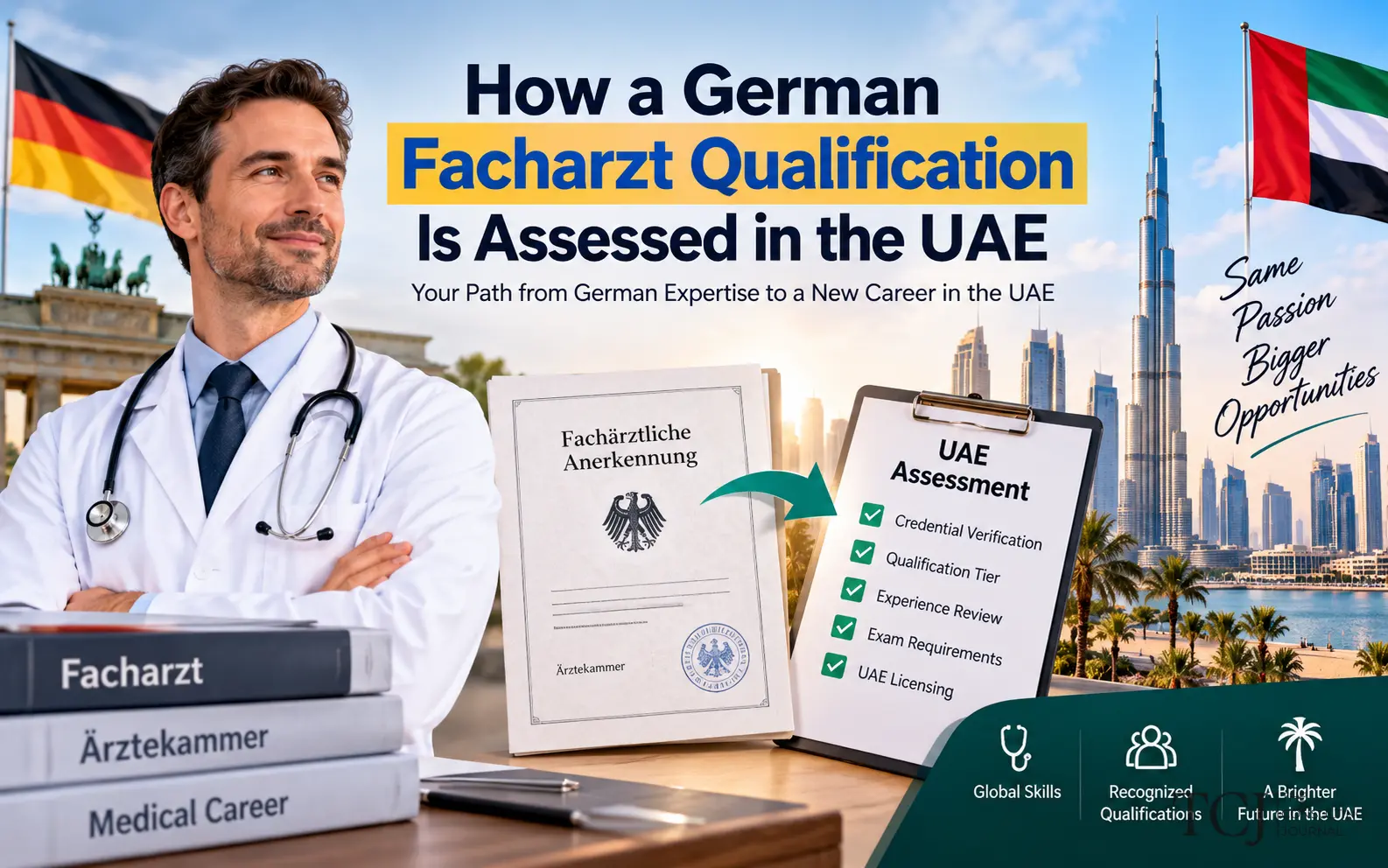
How German Facharzt Qualifications Are Assessed in the UAE
German Facharzt qualifications are recognised under the UAE healthcare licensing framework, but Oberarzt status, qualification tier, experience, verification and the professional title requested can materially affect the assessment.
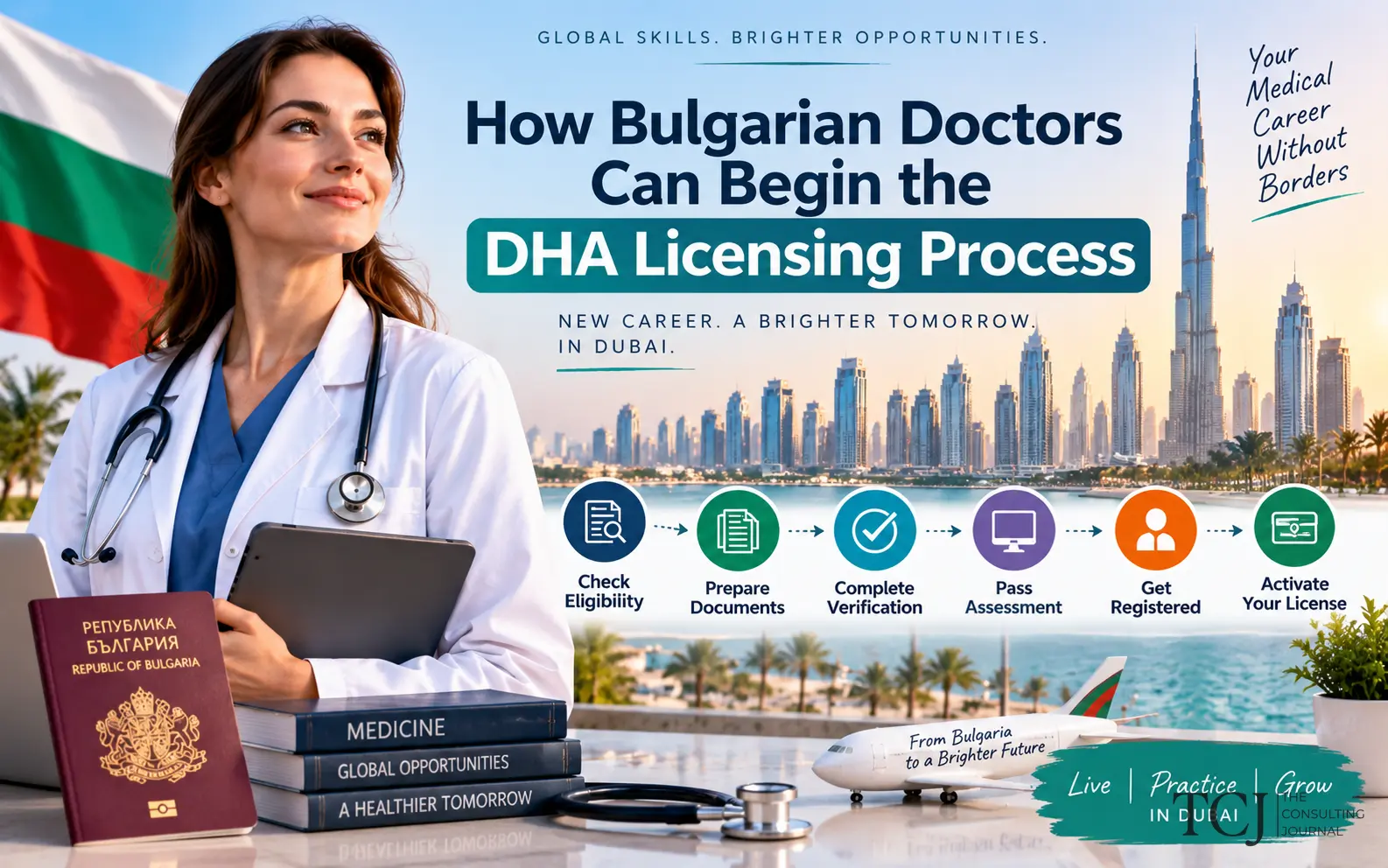
DHA Licensing for Bulgarian Doctors: Dubai Step-by-Step Guide
Bulgarian doctors considering a move to Dubai should understand the difference between DHA eligibility, DataFlow verification, assessment, registration and final professional license activation.
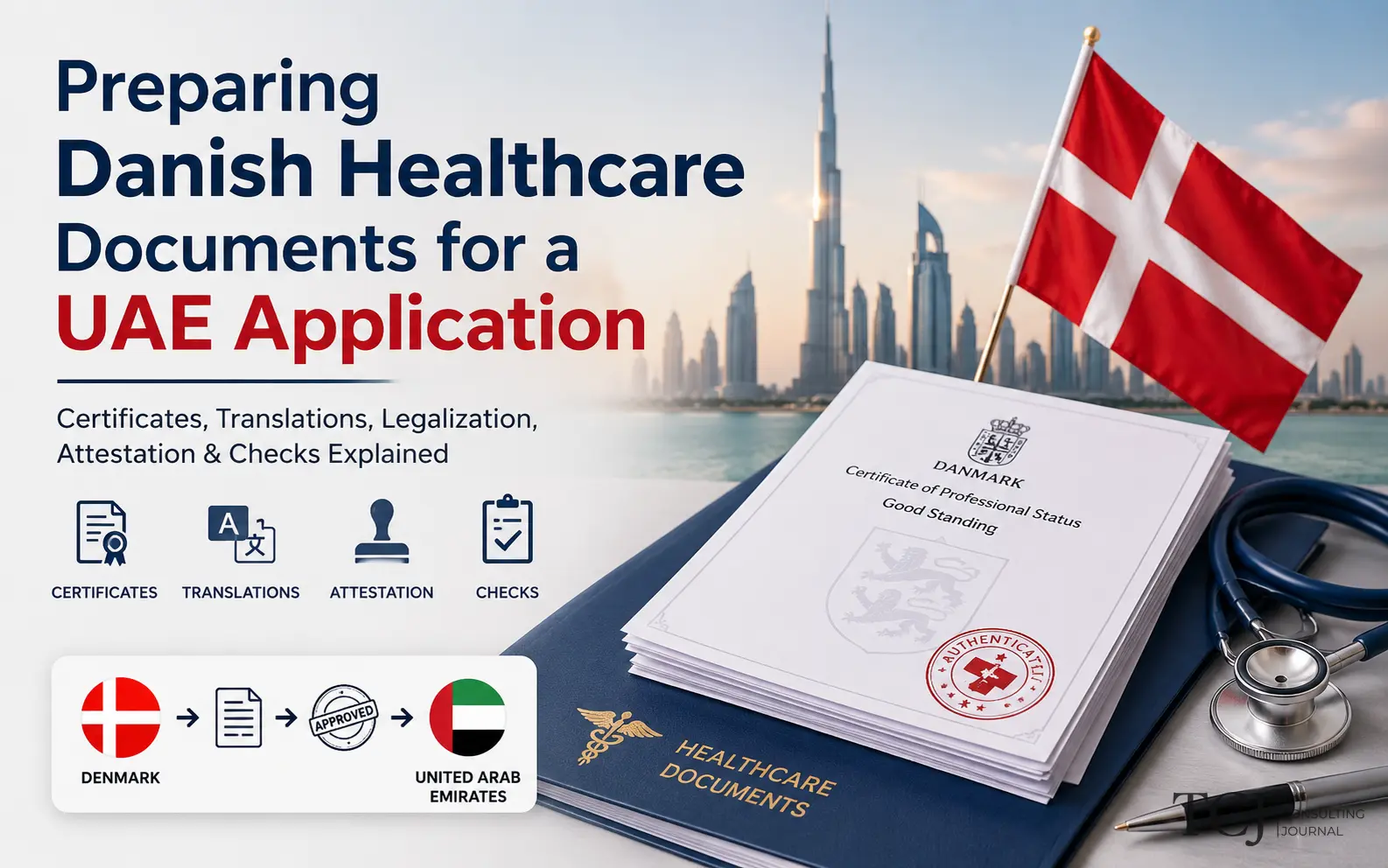
Preparing Danish Healthcare Documents for a UAE Application
Danish healthcare professionals applying in the UAE may need to coordinate qualifications, Good Standing records, translation, legalization, attestation, and authority-specific verification before submission.