DHA vs DOH vs MOHAP for Doctors: Practical UAE License Guide
A practical guide for international doctors comparing DHA, DOH and MOHAP licensing in the UAE, including regions, eligibility, DataFlow, exams, documents and common IMG mistakes.
DHA vs DOH vs MOHAP for Doctors: Why the Choice Matters
For international medical graduates, the first UAE licensing question is often simple on the surface: should I apply for DHA, DOH or MOHAP?
In practice, the answer depends on where the doctor wants to work, which healthcare facility is willing to sponsor or activate the license, and whether the doctor’s qualifications, experience and professional documents are ready for authority review. The uploaded article brief correctly frames the issue as a major decision point for IMGs before they spend money on exams, Primary Source Verification and applications.
The UAE has a unified qualification framework, but licensing is still managed through different healthcare regulators. The Department of Health Abu Dhabi explains that the Unified Healthcare Professionals Qualification Requirements are used by UAE health authorities, including MOHAP, DOH, DHA and Sharjah Health Authority, as a base for assessing applicants within each authority’s geographical jurisdiction.
That means a doctor should not choose a license only because a friend said one exam was easier or one pathway was cheaper. The better question is: where is the job market you are actually targeting?
Understanding the Three Main UAE Medical Licensing Authorities
DHA for Dubai
DHA licensing is for doctors who want to practise in Dubai. The Sheryan system is the digital gateway for healthcare professional and facility licensing in Dubai, and DHA states that Sheryan helps professionals get registered and licensed to practise in Dubai.
For many IMGs, Dubai is attractive because of its large private healthcare market, specialist clinics, hospital groups and international patient base. It can also be more competitive. A GP, specialist or consultant applying without strong documentation, a clear employer route, or realistic expectations may spend months moving between verification, exam booking and job search.
DHA’s registration service confirms that the professional meets the requirements for the applied category, title and specialty. The registration is valid for one year and must be activated into a license by a healthcare facility before the doctor can practise.
DOH for Abu Dhabi
DOH regulates healthcare professional licensing in Abu Dhabi emirate. This includes Abu Dhabi city, Al Ain and Al Dhafra. DOH lists professional services such as registering a new healthcare professional license, managing a healthcare professional license and requesting a professional status certificate through its eServices/TAMM route.
Doctors who are targeting large hospitals, government-linked providers, long-term institutional roles or Abu Dhabi-based healthcare groups usually start with DOH. Some candidates still use the old term “HAAD,” but the current authority is DOH.
A consultant observation: doctors often underestimate how different the Abu Dhabi hiring cycle can feel from Dubai. Dubai may have more visible private clinic openings, while Abu Dhabi roles can be more structured, employer-led and documentation-heavy.
MOHAP for the Northern Emirates
MOHAP is the federal pathway commonly associated with healthcare professional licensing outside Dubai and Abu Dhabi, especially for doctors targeting Sharjah, Ajman, Ras Al Khaimah, Fujairah and Umm Al Quwain.
MOHAP’s licensing service requires a valid medical professional evaluation, third-party document verification such as DataFlow, no professional practice gap of more than two years unless handled through PQR requirements, and acceptance of the work invitation by the medical professional.
MOHAP may suit doctors who are open to smaller markets, clinics outside Dubai and Abu Dhabi, or employers in the Northern Emirates. It should not be treated as a “shortcut.” It is still a regulated medical licensing process with document, evaluation and facility requirements.
The right medical license is usually the one aligned with the employer, emirate and specialty pathway — not the one that looks easiest on a comparison chart. — The Consulting Journal
The Geographic Difference Is the First Filter
The most practical way to compare DHA, DOH and MOHAP is by location.
DHA is the Dubai route. DOH is the Abu Dhabi route. MOHAP is generally the route for the Northern Emirates. The PQR framework may be unified, but applications are still reviewed through authority-specific systems and jurisdictional processes.
A doctor who wants to work in a Dubai clinic should not begin with DOH unless there is a clear transfer or future employment plan. A doctor with an Abu Dhabi hospital offer should not apply for DHA simply because a colleague already prepared for that exam. A doctor considering Sharjah or Ajman should check the MOHAP route early instead of treating it as a fallback.
This is where many IMGs lose time. They prepare for the authority they know best, not the authority linked to their target employer.
Eligibility: What Doctors Should Prepare Before Applying
Eligibility depends on the doctor’s professional title, specialty, qualification country, internship, experience, current license status and practice history. A GP, specialist dermatologist, consultant surgeon and dentist will not be assessed in the same way.
Most doctors should prepare these documents before starting:
- Passport copy
- Recent photograph
- Medical degree and transcripts where required
- Internship completion certificate
- Current or previous professional license
- Good standing certificate
- Experience certificates with exact dates and designation
- Specialist qualification, if applicable
- Logbook for surgical or procedural specialties, where required
- Updated CV
- Employer offer or facility invitation, where applicable
- DataFlow or Primary Source Verification documents
DHA’s process refers to Primary Source Verification, CBT assessment if required, registration review and activation by a hiring facility. MOHAP also requires document verification by an accepted third-party agency such as DataFlow and lists passport, introductory statement, malpractice insurance, experience certificate and other documents depending on the case.
DataFlow and Primary Source Verification
DataFlow is often the slowest part of the journey. Not because the process is unclear, but because universities, employers and licensing bodies may take time to respond.
In practice, delays usually come from simple document problems: inconsistent names, missing stamps, vague experience letters, incomplete employment dates, or certificates issued by departments that do not respond quickly to verification requests.
A doctor should check every document before submission. The name should match the passport or be supported by legal proof. Experience letters should state designation, specialty, employment dates, working hours where relevant, and facility details. Good standing certificates should usually be recent and issued by the correct licensing body.
The mistake is to treat DataFlow as an upload exercise. It is really a credibility check.
Exam Comparison: Do Not Choose Based on “Easy”
Doctors often ask which exam is easiest: DHA, DOH or MOHAP. That question can be misleading.
The better approach is to ask which exam is relevant to the employer and emirate. Licensing exams usually assess whether the doctor is safe and competent for the requested title. The question style, booking process and assessment route may differ, but the business decision should begin with the intended job market.
DHA confirms that applicants may need CBT assessment through Prometric depending on the professional position, and may also need oral assessment depending on the case. MOHAP requires a valid medical professional evaluation before licensing.
For a serious IMG, preparation should include clinical revision, authority-specific exam references, document readiness and an employer search strategy.
Cost and Timeline Considerations
Costs vary depending on the authority, professional category, exam, PSV requirements, translation, attestation, renewal, facility activation and whether the doctor needs reassessment or additional documentation.
MOHAP publishes licensing service fees that include AED 100 application fees for all medical professionals in private and semi-government facilities and AED 3,000 license fees for doctors in private facilities. DHA states that its “Get Registered” service has an average processing time of five working days, although that does not include every external step such as PSV response time, exam booking or employer activation. MOHAP states that licensing applications are typically processed within one to two working days depending on license type and completion of requirements.
These timelines should be read carefully. A portal processing time is not the same as the full relocation timeline. A doctor may still need document correction, exam scheduling, employer onboarding, malpractice insurance, visa processing and license activation.
Example 1:
A general practitioner from India wants to move to Dubai and has already spoken to two Dubai-based clinics. In this case, DHA is usually the logical first route because the target employers are DHA-licensed facilities. The doctor should focus on Sheryan registration, DataFlow readiness, CBT preparation if required, and clinic-led activation after approval.
The risk would be applying for another authority first without a transfer plan, then discovering that the Dubai employer still needs the DHA pathway completed.
Example 2:
A specialist physician has an offer discussion with a hospital group in Al Ain. The doctor is also comparing Dubai salaries online, but the real opportunity is in Abu Dhabi emirate. In this case, DOH should be assessed first because the employer location, facility system and licensing activation are linked to Abu Dhabi.
This is a common consulting point: the best license is not always the license with the most online search volume. It is the one attached to the employer that can actually hire and activate the doctor.
Common Mistakes Business Owners and IMGs Make
Healthcare employers and doctors both make avoidable mistakes during licensing.
- Choosing the license before choosing the target emirate
- Assuming DHA, DOH and MOHAP approvals are automatically interchangeable
- Submitting vague experience letters
- Ignoring name mismatches across documents
- Starting DataFlow without checking whether documents are complete
- Depending on old HAAD, DHA or MOHAP advice from social media
- Comparing costs without including exam, PSV, attestation and activation steps
- Assuming registration means the doctor can immediately practise
- Waiting until after a job offer to discover a practice gap issue
- Applying under the wrong title or specialty category
For employers, the biggest mistake is promising a start date before the licensing file has been properly reviewed. For doctors, the biggest mistake is spending money before confirming the correct jurisdiction.
Practical Checklist Before Choosing DHA, DOH or MOHAP
Before applying, doctors should answer these questions:
- Which emirate do I genuinely want to work in?
- Do I already have an employer discussion in Dubai, Abu Dhabi or the Northern Emirates?
- Is my professional title clear under PQR?
- Are my experience certificates detailed and verifiable?
- Is my good standing certificate recent and from the correct authority?
- Are my degree, internship and specialist documents consistent?
- Do I need CBT, oral assessment or professional evaluation?
- Is there any practice gap that must be explained?
- Can the hiring facility activate the registration or license?
- Have I checked the latest regulator requirements before payment?
Documents and Preparation Checklist
A clean licensing file usually includes:
- Passport and photograph
- Degree and internship certificate
- Specialist qualification, where applicable
- Current medical license
- Good standing certificate
- Experience certificates
- DataFlow/PSV documents
- CV
- Logbook, where required
- Malpractice insurance, where required
- Facility invitation or employment-related documents
- Attested or translated documents, where required
MOHAP specifically lists required documents including passport, introductory statement, malpractice insurance, physical and mental report for doctors aged 60 and above, and experience certificate for its licensing service.
A Note on the UAE’s National Licensing Platform
The UAE healthcare licensing environment is moving toward greater standardisation. MOHAP announced a National Licensing Platform in February 2025 aimed at standardising health professional licensing, streamlining procedures and supporting a standard professional practice license valid across the UAE.
Doctors and employers should still check the relevant authority process before applying. During regulatory transitions, practical implementation, facility requirements and portal workflows may not feel identical for every case.
How KPM Global Services UAE Can Assist
KPM Global Services UAE can support doctors, healthcare entrepreneurs and clinic operators by reviewing licensing readiness before applications are submitted. This may include document gap checks, jurisdiction planning, business setup alignment, facility licensing coordination, accounting readiness for healthcare businesses, and practical compliance support.
For clinic owners and healthcare investors, the licensing of doctors should be planned alongside trade licensing, facility approvals, medical equipment planning, staffing ratios, payroll, VAT registration where applicable, accounting records and banking documentation. A healthcare business can face delays when professional licensing and business licensing are handled separately.
KPM Global Services UAE does not promise guaranteed approval. The value is in reducing avoidable errors, preparing cleaner submissions and helping decision-makers understand the commercial impact of licensing choices.
This article is for informational purposes and does not constitute legal, tax, accounting, or financial advice.
Final Advisory Note
DHA, DOH and MOHAP are not three versions of the same application. They represent different licensing routes connected to different markets inside the UAE.
For doctors, the best starting point is not the cheapest exam or the fastest story from another IMG. It is the target employer, target emirate, correct professional title and document readiness. For healthcare businesses, the licensing pathway should be mapped before hiring promises are made.
A careful decision at the beginning can save months of correction later.
Questions and answers
Which license is best for doctors in the UAE: DHA, DOH or MOHAP?
The best license depends on where the doctor wants to work. DHA is for Dubai, DOH is for Abu Dhabi emirate, and MOHAP is generally used for the Northern Emirates. Doctors should choose based on employer location, not only exam preference.
Can I work in Dubai with a DOH or MOHAP license?
Usually, a doctor needs the correct authority approval for the emirate and facility where they will practise. Transfers or conversions may be possible depending on current rules, title, experience and regulator process, but they should not be assumed.
Is DataFlow required for DHA, DOH and MOHAP?
Primary Source Verification is a major part of UAE healthcare licensing. DHA refers to PSV through DataFlow in its registration process, and MOHAP requires document verification by an accepted third-party agency such as DataFlow. Requirements should be checked for the exact professional category.
Does DHA registration mean I can immediately start working as a doctor?
Not by itself. DHA states that registration confirms eligibility and becomes part of the Dubai Medical Registry, but a healthcare facility must activate it into a license before the professional starts practising.
Should an IMG apply before getting a UAE job offer?
It depends on the strategy. Some doctors start eligibility and verification before securing an offer, while others wait for employer direction. The safest approach is to confirm the target emirate, professional title and document readiness before paying application or exam fees.
More in Medical Career
View all Medical Career →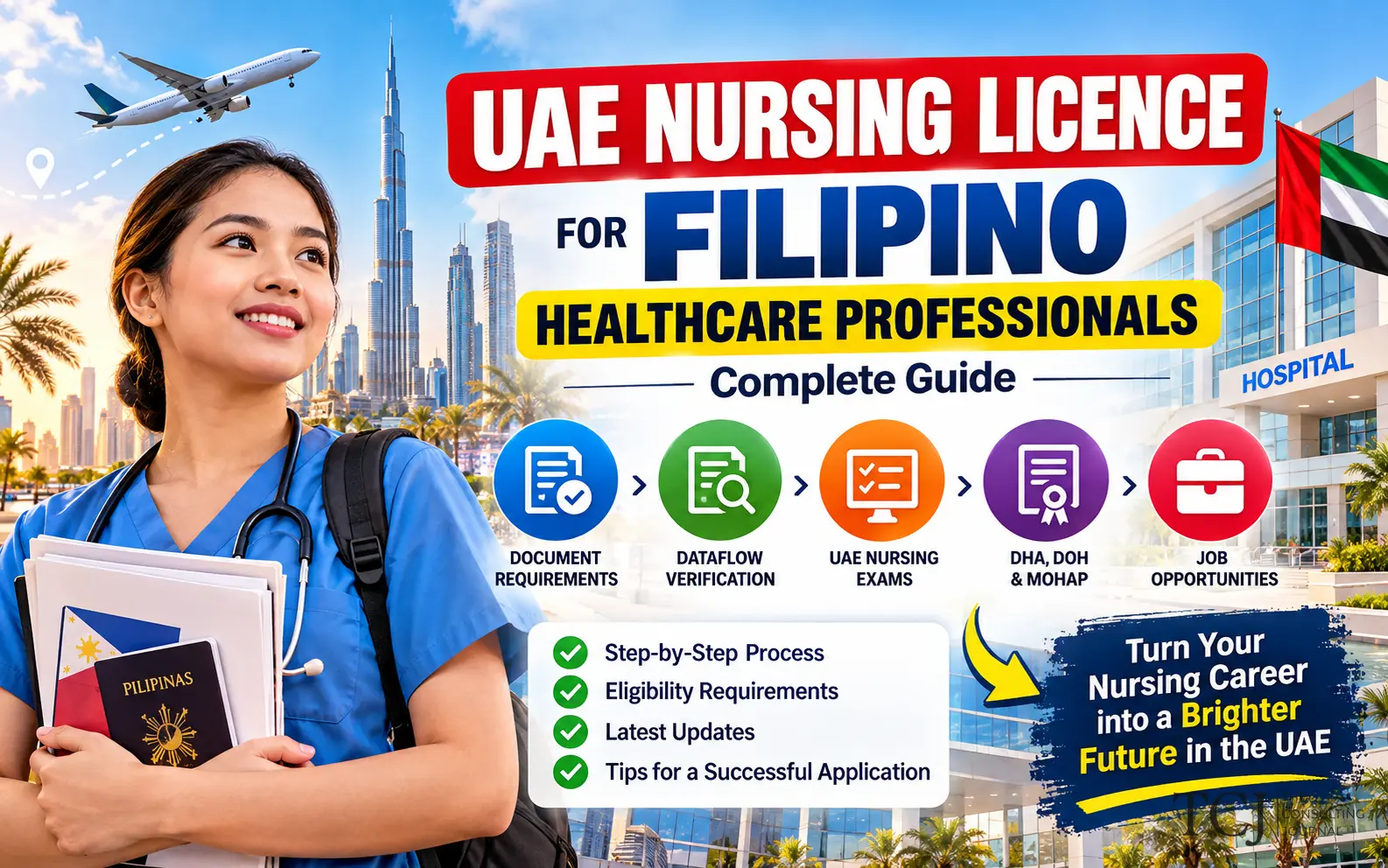
UAE Nursing Licence for Filipino Healthcare Professionals: Requirements and Application Process
Planning to work as a nurse in the UAE? Learn how Filipino healthcare professionals can navigate DHA, DOH and MOHAP licensing, DataFlow verification, nursing assessments, documents and employer licence activation.
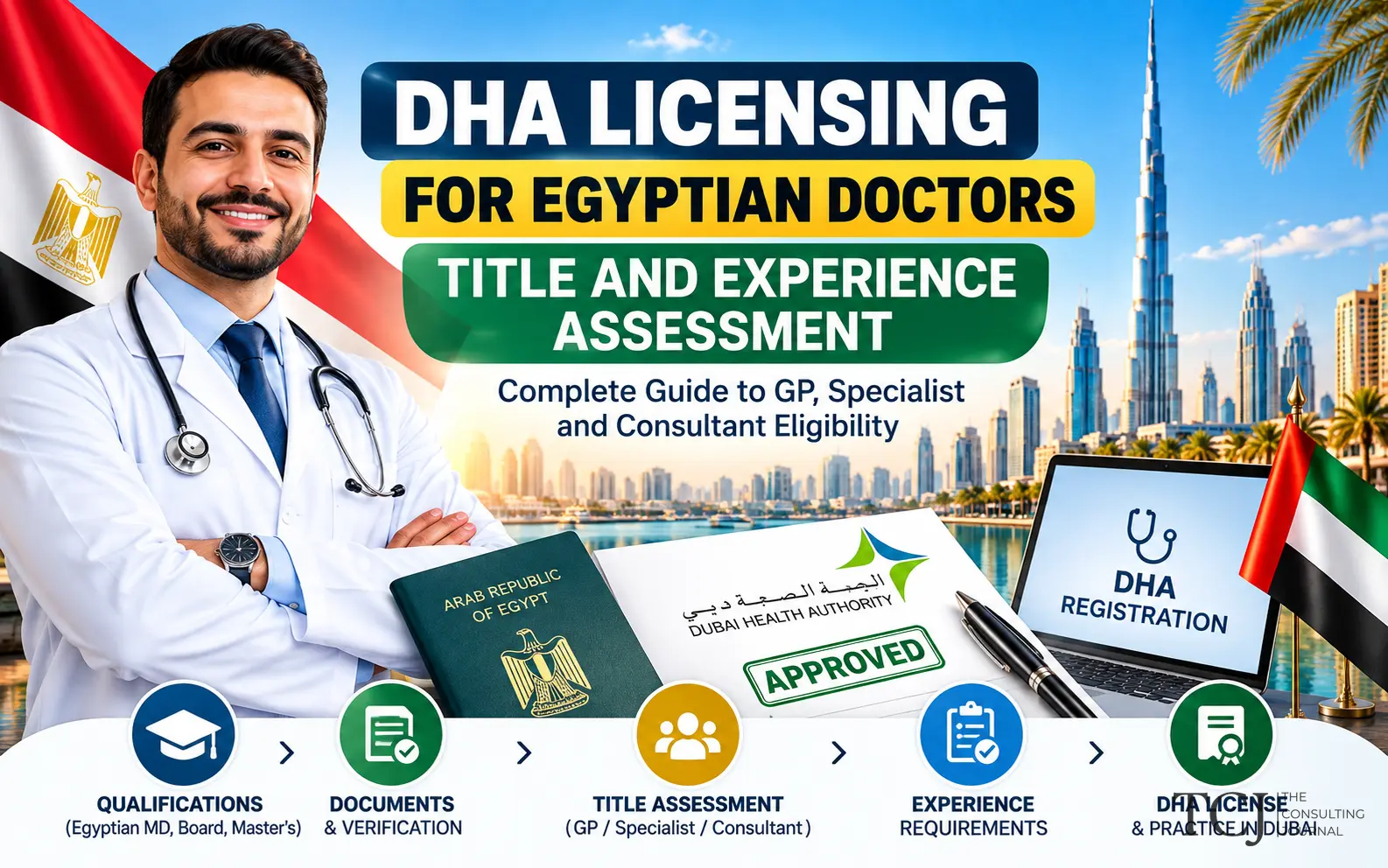
DHA Licensing for Egyptian Doctors: Titles, Tiers and Experience
Egyptian doctors applying for DHA licensing in Dubai need to understand how their MD, Egyptian Board Fellowship, Clinical Master’s and post-qualification experience affect eligibility for GP, Specialist and Consultant titles.

DHA Licence for Nurses in Dubai: Eligibility, DataFlow, Exam and Application Process
A practical 2026 guide to DHA licensing for nurses in Dubai, covering Registered Nurse and Assistant Nurse eligibility, DataFlow verification, assessments, registration, documents and employer-led licence activation.