What Is the Real Cost of Renting an Apartment in Dubai?
Renting in Dubai costs more than the annual rent. Tenants should budget for deposits, Ejari, DEWA, agency fees, housing fees, cooling, internet, and renewal rules.
Key takeaways
- Annual rent is only the starting point; deposits, DEWA, Ejari, housing fee, cooling, internet, and moving costs complete the budget.
- Community choice can change the real cost more than apartment size alone.
- Tenants should verify chiller terms, maintenance duties, payment schedule, and landlord documents before paying.
- Dubai rental increases should be checked against the Dubai Land Department Rental Index and applicable rules.
- Business owners should treat relocation housing as part of Financial and Accounting planning, not as a personal afterthought.
What is the real cost of renting an apartment in Dubai?
Most tenants should budget for annual rent, a 5–10% security deposit, broker commission if an agency is used, Ejari registration, DEWA connection deposit, Dubai Municipality housing fee, internet, moving costs, and possible chiller fees. A cheaper apartment can still become expensive if cooling, commuting, and payment terms are weak.
Dubai rent is usually discussed as one annual number, but the cash flow picture is wider. Many landlords still prefer one to four cheques, although more listings now offer flexible payment terms. For a tenant, the key question is not only “Can I afford the rent?” It is “Can I afford the first 30 days and the monthly running cost after move-in?”
Published 2026 market data shows wide differences between communities. Engel & Völkers, citing Property Monitor data, reported Dubai-wide average annual apartment rents of about AED 41,173 for studios, AED 61,984 for one-bedrooms, AED 85,727 for two-bedrooms, and AED 150,990 for three-bedrooms as of May 2026 year-to-date. Premium communities can sit far above these citywide averages.
How much should tenants budget by apartment type?
A practical budget should start with the apartment size and then adjust for the community, building quality, furnishing, view, parking, metro access, and cooling arrangement. Listing averages are useful, but tenants should always compare recent listings and check the Dubai Land Department Rental Index before renewal discussions.
Apartment typePractical 2026 annual rent rangeNotesStudioAED 40,000–85,000+Lower in outer communities; higher in Marina, Downtown, and branded towers1-bedroomAED 60,000–140,000+JVC and Dubai Sports City can be more accessible; Downtown and DIFC are premium2-bedroomAED 90,000–190,000+Family demand, parking, schools, and commute matter3-bedroomAED 140,000–285,000+Pricing changes sharply by view, tower, and location
Dubai Marina, Business Bay, Downtown Dubai, and JVC remain common search areas for professionals and families. For example, 2026 data showed average annual rents of around AED 97,434 for a one-bedroom in Dubai Marina, AED 94,206 in Business Bay, AED 120,285 in Downtown Dubai, and AED 71,356 in JVC.
Which Dubai areas suit different rental budgets?
Budget-friendly tenants typically compare International City, Al Nahda, Dubai Silicon Oasis, Dubai Sports City, and parts of JVC. These areas may offer better space for the rent, but commute time and building age should be reviewed carefully.
Mid-range tenants often consider JVC, JLT, Arjan, Dubai Hills fringe areas, Business Bay, and Dubai Creek Harbour depending on office location and lifestyle. These communities can offer a balance between access, amenities, and apartment quality.
Luxury-focused tenants usually compare Downtown Dubai, Dubai Marina, Palm Jumeirah, DIFC, Dubai Hills Estate, and high-end waterfront projects. The rent is only one part of the premium. Service quality, parking, views, lifts, and traffic patterns all affect the real value.
A rent that looks attractive on the listing page can become expensive after cooling charges, cheque pressure, commute time, and weak handover documentation are added. — KPM Global Services UAE consultant observation
What hidden costs should tenants expect beyond rent?
The most common upfront costs are the security deposit, agency commission, Ejari, DEWA deposit, moving charges, and initial furnishing needs. The most common monthly costs are electricity, water, municipality housing fee, internet, cooling, parking add-ons, and small maintenance items.
Security deposits are commonly 5% of annual rent for unfurnished apartments and 10% for furnished apartments. Broker commission is often around 5% of annual rent where an agent is involved. These are market practices, so tenants should confirm the exact amount in writing before paying.
DEWA states that the electricity and water security deposit is AED 2,000 for a flat and AED 4,000 for a villa. DEWA also lists supply activation fees of AED 155 through its payment channels.
Dubai Municipality housing fee is another regular cost that many new residents miss. It is generally calculated at 5% of the annual rent and charged monthly through the DEWA bill for expatriate tenants.
Ejari registration should also be budgeted. Current public guidance based on Dubai Land Department fees commonly places online Ejari registration around AED 177.75 and trustee-centre registration around AED 220, although tenants should verify the final charge at the time of registration.
Furnished or unfurnished: which gives better value?
Furnished apartments are convenient, but the rent and deposit are usually higher. They can work well for new arrivals, consultants on short assignments, founders testing Dubai before a long-term move, or employees waiting for family relocation.
Unfurnished apartments usually offer better value for tenants staying more than one year. The initial furniture spend can be high, but the tenant controls quality and avoids paying a rent premium for furniture that may not fit their needs.
The practical comparison is not only monthly rent. Tenants should compare:
- Higher rent versus furniture purchase cost.
- Deposit amount and handover risk.
- Appliance warranty and maintenance responsibility.
- Length of stay.
- Whether the landlord’s inventory list is detailed and signed.
Example 1: A founder moving from Abu Dhabi to Dubai compares a furnished one-bedroom in Business Bay with an unfurnished apartment in JVC. Business Bay saves commute time and setup effort, but the JVC option leaves more monthly cash for payroll and marketing. For a new company, the better choice depends on cash flow, not only lifestyle.
What legal and compliance points should tenants check?
Tenants should check the tenancy contract, Ejari registration, payment schedule, maintenance terms, notice clauses, and renewal position before signing. Dubai’s rental framework is structured, but protection depends on proper documentation and registration.
Dubai Land Department provides a Rental Index service that allows users to calculate rental increases and average market rent by entering details such as contract expiry date, property type, area, rooms, and current annual rent.
Dubai Decree No. 43 of 2013 sets maximum rental increases on renewal based on how far the current rent is below the average market rent. The decree provides bands of no increase, 5%, 10%, 15%, and 20%, and applies across Dubai, including special development areas and free zones such as DIFC.
This matters because a landlord’s requested increase is not automatically valid just because market rents have risen. Tenants should check the Rental Index, keep communication in writing, and avoid verbal renewal agreements.
Common mistakes tenants and business owners make
The first mistake is budgeting only for annual rent. A tenant who signs a lease at the edge of affordability may struggle once DEWA, housing fee, internet, cooling, parking, and moving costs appear.
The second mistake is ignoring chiller charges. Some buildings include cooling in the rent, while others bill cooling separately. The difference can materially change the monthly cost, especially during summer.
The third mistake is paying deposits before verifying the landlord, agent, title documents, and payment instructions. Tenants should be careful with unusually cheap listings and rushed payment requests.
The fourth mistake is accepting vague maintenance wording. Contracts should make clear who handles air conditioning, appliances, plumbing, leaks, and major repairs.
The fifth mistake is failing to review payment terms. A lower annual rent with one cheque may be harder on cash flow than a slightly higher rent spread across four or twelve payments.
Example 2: A finance manager relocating with family chooses a two-bedroom in Al Nahda instead of Downtown Dubai. The apartment is less central, but the family gets more space and lower annual rent. The saving supports school fees and emergency cash reserves, which is often better Financial planning than choosing the most prestigious address.
Documents and preparation checklist before signing
Prepare these items before committing to an apartment:
- Passport copy and UAE residence visa, where applicable.
- Emirates ID or Emirates ID application details.
- Salary certificate or employment contract if requested.
- Trade licence details if the lease is linked to business relocation planning.
- Cheque book or agreed digital payment method.
- Tenancy contract draft.
- Landlord title deed or ownership proof.
- Broker RERA card and agency details.
- Ejari registration plan.
- DEWA premise number.
- Signed inventory list for furnished units.
- Move-in permit requirements for the building.
- Written confirmation on chiller, parking, maintenance, and pets.
For business owners, rental decisions can also affect Accounting records, employee relocation allowances, cash flow forecasts, and Tax documentation. Keep lease payments, deposits, utility bills, and reimbursements properly recorded.
How KPM Global Services UAE can assist
KPM Global Services UAE can support founders, SMEs, investors, and finance teams with relocation budgeting, cash flow planning, Accounting setup, expense classification, and documentation controls linked to Dubai operations.
For companies relocating staff or opening in the UAE, housing costs should not sit outside the budget. They can affect salary structuring, payroll planning, corporate accommodation policies, and monthly Financial reporting. KPM Global Services UAE can help businesses create a practical cost model before commitments are made.
Final advisory note
Renting an apartment in Dubai can be straightforward when the tenant checks the full cost before signing. The best apartment is not always the cheapest listing or the most premium tower. It is the unit that fits the tenant’s commute, lifestyle, documentation, cash flow, and renewal position.
This article is for informational purposes and does not constitute legal, tax, accounting, or financial advice.
Questions and answers
How much does it cost to rent an apartment in Dubai in 2026?
The cost depends on size, location, furnishing, and building quality. As a practical guide, studios can range from about AED 40,000 to AED 85,000+ annually, while one-bedrooms often range from AED 60,000 to AED 140,000+. Premium areas such as Downtown Dubai, DIFC, Palm Jumeirah, and Dubai Marina usually sit higher.
What extra costs should I budget for before renting in Dubai?
Budget for the security deposit, agency commission, Ejari, DEWA deposit, activation charges, moving costs, internet, and possible chiller fees. Tenants should also remember the Dubai Municipality housing fee, which is generally charged monthly through the DEWA bill.
Is Ejari mandatory when renting an apartment in Dubai?
Yes, Ejari registration is a key part of formalising a Dubai tenancy contract. It is typically needed for utility connections, official address records, and rental dispute protection. Tenants should not treat Ejari as optional.
Can my landlord increase rent when I renew?
A landlord may request an increase only within Dubai’s rental increase framework. Tenants should check the Dubai Land Department Rental Index and compare the requested increase with the permitted range before agreeing.
Is a furnished apartment better than an unfurnished apartment in Dubai?
Furnished apartments are better for convenience and short stays. Unfurnished apartments usually offer better long-term value if you plan to stay more than one year. The right choice depends on deposit, rent premium, furniture cost, and how long you expect to remain in Dubai.
More in Real Estate
View all Real Estate →
Off-Plan Property Due Diligence in Dubai: 12 Checks Before Paying a Deposit
Buying off-plan property in Dubai requires more than reviewing a brochure. Check the developer, DLD project status, escrow account, SPA, unit details, payment plan, registration and exit conditions before transferring a deposit.

How to Start a Holiday Home Business in Dubai: DET Guide
Starting a holiday home business in Dubai requires the right owner or operator structure, DET registration, individual unit permits, guest compliance, Tourism Dirham administration, and annual renewals.
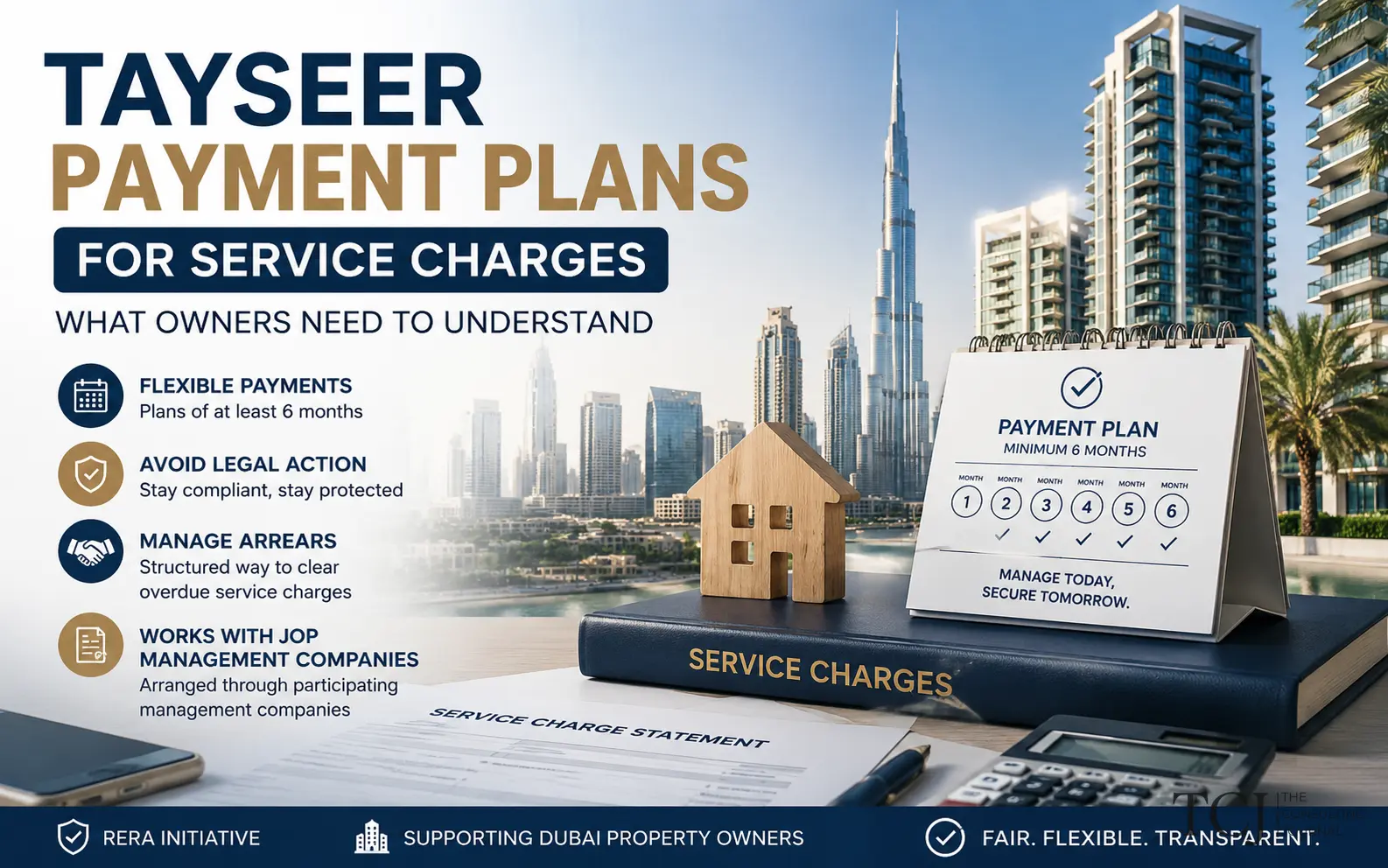
Tayseer Payment Plans for Service Charges in Dubai
Dubai property owners with overdue service charges may be able to use Tayseer payment plans. Here is what owners should verify about instalments, enforcement, ongoing charges, and property sales.