UAE Open Finance in 2026: What Businesses Should Prepare For
UAE Open Finance is moving from policy to practical implementation. This guide explains what connected banking means for payments, lending, Accounting data, cash flow and business readiness.
Key takeaways
- UAE Open Finance operates through regulated, consent-based access to Financial data and transaction services.
- The current CBUAE framework is in force and is being implemented in phases.
- Open Finance may improve payment workflows, reconciliation, cash-flow visibility and access to tailored Financial services.
- Connected banking does not replace Accounting accuracy, cybersecurity or internal approval controls.
- Businesses should begin with data cleanup, access mapping, provider checks and a limited pilot.
- Financing, licensing and provider outcomes are never guaranteed.
What is UAE Open Finance?
UAE Open Finance is a regulated system that allows customers to use approved third-party providers to access consented Financial data or initiate transactions. It extends financial connectivity beyond a single bank interface and may support services involving banking, payments, credit and insurance as the framework develops in phases.
The CBUAE describes Open Finance as a secure way for financial institutions to open their systems to accredited third-party providers. Its stated vision is to encourage consent-driven, data-rich and customer-focused Financial services while giving customers greater clarity and control over how they manage their finances.
The framework includes a trust structure, an application programming interface hub and shared infrastructure services. In practical terms, these components are intended to create common technical and security arrangements rather than requiring every provider to build a separate connection with every participating institution.
For a UAE company, the intended result could be a more connected Financial environment. A business may eventually be able to view information from participating institutions within one authorised application, approve a payment through an integrated platform or share verified Financial records with a provider assessing a service request.
How does Open Finance differ from Open Banking?
Open Banking usually focuses on bank-account information and payment initiation. Open Finance applies the same consent-based principle across a wider Financial ecosystem. Depending on the implementation phase and products brought into scope, this may include credit, insurance and other regulated Financial services.
The UAE model commenced with Open Banking and was designed to extend to Open Insurance in phases. The initial implementation announcement also described a consolidated trust framework and centralised API hub intended to connect approved third parties securely with banking and insurance markets.
The difference matters because businesses rarely manage only a current account. A mainland trading company may have several bank accounts, credit facilities, merchant settlements and insurance arrangements. A Dubai free zone consultancy may also use cloud Accounting, payroll and expense-management applications. Open Finance could allow selected services to interact more effectively, subject to the provider’s approval, regulatory scope and the company’s consent.
Why is 2026 an important year for connected banking in the UAE?
The key change in 2026 is that businesses can assess Open Finance against active regulatory and infrastructure developments rather than treating it as a distant concept. The CBUAE reported progress in expanding the scope of Al Tareq services in April 2026, while the current regulation applies through phases notified by the regulator.
The Open Finance Regulation currently listed by the CBUAE was issued on 10 July 2025 and is marked as in force. It establishes requirements covering licensing, data sharing, service initiation, authentication, secure communication, user obligations, liability, privacy and consent. Its application is phased according to CBUAE notifications.
Participation is mandatory for regulated licensees in relation to products and services brought within scope. However, onboarding is phased. The first phase identified in the framework includes banks, foreign bank branches and insurance companies, with later phases to be announced through official channels.
This distinction is important for planning. A business should not assume that every account, institution or financial product is already available through every Open Finance application. Actual functionality will depend on regulatory phasing, participating institutions, product coverage and the approved services offered by each provider.
Open Finance readiness is less about purchasing another dashboard and more about making Financial data accurate, controlled and usable across connected systems. — Consultant observation, KPM Global Services UAE
What changes could businesses experience?
The most practical effects are likely to appear in routine Financial processes. Benefits will not be identical for every organisation, but companies with multiple accounts, frequent transactions or fragmented systems may find the strongest use cases.
Could business payments become easier to manage?
Open Finance can allow an approved service provider to initiate a transaction when the user gives explicit consent and instructions. The regulation requires secure communication and states that a service owner should treat the instruction in the same way as one received directly from the user.
For finance teams, this could reduce repeated movement between bank portals and operational software. Potential applications include:
- Initiating approved supplier payments from an Accounting or treasury platform
- Receiving transaction-status information within a connected workflow
- Matching bank transactions with invoices more efficiently
- Monitoring balances across participating institutions
- Reducing manual data entry during bank reconciliation
These improvements still require proper controls. Businesses should retain approval limits, segregation of duties and independent review of beneficiary details. A faster payment process should not weaken internal authorisation.
Could Open Finance improve access to business lending?
Open Finance may allow a business to share verified, consented Financial information with an approved provider. This could give a lender or finance platform more current information when assessing cash flow, account conduct or an application, subject to its credit policy and regulatory permissions.
It should not be interpreted as a guarantee of funding or faster approval. Banks and finance providers will continue to apply eligibility criteria, know-your-customer checks, financial-crime controls and risk assessments. Good bookkeeping will remain essential because connected data exposes inconsistencies as readily as it demonstrates strong performance.
Example 1:
A fictional Dubai mainland wholesaler maintains accounts with two banks and applies periodically for working capital. Its management accounts show stable sales, but unreconciled transfers create differences between the Accounting ledger and bank balances. Before consenting to data sharing, the company resolves old reconciling items and standardises customer receipt references. The stronger process improves the quality of information available for any future assessment, although it does not guarantee finance approval.
Could finance teams obtain a clearer cash-flow view?
A consolidated view of consented data could help finance teams monitor balances, incoming receipts, debt obligations and payment timing. This may be useful for SMEs that currently prepare cash-flow reports using manual spreadsheet exports from several banks.
The main value is not simply seeing more data. It is being able to use reliable data in budgeting and decision-making. A connected dashboard will not correct duplicate entries, missing invoices or outdated forecasts. The Accounting records, bank feeds and reporting structure must first be aligned.
Where could embedded finance appear?
Embedded finance places a regulated Financial service inside a non-financial business platform. An e-commerce merchant might access a payment or financing feature through its commerce software. A procurement platform might incorporate supplier-payment functionality. An Accounting application could support transaction initiation through an authorised Open Finance provider.
The CBUAE’s implementation announcement expressly identified customer-centred and embedded Financial services as intended areas of innovation. Any business considering such a service should still verify which entity is regulated, what activity it is authorised to perform and how customer consent is managed.
Which UAE businesses may see the clearest benefits?
Businesses with fragmented Financial processes are likely to find the most immediate use cases. This includes SMEs with several bank relationships, retailers processing large transaction volumes and organisations that rely on manual reconciliation.
Potential beneficiaries include:
- Retail and e-commerce businesses: Better settlement visibility, payment reconciliation and integration with merchant systems
- Trading and logistics companies: Stronger oversight of supplier payments, working capital and cross-border documentation
- Professional service firms: Clearer tracking of customer receipts, expenses and short-term cash requirements
- Property businesses: Improved monitoring of rent collections, operating payments and financing obligations
- Healthcare operators: Better integration between billing, payments and insurance-related workflows where permitted
- Fintech and software companies: Opportunities to build authorised services around data sharing or transaction initiation
Project Aperta, completed by the CBUAE and international partners in June 2026, also tested cross-border data portability and trade-finance lifecycle management. The prototype demonstrated how verified business information could support onboarding and structured trade processes while preserving domestic regulatory oversight. These remain tested use cases rather than a promise that every UAE business can access them immediately.
Example 2:
A fictional Abu Dhabi logistics SME receives customer payments through one bank and pays overseas suppliers through another. Its CFO currently combines bank exports manually each week. The company evaluates a regulated connected-banking tool but first documents user-access rights, payment approval levels and procedures for withdrawing consent. The result is a controlled pilot rather than a rushed company-wide implementation.
What risks should businesses prepare for?
Open Finance introduces convenience, but it also increases the importance of data governance and system control. Connecting more services can widen the operational impact of incorrect permissions, weak user access or poor-quality data.
Consent must be specific and controlled
The current regulation requires Data Sharing and Service Initiation to operate according to the user’s explicit consent and instructions. Providers must communicate securely and should not use information for purposes beyond the service requested, except where required by applicable UAE law.
A business should therefore know:
- Who may grant or withdraw consent
- Which accounts and data categories are covered
- How long the consent remains valid
- Which employees can initiate transactions
- How access is reviewed when an employee changes roles or leaves
- How the provider records and communicates changes
Cybersecurity remains a management responsibility
A regulated connection does not remove the business’s responsibility to protect credentials, devices and internal access. Finance teams should use strong authentication, monitor unusual activity and maintain escalation procedures for suspected fraud or data exposure.
The CBUAE regulation requires secure communication and protects personalised credentials such as PINs and passwords from access by unauthorised parties. Businesses should treat these requirements as a baseline, not a replacement for their own cybersecurity controls.
Connected data can expose weak Accounting records
Poor bank reconciliation, duplicate supplier records and inconsistent invoice references can reduce the usefulness of connected Financial information. Businesses should also ensure that VAT records, Corporate Tax support, management accounts and bank transactions remain consistent. Open Finance does not replace Tax or Accounting compliance.
What common mistakes do business owners make?
The most frequent mistakes arise when a business treats Open Finance as a technology purchase rather than a controlled Financial change.
- Connecting systems before completing bank reconciliations
- Giving one employee excessive authority over access and payments
- Accepting provider terms without checking the regulated entity
- Assuming consent cannot be changed or withdrawn
- Failing to map which data will be shared
- Overlooking cybersecurity and incident-response procedures
- Expecting connected banking to guarantee credit approval
- Retaining outdated user access after staff changes
- Ignoring the effect on existing Accounting and ERP integrations
- Assuming automation removes the need for supporting documents
What should be included in an Open Finance readiness checklist?
A practical review should cover data, systems, controls and provider due diligence before any connection is activated.
- Current bank-account list and authorised signatories
- Latest completed bank reconciliations
- Accounting system and ERP integration map
- User-access and payment-approval matrix
- Cash-flow forecast and management-reporting process
- Customer and supplier master-data review
- Cybersecurity and incident-response procedures
- Consent-granting and consent-withdrawal workflow
- Data-retention and privacy policies
- Provider licence and regulatory-status checks
- Service agreement, fee schedule and termination terms
- VAT and Corporate Tax record-alignment review
- Pilot scope, testing plan and responsible project owner
Businesses should also retain evidence of implementation decisions. Open Finance providers are themselves subject to record-keeping requirements, including records relating to user consent, with specified records generally retained for at least five years unless another requirement applies.
How can KPM Global Services UAE assist?
KPM Global Services UAE can help businesses assess whether their Financial and Accounting processes are ready for connected banking. The work should begin with the operating model rather than a software recommendation.
Support may include:
- Reviewing bank reconciliation and cash-flow processes
- Assessing Accounting data quality and reporting gaps
- Mapping payment approvals and user-access controls
- Preparing Financial documentation for provider discussions
- Reviewing the operational impact of banking or ERP integrations
- Supporting management with readiness checklists and implementation planning
- Identifying where VAT, Corporate Tax and Accounting records require alignment
- Coordinating with relevant legal, technology or regulated Financial specialists where separate advice is needed
The objective is to help management make an informed decision, maintain appropriate controls and avoid connecting unreliable data to a new platform. Provider approval, lending decisions and regulatory outcomes remain subject to the responsible institutions and authorities.
What should UAE businesses do next?
Businesses should monitor CBUAE announcements, speak with their banking and software providers, and identify one controlled use case rather than attempting a wide implementation immediately. A pilot involving balance visibility or reconciliation may be more manageable than enabling payment initiation at the outset.
Open Finance is likely to become a practical part of UAE Financial infrastructure, but readiness will vary. Companies with reliable Accounting records, documented approvals and clear data ownership will be better placed to evaluate the services becoming available through Al Tareq and participating providers.
This article is for informational purposes and does not constitute legal, tax, accounting, or financial advice.
Questions and answers
Q: Is UAE Open Finance already active in 2026?
A: Yes, the UAE has an in-force Open Finance Regulation, and the CBUAE reported continued expansion of services through Al Tareq in April 2026. Availability still depends on implementation phases, participating institutions, products and approved providers.
Q: Does Open Finance allow any company to access my business bank data?
A: No. Access is intended to operate through regulated or approved providers and requires explicit user consent. Businesses should still verify the provider, permitted service, data scope and consent terms before connecting an account.
Q: Will Open Finance guarantee a business loan?
A: No. It may help a business share more current and structured Financial information, but the lender retains its own eligibility, compliance and credit-risk requirements. Accurate Accounting records can support an application but cannot guarantee approval.
Q: Can a business use Open Finance for payments?
A: The framework permits service initiation where the relevant product and provider are within scope and the user gives explicit consent. Payment limits, internal approvals and fraud controls should remain in place.
Q: How should an SME prepare for connected banking?
A: Start by completing bank reconciliations, cleaning Accounting data and documenting access and payment approvals. Then verify potential providers, review consent terms, test cybersecurity controls and begin with a limited use case rather than a full rollout.
More in Banking
View all Banking →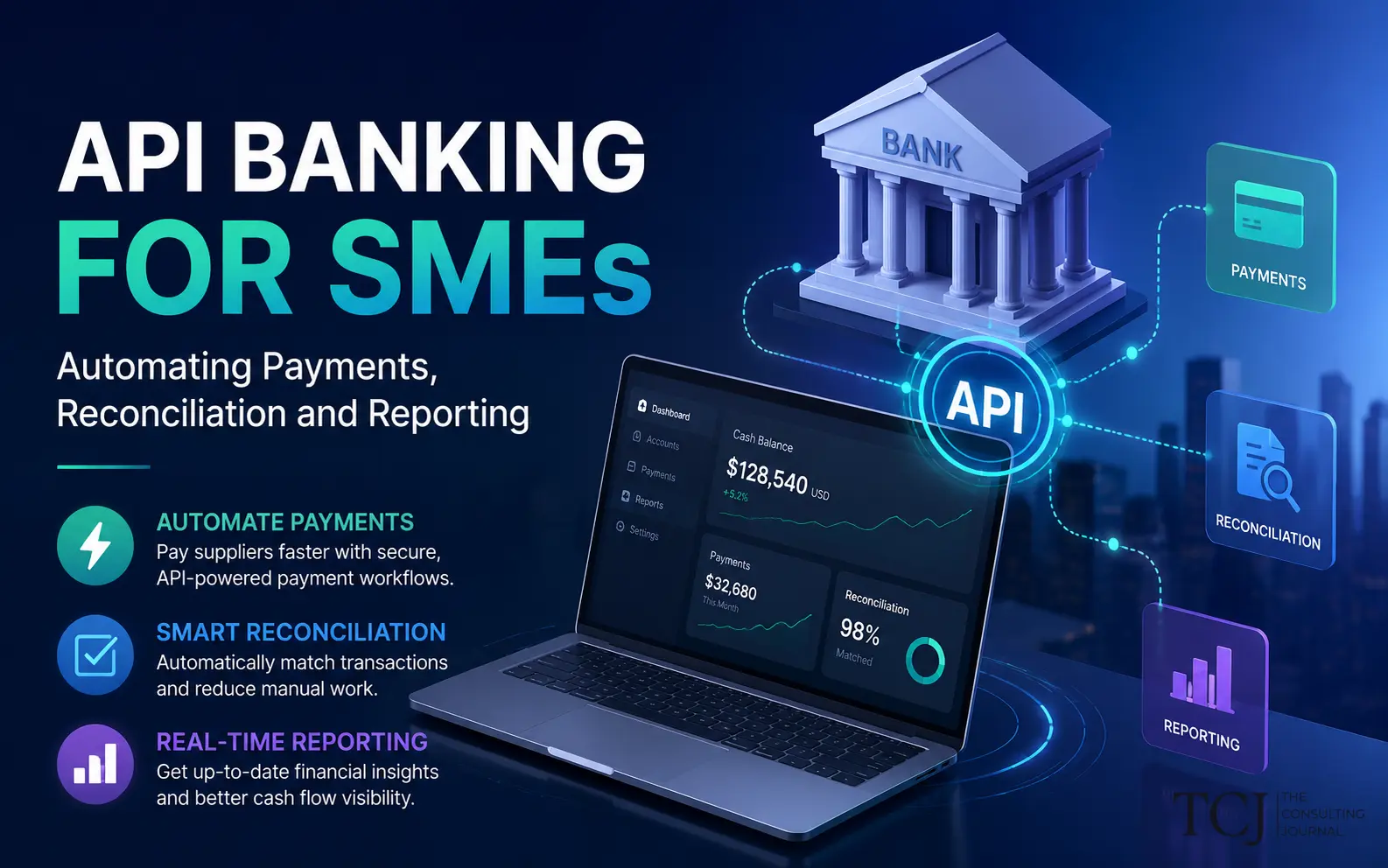
API Banking for SMEs in UAE: Automating Payments, Reconciliation and Reporting
API banking can help UAE SMEs connect banking with Accounting and Financial systems, reducing manual payment work, improving reconciliation and providing more timely cash visibility.

Instant Payments for UAE Businesses: How Real-Time Settlement Changes Cash Management
Instant payments can shorten settlement cycles, improve cash visibility and support faster reconciliation. Here is what UAE business owners and finance teams should consider before adapting treasury and accounting processes.

Jaywan Cards and the Future of Domestic Payments in the UAE
Jaywan is moving from policy concept to practical payment infrastructure. This guide explains what the UAE rollout means for cardholders, merchants, banks, and finance teams.