Can I Use a Freelance Accountant Instead of a Firm in the UAE?
UAE businesses can use freelance accountants for many bookkeeping and financial tasks, but tax complexity, audit requirements, continuity, controls, and growth may make an accounting firm the safer choice.
Key takeaways
- A UAE business can use a freelance accountant for many routine accounting tasks, provided the scope matches the person's competence, capacity, and legal authority.
- Bookkeeping and regulated audit work are not the same, and businesses should verify whether a particular service requires licensed or authorised professionals.
- A freelancer may suit a straightforward small business, while an accounting firm can provide stronger continuity, review depth, and specialist support for complex operations.
- Price should not be the only deciding factor; businesses should compare scope, reporting quality, tax support, documentation standards, backup arrangements, and accountability.
- UAE businesses should maintain control over their accounting systems, records, passwords, and supporting documents rather than relying entirely on one external person.
Can I Use a Freelance Accountant Instead of a Firm in the UAE?
Yes, in many cases a UAE business can engage a freelance accountant for bookkeeping, management reporting, invoicing support, payroll coordination, and day-to-day accounting work. However, certain regulated or specialised assignments may require appropriately licensed professionals, and some companies need broader capacity than one individual can reasonably provide.
The practical question is therefore not simply whether a freelancer is cheaper. It is whether that person can maintain accurate records, understand UAE Tax and Accounting requirements, protect confidential data, meet deadlines, provide continuity, and support the business as transactions become more complex.
For a small Dubai consultancy with straightforward monthly transactions, a capable independent accountant may be sufficient. For a business with multiple entities, VAT obligations, Corporate Tax considerations, cross-border transactions, payroll, inventory, banking requirements, or audit obligations, an established accounting firm may provide stronger technical coverage and operational resilience.
What Is the Difference Between a Freelance Accountant and an Accounting Firm?
A freelance accountant normally works independently and serves clients directly, while an accounting firm operates through a structured team of accountants, tax professionals, reviewers, and other specialists. The better model depends on transaction volume, complexity, internal controls, reporting expectations, deadlines, and the consequences of errors or service interruptions.
A freelancer may offer close communication and flexibility. Business owners often speak directly with the person maintaining their books, which can be helpful when the company's transactions are uncomplicated.
An accounting firm usually provides wider capacity. A business may have access to bookkeeping, VAT, Corporate Tax, Financial reporting, payroll, audit coordination, and advisory support without depending entirely on one person's availability or specialist knowledge.
The distinction becomes particularly relevant as a UAE business grows. A five-person professional services company may need basic monthly bookkeeping and VAT support. A trading company with inventory, imports, multiple bank accounts, supplier reconciliations, and significant receivables may need greater review depth and stronger procedures.
The lowest monthly accounting fee is not necessarily the lowest financial risk. The real question is whether the service model can maintain continuity, evidence, review discipline, and accountability as the business grows. — Consultant observation
Can a Freelance Accountant Legally Handle My Accounts in the UAE?
A freelance accountant may handle many ordinary accounting and bookkeeping activities, depending on the nature of the work and the person's legal authority to provide the relevant service. Businesses should distinguish routine accounting support from regulated audit work or other activities that require specific professional licensing or approval.
The UAE Ministry of Economy and Tourism regulates the accounting and auditing profession and provides registration and licensing services for audit offices and auditors. Businesses should therefore avoid assuming that a person who can perform bookkeeping is automatically authorised to issue a statutory audit report or provide every regulated professional service.
Certain companies may also face audit requirements under applicable company law, their licence conditions, free zone rules, financing arrangements, shareholder agreements, or other regulatory requirements. For example, the UAE Commercial Companies Law contains annual audit provisions for limited liability companies and joint stock companies. The precise position should be checked against the entity's legal form and applicable jurisdiction.
A business should therefore ask a very specific question: What exactly do we need this accountant to do?
Routine monthly bookkeeping is different from issuing an audit opinion. Preparing schedules for a tax return is different from providing specialist tax advice on a complex restructuring. The required competence and regulatory position should match the actual scope of work.
When Does a Freelance Accountant Make Sense for a UAE Business?
A freelancer can be a practical choice when the business is small, the transaction volume is manageable, the accounting is straightforward, and the owner has clear systems for document sharing, review, approval, and continuity. Cost may be one consideration, but competence and reliability should come first.
A freelance accountant may suit:
- Solo consultants and independent professionals with uncomplicated transactions.
- Early-stage businesses with limited monthly activity.
- Small service companies without inventory or complex cross-border transactions.
- Businesses that already have strong internal controls and only need additional accounting support.
- Short-term bookkeeping clean-up projects where the scope is clearly defined.
The strongest freelance arrangement is usually one where the accountant has relevant UAE experience, works within a written scope, follows defined reporting deadlines, uses appropriate accounting software, and maintains an organised handover process.
Example 1: A fictional Dubai-based design consultancy has six employees, one UAE entity, two bank accounts, no inventory, and a modest number of monthly invoices. Its owner maintains proper contracts and expense documents and approves payments personally. An experienced freelance accountant may be able to manage monthly bookkeeping and reporting effectively, provided tax and specialist issues are referred appropriately.
When Is an Accounting Firm the Better Choice?
An accounting firm is generally more suitable when the business has greater financial complexity, several compliance obligations, multiple entities, higher transaction volumes, specialist tax issues, audit requirements, or a need for continuity across several professionals. Firms may also provide stronger review structures and greater capacity during reporting deadlines.
An accounting firm may be preferable where a business has:
- Multiple mainland or free zone entities.
- High transaction volumes.
- Inventory and complex cost-of-goods calculations.
- Several currencies or overseas operations.
- VAT and Corporate Tax obligations requiring technical review.
- Related-party transactions.
- Significant payroll or employee reimbursement volumes.
- Financing, investor reporting, or due diligence requirements.
- Regular external audit requirements.
- A need for monthly management accounts, cash-flow reporting, and CFO-level analysis.
Example 2: A fictional UAE trading company imports equipment, sells to customers across several Emirates, maintains warehouse inventory, has related companies, and requires regular reporting for a bank facility. One competent freelancer may still perform some tasks, but the business could be exposed if the accountant becomes unavailable or lacks expertise in a specialist area. A firm with bookkeeping, Tax, Financial, and Accounting capabilities may provide stronger operational coverage.
What UAE Tax and Record-Keeping Obligations Should Influence the Decision?
Your choice of accountant should reflect the obligations that actually apply to your business. Proper records are not simply an administrative preference. They support tax filings, financial reporting, audits, banking discussions, management decisions, and responses to authority enquiries.
For VAT, the Federal Tax Authority states that mandatory registration generally applies when taxable supplies and imports exceed AED 375,000, while voluntary registration may be available above AED 187,500, subject to the applicable rules.
For Corporate Tax, the FTA has emphasised that Taxable Persons and Exempt Persons should retain relevant records for at least seven years following the end of the Tax Period to which they relate. This makes document discipline and accounting continuity particularly important.
Not every UAE Corporate Tax taxpayer is automatically required to have audited financial statements. The FTA states that only categories specified in the relevant ministerial decision are required to prepare and maintain audited or certified financial statements for Corporate Tax purposes. Other audit requirements may still arise under company law, free zone rules, licensing conditions, financing arrangements, or other applicable requirements.
The decision should therefore consider more than bookkeeping fees. Businesses should assess whether the service provider can maintain complete records, reconcile balances, preserve supporting evidence, identify missing documents, and escalate unusual transactions before they become larger problems.
What Are the Main Risks of Depending on One Freelance Accountant?
The main risk is concentration. When one person holds most of the accounting knowledge, system access, reconciliations, supporting schedules, and filing history, the business may face disruption if that person becomes unavailable. This does not make freelancers unsuitable, but it makes continuity planning essential.
Common risks include:
- No backup during illness, leave, or sudden unavailability.
- Limited expertise outside the accountant's primary experience.
- Weak segregation of duties.
- Delayed monthly closes during busy periods.
- Inadequate review of complex transactions.
- Poor documentation of accounting procedures.
- Passwords or records being controlled by one external person.
- Difficulty transferring historical knowledge to a replacement.
A well-managed freelancer can reduce these risks through documented procedures, shared company-controlled systems, regular backups, clear deadlines, and a formal handover plan.
An accounting firm is not automatically risk-free either. Businesses should still ask who will perform the work, who will review it, how frequently senior staff will be involved, and how quickly issues will be escalated.
How Should You Compare Cost Between a Freelancer and an Accounting Firm?
Businesses should compare the full scope and risk allocation rather than only the monthly fee. A lower quote may exclude reconciliations, management reporting, VAT return preparation, Corporate Tax support, year-end schedules, audit coordination, corrections, or advisory work that later becomes necessary.
Ask each provider to define:
- Number of monthly transactions covered.
- Number of bank and payment accounts included.
- Frequency of bank reconciliations.
- Treatment of accounts receivable and accounts payable.
- VAT return preparation and review responsibilities.
- Corporate Tax scope.
- Payroll and employee reimbursement scope.
- Monthly reporting deadlines.
- Year-end closing responsibilities.
- Audit support, where applicable.
- Software costs.
- Fees for historical clean-up work.
- Charges for out-of-scope support.
The lowest quote can become expensive when work must be corrected later, deadlines are missed, supporting documents cannot be located, or balances remain unreconciled for months.
What Common Mistakes Do UAE Business Owners Make When Choosing an Accountant?
The most common mistake is choosing solely on price. Another is assuming that bookkeeping, tax advice, financial reporting, and statutory audit are interchangeable services. They are not, and the right provider should have the competence, authority, systems, and capacity required for the actual assignment.
Other frequent mistakes include:
- Hiring without checking UAE-specific experience.
- Giving an external accountant sole control over passwords and records.
- Failing to define monthly deadlines.
- Not requesting regular bank reconciliations.
- Waiting until the VAT, Corporate Tax, audit, or licence renewal deadline to review the accounts.
- Accepting reports without understanding unexplained balances.
- Not keeping copies of invoices, contracts, payroll records, and supporting documents.
- Continuing with a service model that no longer suits a growing business.
- Assuming a freelancer can issue a regulated audit report merely because they provide accounting services.
- Failing to create a documented transition plan.
Business owners do not need to become accountants, but they should retain visibility over the numbers. At minimum, management should understand cash, receivables, payables, revenue trends, major expenses, tax obligations, and unusual balances.
What Documents and Information Should You Prepare Before Hiring an Accountant?
A proper onboarding process helps either a freelancer or accounting firm work more accurately. Businesses should prepare the following, depending on their activity and legal structure:
- Trade licence and constitutional documents.
- Shareholding information.
- VAT and Corporate Tax registration details, where applicable.
- Previous VAT returns and tax correspondence.
- Prior financial statements or management accounts.
- Bank statements.
- Sales invoices and credit notes.
- Supplier bills and expense documents.
- Customer and supplier lists.
- Loan and financing agreements.
- Lease agreements.
- Payroll records.
- Employee reimbursement records.
- Fixed asset details.
- Inventory records, where applicable.
- Related-party transaction information.
- Accounting software access.
- Previous audit reports, if relevant.
- Opening balances and historical ledgers.
- A schedule of upcoming filing and reporting deadlines.
Company-controlled access should be maintained wherever possible. The business should be able to retrieve its own accounting data, supporting documents, tax records, and system credentials without depending entirely on one external individual.
What Questions Should You Ask Before Appointing a Freelancer or Firm?
Ask questions that reveal how the work will actually be performed rather than relying on broad promises.
Useful questions include:
- Who will handle my day-to-day accounts?
- Who reviews the work?
- What UAE business sectors do you regularly support?
- How often will bank accounts be reconciled?
- When will monthly reports be delivered?
- How are missing documents identified and followed up?
- What happens when my usual accountant is unavailable?
- Who controls access to the accounting software and records?
- Which services are excluded from the monthly fee?
- How are complex VAT, Corporate Tax, or accounting issues escalated?
- Can you support a clean handover if I change providers?
- Are you appropriately licensed or authorised for any regulated service included in the scope?
Clear answers at the start often prevent disputes later.
How Can KPM Global Services UAE (https://kpmglobal.ae/en) Assist?
KPM Global Services UAE (https://kpmglobal.ae/en) can support UAE businesses that need structured Accounting, Tax, Financial, and business advisory assistance based on the company's size, activities, reporting needs, and regulatory position.
Depending on the engagement, support may include bookkeeping, management reporting, VAT assistance, Corporate Tax support, financial process improvement, accounting review, cash-flow visibility, payroll coordination, and preparation for audit or external reporting requirements.
For business owners deciding between a freelance accountant and a firm, KPM Global Services UAE (https://kpmglobal.ae/en) can also help assess whether the existing accounting setup remains suitable for the company's transaction volume, tax obligations, management needs, and growth plans.
The objective should not be to add unnecessary complexity. A small business may only need a simple, disciplined accounting process. A more complex company may require deeper review, specialist input, and stronger continuity. The service model should fit the actual business risk.
What Is the Better Choice: A Freelance Accountant or an Accounting Firm?
Neither option is universally better. A skilled freelancer can be highly effective for a straightforward UAE business with limited complexity and good internal discipline. An accounting firm may be more appropriate when continuity, specialist knowledge, independent review, scale, or multiple compliance obligations become material.
The decision should consider:
- Business size.
- Monthly transaction volume.
- Number of entities.
- VAT and Corporate Tax position.
- Complexity of revenue and expenses.
- Inventory.
- International transactions.
- Related parties.
- Banking and financing requirements.
- Audit obligations.
- Internal control needs.
- Reporting frequency.
- Business growth plans.
- The operational impact if one person becomes unavailable.
The right accountant should make the business more financially organised, not more dependent. Records should be accessible, reconciliations should be current, unexplained balances should be investigated, and management should know where responsibility sits.
This article is for informational purposes and does not constitute legal, tax, accounting, or financial advice.
Questions and answers
Q: Can I legally use a freelance accountant for my UAE business?
A: Yes, a freelance accountant may handle many ordinary bookkeeping and accounting activities, depending on the scope and applicable licensing requirements. Regulated services such as certain audit work should only be performed by appropriately authorised professionals.
Q: Is a freelance accountant cheaper than an accounting firm in Dubai?
A: A freelancer may charge less because of lower overheads, but the total cost depends on the scope of work. Businesses should compare whether VAT, Corporate Tax, reporting, reconciliations, year-end support, corrections, and specialist advice are included.
Q: Can a freelance accountant file VAT and handle Corporate Tax work?
A: A freelancer may provide VAT and Corporate Tax support where appropriately competent and authorised for the services offered. The business remains responsible for ensuring accurate records, timely filings, and compliance with applicable UAE Tax requirements.
Q: When should I move from a freelance accountant to an accounting firm?
A: Consider moving when transaction volumes increase, the business adds entities or jurisdictions, reporting becomes more complex, specialist Tax or Financial expertise is needed, or dependence on one person creates continuity risk. Growth is not the only trigger; complexity and risk matter equally.
Q: What is the biggest risk of using one freelance accountant?
A: The main risk is excessive dependence on a single person for records, knowledge, deadlines, and system access. This can be managed through company-controlled systems, documented procedures, regular backups, clear review processes, and a formal handover plan.
More in Finance
View all Finance →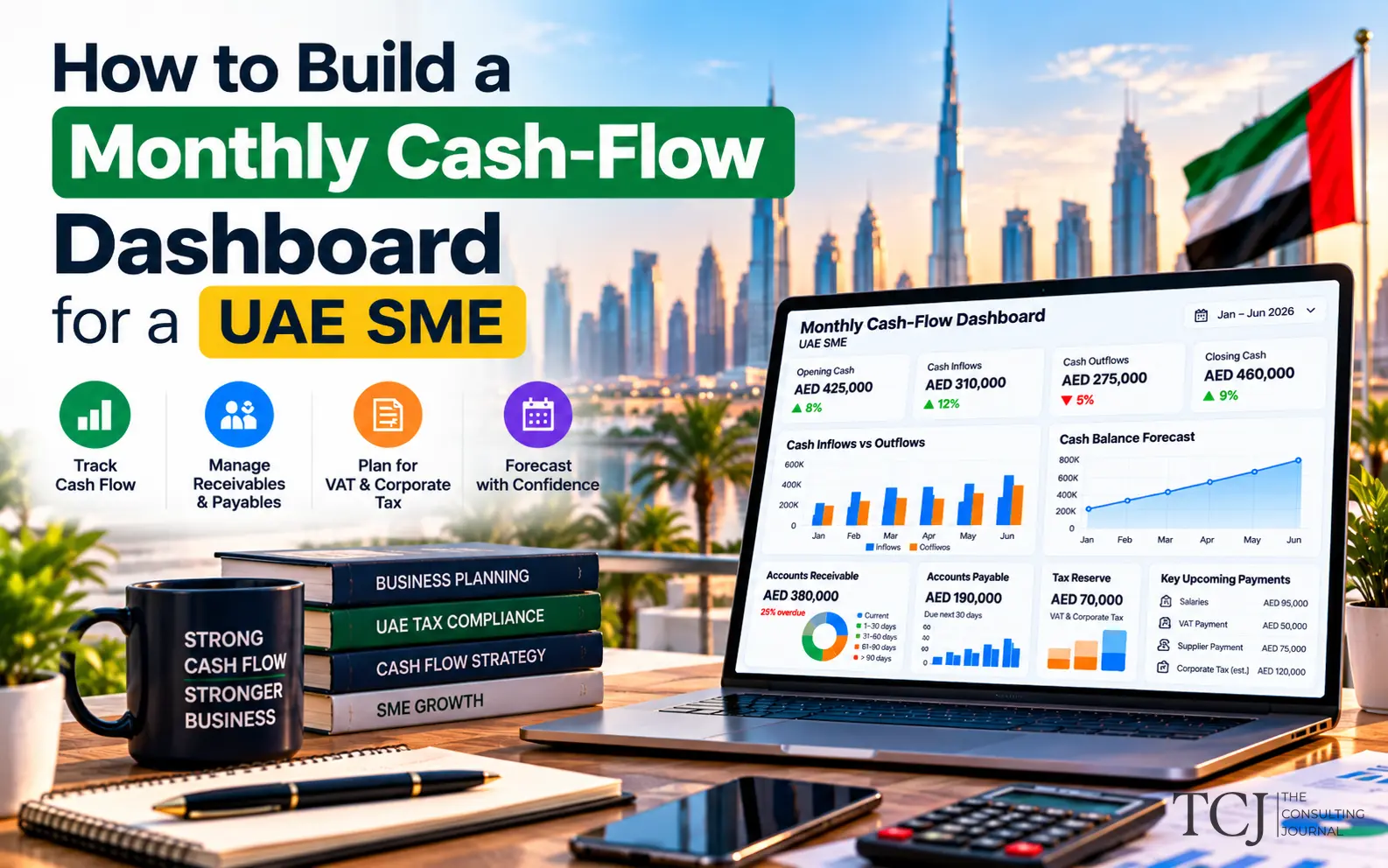
How to Build a Monthly Cash-Flow Dashboard for a UAE SME
A practical guide for UAE SME owners and finance teams on building a monthly cash-flow dashboard that tracks liquidity, collections, payments, tax obligations, forecasts, and working capital.

How UAE Companies Can Build a Faster, More Reliable Month-End Close
A practical UAE finance guide to shortening the month-end close through better reconciliations, cut-off controls, automation, tax readiness, data quality, and clear accountability.

Gross Margin Bridge Analysis: Explaining Why Profitability Changed Month to Month
Gross margin bridge analysis helps finance teams explain monthly profitability changes by separating the impact of price, volume, sales mix, cost, and other operational drivers.