What Accounting Software Do UAE Businesses Use?
A practical UAE guide to choosing accounting software for VAT, Corporate Tax, reporting, invoicing, and business growth in Dubai and across the UAE.
Key takeaways
- The best UAE accounting software depends on business model, VAT status, reporting needs, inventory, and user capability.
- VAT and Corporate Tax make clean accounting records more important for SMEs, free zone entities, and mainland companies.
- Cloud tools suit many service businesses, while trading and group structures may need inventory or ERP-level controls.
- Software implementation should include chart of accounts design, opening balances, user access, reconciliation rules, and staff training.
- KPM Global Services UAE can assist with software selection, accounting setup, VAT readiness, reporting, and Corporate Tax record preparation.
What accounting software do UAE businesses commonly use?
UAE businesses commonly use platforms such as Zoho Books, TallyPrime, QuickBooks, Xero, Sage, Odoo, Wafeq, Daftra, Microsoft Dynamics 365 Business Central, Oracle NetSuite, and SAP Business One. The right choice depends less on popularity and more on VAT handling, Corporate Tax records, inventory, reporting needs, integrations, and the skill level of the finance team.
For a small Dubai consultancy, a clean cloud system with VAT invoices and bank feeds may be enough. For a trading company in Deira, inventory, landed cost, multi-currency supplier balances, and ageing reports matter more. For a free zone group with several entities, consolidation, approval workflows, and audit-ready records may become the deciding factors.
The Federal Tax Authority maintains a Tax Accounting Software Vendors page. The displayed list includes vendors and software names such as Xero, TallyPrime, Daftra, Wafeq, and others, with validity details that businesses should check before making a procurement decision.
Why does software choice matter more after VAT and Corporate Tax?
Software choice matters because UAE businesses are expected to keep accurate financial records, issue proper tax invoices where applicable, and prepare reliable financial statements. The system should help owners see cash flow clearly while giving accountants the data needed for VAT filings, Corporate Tax calculations, audit support, and bank or investor reporting.
The UAE VAT mandatory registration threshold is AED 375,000 in taxable supplies and imports, while voluntary registration is available where taxable supplies, imports, or taxable expenses exceed AED 187,500. Once a business is registered, weak invoicing, delayed reconciliation, and inconsistent expense coding can quickly become compliance and cash-flow problems.
Corporate Tax has made the accounting system even more important. The Ministry of Finance states that taxable income generally starts from accounting income, meaning net profit or loss before tax as per financial statements, with adjustments made where required. Taxable persons are also required to file a Corporate Tax return within nine months from the end of the relevant tax period.
This is why business owners should not select software only because it is cheap, familiar, or recommended by another company. Accounting software is now part of the business control environment.
Accounting software should reduce manual judgment, not replace financial review. The stronger system is the one your team can reconcile, document, and explain. — KPM Global Services UAE consultant observation
Which accounting software options should UAE SMEs compare?
Most SMEs should compare software in three groups: simple cloud accounting tools, inventory-led accounting systems, and enterprise or ERP platforms. A business should shortlist based on transaction volume, VAT registration status, reporting expectations, number of users, branches, currencies, inventory complexity, and whether the accountant can maintain the system properly.
Zoho Books
Zoho Books is often considered by startups, professional firms, small trading companies, and service businesses that want cloud accounting with invoicing, expenses, bank reconciliation, and basic automation. It suits owners who want visibility without building a heavy ERP environment.
A Dubai marketing agency, for example, may use Zoho Books to issue VAT invoices, track project expenses, monitor receivables, and share records with an external accountant. The main risk is over-customising workflows before the chart of accounts and reporting structure are agreed.
TallyPrime
TallyPrime remains familiar to many UAE accountants, especially in trading, wholesale, distribution, and inventory-heavy businesses. Its appeal is practical: many bookkeepers know it, reporting can be detailed, and stock-led accounting can be handled efficiently.
For businesses with high invoice volume and established accounting staff, TallyPrime may be easier to operate than a purely owner-led cloud system. The decision should include data backup discipline, user controls, and whether management reporting can be produced without manual spreadsheet work.
QuickBooks and Xero
QuickBooks and Xero are commonly assessed by SMEs that want cloud accounting, bank connections, app integrations, recurring invoices, and accountant collaboration. They can work well for service businesses, consultants, agencies, small e-commerce operators, and professional firms.
The main question is UAE suitability. Businesses should verify VAT invoice formats, tax reporting outputs, user permissions, bank feed availability, and whether their accountant has local implementation experience.
Wafeq and Daftra
Wafeq and Daftra are regional options that may appeal to businesses wanting Arabic-friendly workflows, UAE-focused invoicing, and practical SME features. They may suit companies that want local support and a finance system designed with Gulf tax and invoicing practices in mind.
Before selecting either, management should test sample invoices, VAT reports, credit notes, multi-currency entries, and user roles. A short pilot with real transactions is more useful than a generic product demo.
Sage, Odoo, Microsoft Dynamics, NetSuite, and SAP Business One
These platforms are usually considered when a company needs more than bookkeeping. They may support inventory, procurement, approvals, CRM, manufacturing, multi-entity reporting, or stronger controls across departments.
A growing UAE distributor may begin with basic accounting software, then move to Odoo, Dynamics, NetSuite, or SAP Business One when sales orders, warehouse movements, receivables, and management reporting become too fragmented. The cost is not only the licence. The bigger cost is implementation, migration, training, and process redesign.
What features should UAE businesses look for?
UAE businesses should look for VAT-ready invoicing, reliable bank reconciliation, clear audit trails, multi-currency handling, role-based access, inventory controls where needed, good reporting, secure cloud access, and exportable data. The software should also support the way the company actually sells, buys, pays staff, collects money, and reports to management.
A practical checklist should include:
- VAT invoice and credit note capability
- TRN field handling and customer/supplier tax details
- Bank reconciliation and transaction matching
- Receivables and payables ageing
- Cash flow visibility
- Multi-currency invoices and supplier bills
- Inventory, if stock is material
- Payroll or payroll integration, where needed
- Approval workflows for expenses and purchases
- Audit trail and user access controls
- Clean export for auditors, tax consultants, or management
- Support for branches, locations, or departments
- Scalable chart of accounts
- Reliable data backup and security controls
Businesses should also start preparing for eInvoicing. The Ministry of Finance states that an eInvoice is structured invoice data issued and exchanged electronically between supplier and buyer and reported electronically to the FTA. It also clarifies that PDF, Word, image, scanned copy, and email formats are not eInvoices.
That does not mean every SME must replace its accounting software immediately. It does mean businesses should ask vendors how their systems will handle structured electronic invoicing, accredited service provider connectivity, invoice fields, and future reporting requirements.
How should a UAE business choose the right system?
A UAE business should choose accounting software by mapping its transactions first, then testing the software against real invoices, bills, payments, credit notes, and management reports. The best system is usually the one that fits the business process, not the one with the longest feature list.
A simple selection process works well:
- Define the business model: service, trading, e-commerce, manufacturing, professional practice, or group structure.
- Confirm VAT and Corporate Tax obligations.
- List monthly transaction volumes.
- Identify must-have reports.
- Review inventory and multi-currency requirements.
- Decide who will use the system daily.
- Test three months of sample transactions.
- Review data migration from Excel or old software.
- Agree user roles and approval limits.
- Train the team before going live.
Example 1: A fictional Dubai mainland interior fit-out company issues progress invoices, pays subcontractors, imports materials, and needs project-wise profitability. A basic invoice tool may not be enough. The company should look for project costing, supplier ageing, VAT treatment, retention tracking, and management reports by project.
Example 2: A fictional Sharjah free zone e-commerce seller receives online payments, imports stock, sells across the GCC, and handles returns. Its software should support inventory movement, payment gateway reconciliation, landed cost visibility, VAT reporting, and clear separation between sales, refunds, fees, and shipping charges.
Common mistakes business owners make
Many UAE businesses buy accounting software before defining their accounting process. This leads to poor setup, messy opening balances, duplicated customers, wrong VAT coding, and reports that owners do not trust.
Common mistakes include:
- Choosing software only because another business uses it
- Ignoring VAT invoice format before going live
- Setting up too many or too few ledger accounts
- Giving broad admin access to too many users
- Not reconciling banks every month
- Treating inventory as an afterthought
- Migrating old data without cleaning it
- Depending on manual Excel schedules outside the system
- Not reviewing receivables ageing regularly
- Forgetting that Corporate Tax depends on reliable accounting records
- Skipping staff training
- Not documenting invoice approval and expense approval rules
A system can be technically strong and still fail if the implementation is rushed. In practice, the first month should be treated as a controlled transition, not a casual software switch.
Documents and preparation checklist
Before selecting or implementing accounting software, a UAE business should prepare the documents and information that shape the system.
Useful preparation includes:
- Trade licence
- VAT certificate, if registered
- Corporate Tax registration details, if available
- Opening trial balance
- Chart of accounts
- Customer list
- Supplier list
- Bank account details
- Recent bank statements
- Unpaid customer invoices
- Unpaid supplier bills
- Inventory list with quantities and values
- Fixed asset register
- Payroll summary, where relevant
- Existing invoice templates
- Sample sales invoices and purchase bills
- Existing VAT return workings
- Management reporting requirements
- User list and access levels
- Approval matrix for purchases and expenses
Good preparation reduces implementation delays. It also helps the consultant or accountant identify gaps before the software goes live.
How KPM Global Services UAE can assist
KPM Global Services UAE can help businesses in Dubai and across the UAE assess accounting software options from a finance, tax, and operational perspective. The work typically starts with understanding the business model, transaction flow, VAT position, reporting requirements, and current bookkeeping challenges.
Support may include:
- Accounting software selection advice
- Chart of accounts design
- VAT-focused invoice and tax code review
- Opening balance review
- Accounting process setup
- Bank reconciliation process design
- Management reporting templates
- Corporate Tax record readiness
- Coordination with software vendors or implementation partners
- Review of internal controls and user access
- Training for owners and finance teams
The goal is not to push one product. It is to help the business choose and maintain a system that produces records management can use and advisers can review.
Final advisory view
Accounting software should give UAE business owners cleaner numbers, faster reporting, better receivables control, and fewer compliance surprises. For many SMEs, the right answer is not the biggest system. It is a system that handles everyday accounting properly and can grow with the business.
A small business may begin with a cloud accounting tool. A trading company may need stronger inventory and reconciliation controls. A group may need an ERP with approvals, consolidation, and deeper reporting. The decision should be based on evidence from the business’s own transactions.
This article is for informational purposes and does not constitute legal, tax, accounting, or financial advice.
Questions and answers
What is the best accounting software for small businesses in the UAE?
The best option depends on the business activity, transaction volume, VAT status, and reporting needs. Many small UAE businesses compare Zoho Books, QuickBooks, Xero, Wafeq, Daftra, and TallyPrime before deciding.
Should a UAE company choose cloud accounting software?
Cloud accounting is often suitable for SMEs that need remote access, accountant collaboration, invoicing, and regular reporting. Businesses with sensitive controls, complex inventory, or group reporting should review security, integrations, and approval workflows before choosing.
Is accounting software required for VAT in the UAE?
VAT-registered businesses need accurate records and compliant tax invoices, but the exact software depends on the business. Good accounting software can reduce manual VAT errors and make return preparation easier.
Can one accounting software handle both VAT and Corporate Tax?
One system can usually support both if it records income, expenses, invoices, adjustments, and reports properly. Corporate Tax still requires review because taxable income may need adjustments from accounting profit.
When should a UAE business move from basic accounting software to ERP?
A business should consider ERP when inventory, approvals, branches, multi-entity reporting, project costing, or operational controls become difficult to manage in basic software. The decision should be based on process complexity, not company size alone.
More in Finance
View all Finance →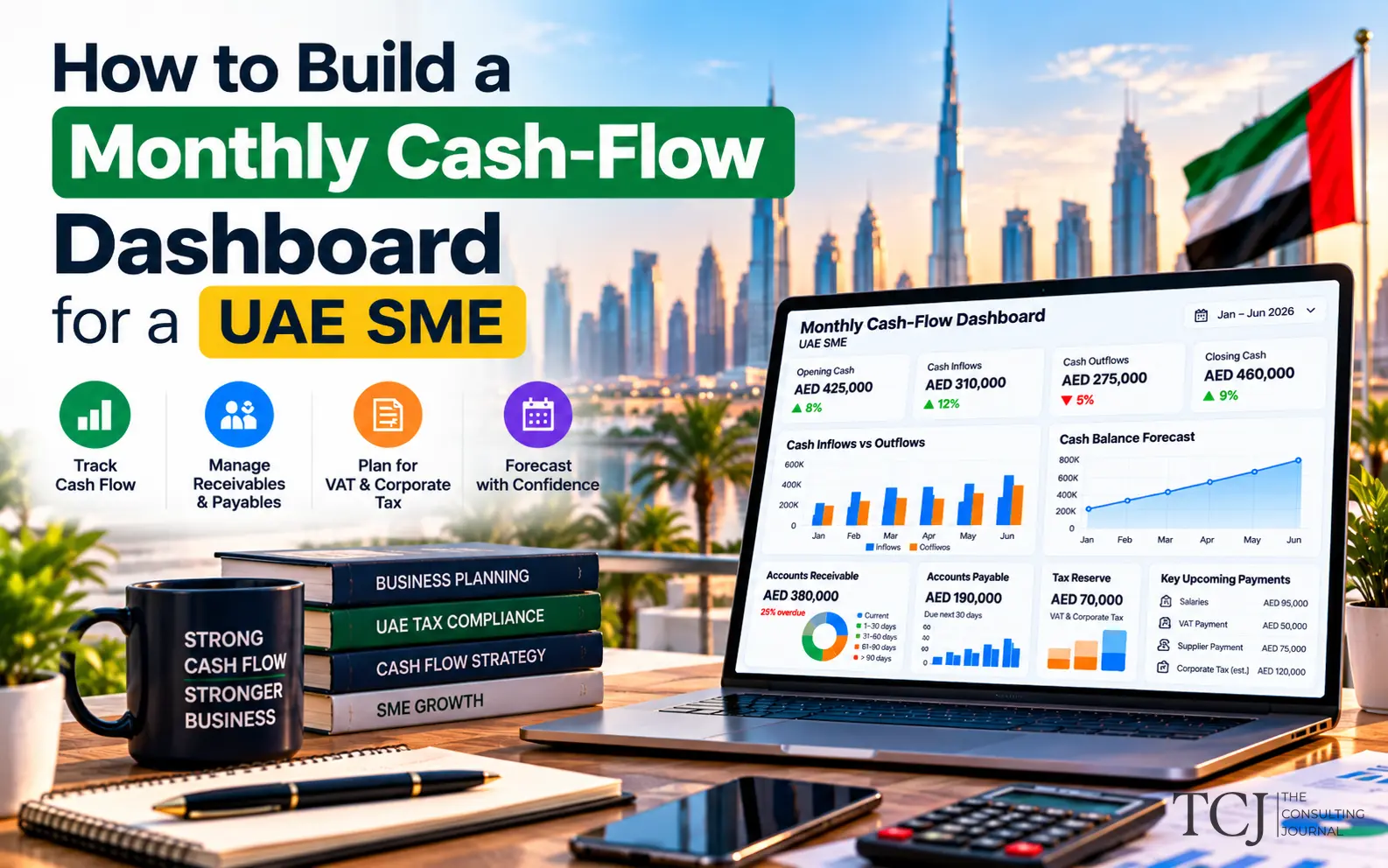
How to Build a Monthly Cash-Flow Dashboard for a UAE SME
A practical guide for UAE SME owners and finance teams on building a monthly cash-flow dashboard that tracks liquidity, collections, payments, tax obligations, forecasts, and working capital.

How UAE Companies Can Build a Faster, More Reliable Month-End Close
A practical UAE finance guide to shortening the month-end close through better reconciliations, cut-off controls, automation, tax readiness, data quality, and clear accountability.
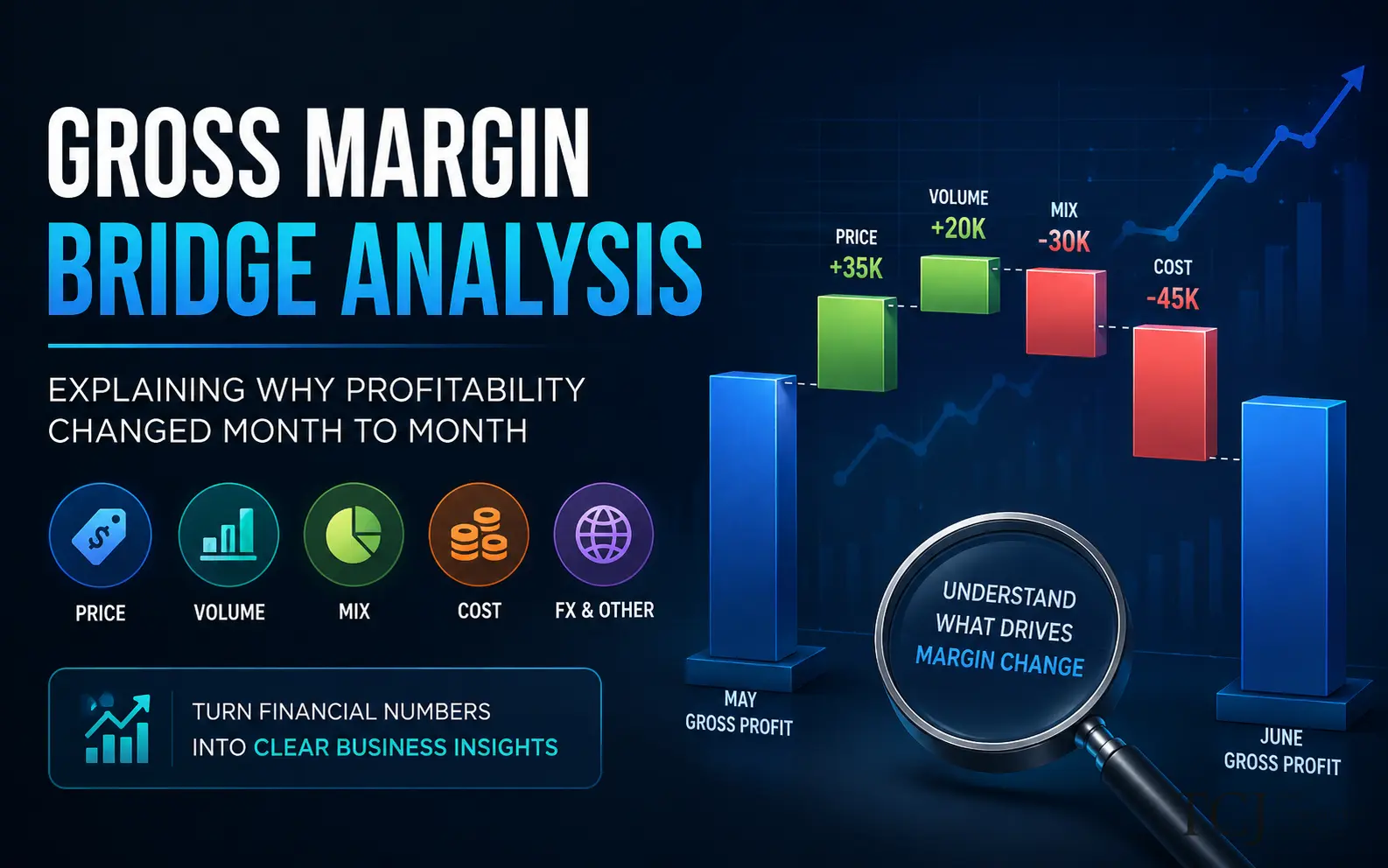
Gross Margin Bridge Analysis: Explaining Why Profitability Changed Month to Month
Gross margin bridge analysis helps finance teams explain monthly profitability changes by separating the impact of price, volume, sales mix, cost, and other operational drivers.