Cash Conversion Cycle in the UAE: Where Working Capital Gets Trapped
A practical guide for UAE business owners and finance teams on calculating the cash conversion cycle, identifying trapped working capital, and improving inventory, collections, supplier terms, and cash flow.
Key takeaways
- Profit does not guarantee liquidity when cash is tied up in stock and unpaid invoices.
- The cash conversion cycle combines inventory days, collection days, and supplier payment days.
- Faster invoicing and disciplined collections can release cash without increasing sales.
- Supplier terms should be negotiated and used fully rather than extended through uncontrolled late payment.
- Weekly working-capital reviews help management address cash pressure before obligations become urgent.
Why can a profitable UAE business still run short of cash?
A business can record revenue, maintain healthy margins, and report an accounting profit while lacking enough cash to pay salaries, suppliers, rent, finance costs, or tax liabilities. This usually happens because money has been committed to inventory, customer credit, project costs, or other operating requirements and has not yet returned as available cash.
This gap between profitability and liquidity is particularly relevant to UAE trading companies, distributors, contractors, manufacturers, retailers, and project-based businesses. Many must pay for goods, shipping, labour, or materials well before customers settle the related invoices.
The cash conversion cycle helps management identify how long money remains trapped between purchasing, selling, invoicing, collecting, and paying suppliers. It turns a broad cash-flow concern into a measurable operational issue.
A cash-flow problem is often created months before the bank balance becomes critical, through purchasing, credit, billing, and contract decisions. — Consulting Journal editorial observation
What is the cash conversion cycle?
The cash conversion cycle, commonly called CCC, measures the number of days a business takes to convert cash invested in inventory and operations back into cash collected from customers. It also considers the supplier credit period available before the business must pay its own trade obligations.
The cycle connects three parts of working capital:
- Inventory
- Accounts receivable
- Accounts payable
A shorter cycle generally means cash returns to the business more quickly. A longer cycle usually indicates that more working capital is tied up in stock, customer invoices, or project activity.
A negative CCC is possible when a company receives customer payments before it pays suppliers. This can occur in selected retail, subscription, marketplace, advance-payment, or high-turnover business models. It should not be treated as a realistic target for every industry.
How is the cash conversion cycle calculated?
The standard calculation adds the number of days cash remains in inventory to the number of days customers take to pay, then subtracts the number of days the company takes to pay suppliers.
Cash Conversion Cycle = Days Inventory Outstanding + Days Sales Outstanding − Days Payables Outstanding
The result should be analysed together with sales growth, operating costs, customer terms, supplier arrangements, seasonality, and short-term funding requirements. A single CCC figure is useful, but the movement in each component usually provides the more actionable insight.
What does Days Inventory Outstanding measure?
Days Inventory Outstanding, or DIO, estimates how long stock remains in the business before it is sold or consumed.
DIO = Average Inventory ÷ Cost of Goods Sold × Number of Days
A high DIO may indicate excess purchasing, slow-moving products, obsolete stock, weak demand planning, long import lead times, or poor coordination between sales and procurement.
Inventory may appear as a current asset in the accounts, but it cannot fund payroll or settle a supplier invoice. Cash only becomes available after the item is sold and the customer pays.
What does Days Sales Outstanding measure?
Days Sales Outstanding, or DSO, measures the average time taken to collect payment after a credit sale.
DSO = Average Accounts Receivable ÷ Credit Sales × Number of Days
A rising DSO can point to delayed invoicing, weak customer credit checks, missing supporting documents, invoice disputes, long contractual terms, or inconsistent collection follow-up.
Revenue may be recognised before the money reaches the bank account. A company offering 60-, 90-, or 120-day terms may therefore be financing customers while continuing to fund its own salaries, rent, logistics, and supplier commitments.
What does Days Payables Outstanding measure?
Days Payables Outstanding, or DPO, estimates how long the company takes to pay trade suppliers.
DPO = Average Accounts Payable ÷ Cost of Goods Sold × Number of Days
A higher DPO can support liquidity because cash remains in the business for longer. However, deliberately paying beyond agreed terms can damage supplier relationships, interrupt deliveries, reduce access to credit, or lead to less favourable pricing.
The objective is to use agreed supplier terms fully while protecting strategically important relationships.
Where does working capital become trapped in UAE businesses?
Working capital is rarely trapped through one large mistake. It usually accumulates across inventory purchases, customer payment delays, unbilled work, retentions, supplier decisions, tax provisions, and documentation gaps. Management should examine each stage of the operating cycle rather than treating every cash shortage as a sales problem.
Excess and slow-moving inventory
Businesses can tie up significant cash by purchasing against optimistic forecasts, maintaining too many product variations, accepting large minimum order quantities, or reordering without checking existing stock.
Supplier discounts can also be misleading. A lower unit price may not create value when the business must finance the stock for several additional months while paying for storage, insurance, handling, expiry, damage, and obsolescence.
Inventory should be reviewed by SKU, category, location, age, gross margin, and sales velocity. Management needs to know which products generate reliable returns and which are simply occupying warehouse space and consuming cash.
Example 1:
A fictional Dubai electronics distributor increases purchases before a projected seasonal sales period. Demand is weaker than expected, leaving AED 1.8 million in slow-moving stock across two warehouses. The company remains profitable on paper but draws further on its overdraft to pay suppliers and staff.
The immediate issue is not the selling price. It is the purchasing quantity, reorder process, and lack of SKU-level ageing analysis.
Delayed customer payments
Credit sales can increase reported revenue while weakening liquidity. The faster a company grows on extended terms, the more cash it may need to finance inventory, delivery, labour, and overheads before customers pay.
Receivables often become trapped because:
- Invoices are issued several days after delivery.
- Purchase-order details do not match the invoice.
- Delivery notes or completion certificates are missing.
- The invoice is sent to the wrong customer contact.
- Collections begin only after the due date.
- Sales teams approve payment terms without finance review.
- Customer disputes do not have a defined owner.
Collection performance is often determined before the sale takes place. Credit checks, approved limits, accurate documentation, clear payment terms, and defined escalation procedures can be more effective than aggressive chasing after an invoice is overdue.
Unbilled work, variations, and retentions
Contractors, fit-out businesses, engineering companies, consultancies, and other project-based organisations face additional working-capital risks.
Cash can remain locked in work completed but not certified, variations awaiting approval, milestones that have not been accepted, retention balances, unsubmitted invoices, and materials purchased before billing becomes permitted.
Example 2:
A fictional Abu Dhabi fit-out company reports a healthy project margin, but several variation orders remain unsigned and milestone certificates are delayed. The company has paid subcontractors and purchased materials, yet it cannot issue AED 900,000 of customer invoices.
The project is profitable in the management accounts but continues to consume cash. The business needs stronger approval tracking, billing responsibility, and contract-document control.
Poor supplier-term management
Some companies pay suppliers earlier than required because invoice approval and payment processing are disconnected from cash forecasting. Others delay every supplier regardless of operational importance.
A more disciplined approach separates suppliers into groups such as:
- Strategic or single-source suppliers
- Operational suppliers
- High-risk suppliers
- Low-value suppliers
- Suppliers offering meaningful early-payment discounts
Payment timing can then reflect commercial value, agreed terms, supply risk, and the company’s cash position.
Tax and compliance timing
VAT and Corporate Tax should be forecast separately from general operating cash. The Federal Tax Authority confirms that VAT and Corporate Tax are distinct UAE taxes, and both continue to apply.
As of 3 August 2026, mandatory VAT registration for a UAE-resident business generally applies when taxable supplies and imports exceed AED 375,000 over the previous 12 months or are expected to exceed that amount within the next 30 days. Businesses should review the detailed rules and their circumstances rather than relying only on the headline threshold.
Collected VAT and expected tax provisions should not be treated as unrestricted working capital. Using those amounts to fund ordinary operating costs can create pressure when filing and payment obligations become due.
The UAE has established large-value and retail payment infrastructure overseen and operated by the Central Bank of the UAE. However, efficient payment systems cannot correct late invoicing, unresolved disputes, missing approvals, or unfavourable commercial terms inside a business.
What does a UAE cash conversion cycle calculation look like?
Assume a UAE trading company has the following results:
- Days Inventory Outstanding: 80 days
- Days Sales Outstanding: 65 days
- Days Payables Outstanding: 40 days
Its cash conversion cycle is:
80 + 65 − 40 = 105 days
This means cash remains committed to the operating cycle for approximately 105 days.
Management then reduces inventory days from 80 to 65, reduces collection days from 65 to 50, and negotiates supplier terms from 40 to 50 days.
The revised calculation is:
65 + 50 − 50 = 65 days
The improvement reduces the cycle by 40 days. Where the relevant daily cash commitment is AED 100,000, the improvement could represent approximately AED 4 million in reduced funding pressure.
This is an illustrative calculation. The actual cash released will depend on the company’s cost base, sales profile, margins, purchasing patterns, and timing of receipts and payments.
How can a UAE business shorten its cash conversion cycle?
A shorter CCC normally requires coordinated action across finance, sales, procurement, warehousing, operations, and project delivery. Reducing one metric temporarily will not create a sustainable improvement when the underlying commercial process remains unchanged.
- Review working capital every week
Track DIO, DSO, DPO, overdue receivables, aged inventory, unbilled work, retentions, supplier balances, and the short-term cash forecast. Monthly reporting may be too slow when liquidity is under pressure.
- Invoice immediately
Define the documents required for invoicing and issue the invoice as soon as delivery, completion, or milestone approval permits. Every avoidable delay increases the effective collection period.
- Segment customer receivables
Group customers by outstanding amount, credit risk, payment history, strategic importance, contractual terms, and dispute status. Large and high-risk balances should receive early attention.
- Set practical credit controls
Establish approved payment terms, credit limits, deposit requirements, stop-supply triggers, and escalation procedures. Sales growth should not automatically result in unlimited customer credit.
- Improve inventory planning
Use actual demand history, confirmed orders, lead times, seasonality, and minimum order quantities. Review options such as supplier returns, product bundles, transfers between locations, controlled discounts, and discontinuation of weak product lines.
- Negotiate commercial terms
Consider deposits, progress billing, shorter customer terms, earlier milestone invoicing, longer supplier terms, scheduled deliveries, consignment stock, retention caps, and faster variation approvals.
- Connect incentives to cash quality
Sales commissions based only on booked revenue can encourage transactions with weak margins or extended terms. Businesses should consider collection performance, gross margin, returns, credit notes, and inventory impact when designing incentives.
What is a good cash conversion cycle?
There is no single ideal CCC for every UAE company. A supermarket, software provider, construction contractor, wholesaler, manufacturer, and luxury retailer will have different purchasing patterns, customer terms, inventory requirements, and supplier arrangements. The most useful comparison is against the company’s own history, budget, operating model, and relevant industry peers.
Management should investigate why the cycle has changed rather than focusing only on whether the result appears high or low.
A rising CCC may be reasonable during a planned inventory build or major project mobilisation. It becomes a concern when the increase was not forecast, does not support future revenue, or creates dependence on expensive short-term funding.
What common mistakes do business owners make?
Common working-capital mistakes include:
- Treating accounting profit as available cash
- Purchasing stock based on optimistic forecasts
- Offering long payment terms without pricing the financing impact
- Sending invoices late or with incomplete documents
- Allowing sales teams to approve credit without finance oversight
- Paying suppliers before agreed due dates without a commercial reason
- Delaying strategic suppliers without negotiation
- Ignoring unbilled work and project retentions
- Reviewing receivables only at month-end
- Using VAT or tax provisions for routine operating expenses
- Measuring project margin without tracking project cash requirements
- Increasing borrowing before investigating internal cash leakage
What documents and reports should management prepare?
A practical working-capital review normally requires:
- Monthly balance sheets and income statements
- Aged accounts-receivable report
- Customer credit limits and approved payment terms
- Aged accounts-payable report
- Supplier contracts and credit terms
- Inventory ageing by SKU and location
- Sales and demand forecasts
- Purchase orders and open commitments
- Unbilled revenue report
- Project milestone and certification tracker
- Variation-order register
- Retention schedule
- VAT and Corporate Tax forecasts
- A rolling 13-week cash-flow forecast
- Details of overdrafts, loans, and other working-capital facilities
- Recent credit notes, customer disputes, and write-offs
- Management calculations for DIO, DSO, DPO, and total CCC
The quality of the review depends on the reliability of the underlying Accounting records. Old customer balances, duplicated inventory codes, unreconciled supplier accounts, and incomplete project data can produce misleading conclusions.
How can KPM Global Services UAE assist?
KPM Global Services UAE can support owners, CFOs, and finance teams with working-capital reviews, cash-flow forecasting, management reporting, receivables analysis, inventory controls, supplier-term assessment, and Accounting process improvement.
The work typically begins by reconciling the financial records and identifying where cash is tied up. Management can then prioritise actions based on value, urgency, customer relationships, supplier risk, and operational feasibility.
Support may also include designing weekly dashboards, preparing a 13-week cash forecast, reviewing credit-control procedures, improving invoice documentation, and connecting Financial performance with operational decisions.
Any recommendation should reflect the company’s activity, contractual obligations, mainland or free-zone structure, tax position, financing arrangements, and commercial relationships. Outcomes cannot be guaranteed because cash release depends on implementation, customer behaviour, supplier negotiations, and business conditions.
What should UAE management teams do next?
Management should calculate the current CCC, compare it with earlier periods, and investigate the movement in inventory, receivables, and payables separately. The first objective is not to force every number downward. It is to understand which operating decisions are consuming cash and whether they support acceptable returns.
A focused review often identifies several smaller improvements rather than one dramatic solution. Faster invoicing, clearer credit limits, better purchasing rules, active dispute resolution, and disciplined supplier payments can collectively release meaningful liquidity from existing operations.
This article is for informational purposes and does not constitute legal, tax, accounting, or financial advice.
Questions and answers
Q: What is the cash conversion cycle in simple terms?
A: The cash conversion cycle measures how long business cash remains tied up in inventory and customer receivables after considering supplier payment terms. A shorter cycle generally means cash returns to the company more quickly.
Q: Can a profitable UAE company still have negative cash flow?
A: Yes. Profit is based on Accounting recognition, while cash flow depends on when inventory is purchased, customers pay, suppliers are settled, and other obligations become due. Rapid growth on credit can increase profit and cash pressure at the same time.
Q: How often should a UAE business calculate its CCC?
A: Most businesses should calculate it monthly. Companies experiencing rapid growth, seasonal demand, collection delays, project certification issues, or funding pressure may benefit from reviewing working-capital indicators weekly.
Q: Should a business delay supplier payments to improve its CCC?
A: A business should use agreed supplier terms fully but should not rely on uncontrolled late payment. Any extension should be negotiated and assessed against supply continuity, pricing, credit availability, and the importance of the supplier relationship.
Q: How can a company reduce its Days Sales Outstanding?
A: A company can reduce DSO by checking customer credit, agreeing clear terms, invoicing promptly, submitting complete documentation, following up before due dates, and resolving disputes quickly. Finance and sales teams should share responsibility for collection quality.
More in Finance
View all Finance →
How UAE Companies Can Build a Faster, More Reliable Month-End Close
A practical UAE finance guide to shortening the month-end close through better reconciliations, cut-off controls, automation, tax readiness, data quality, and clear accountability.
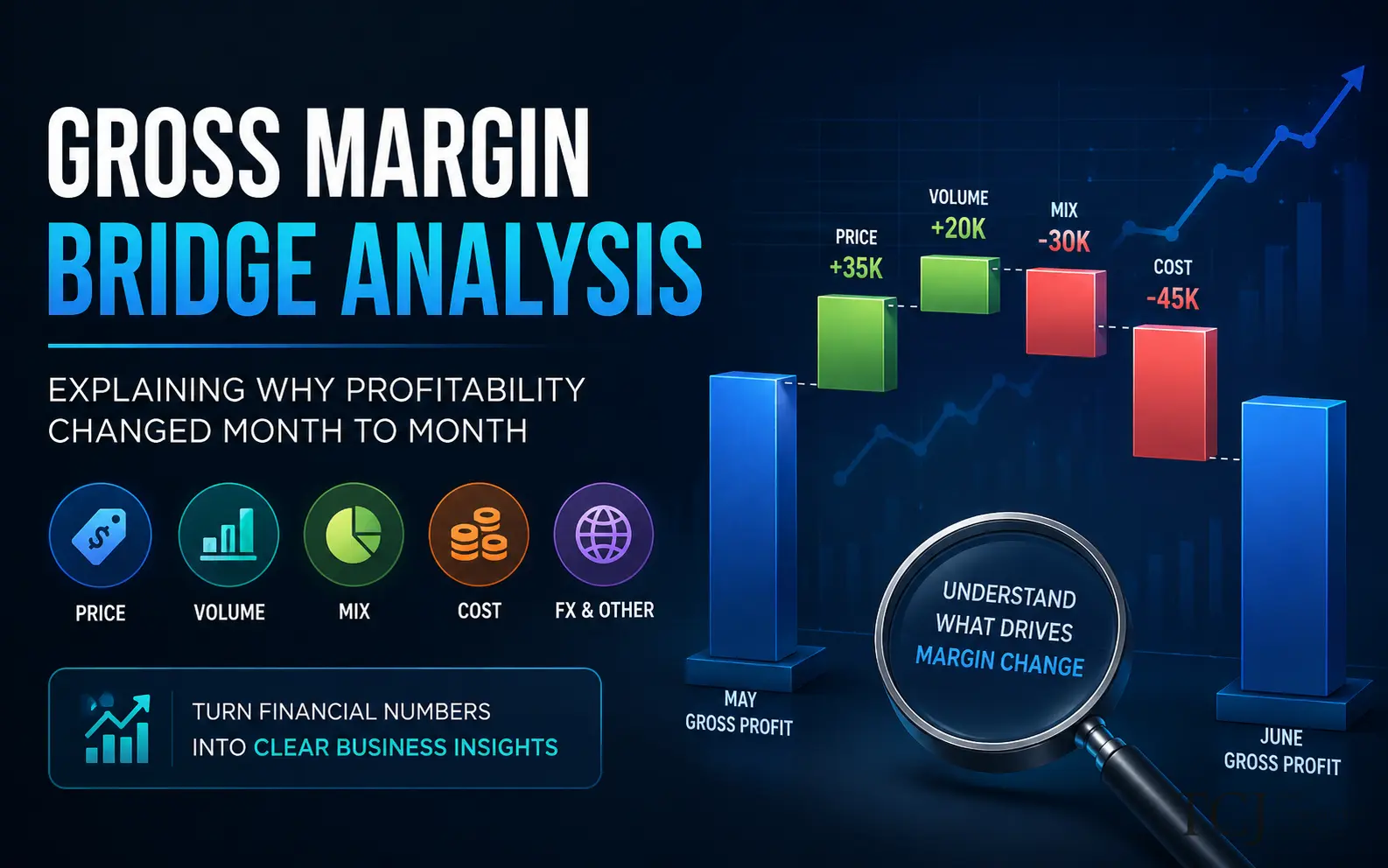
Gross Margin Bridge Analysis: Explaining Why Profitability Changed Month to Month
Gross margin bridge analysis helps finance teams explain monthly profitability changes by separating the impact of price, volume, sales mix, cost, and other operational drivers.

Revenue Quality Analysis: Durable vs One-Off Revenue in UAE Businesses
Revenue growth can look impressive while masking customer concentration, weak cash collection or temporary sales. Here is how UAE businesses, CFOs and investors can assess the durability of reported revenue.