Revenue Quality Analysis: Durable vs One-Off Revenue in UAE Businesses
Revenue growth can look impressive while masking customer concentration, weak cash collection or temporary sales. Here is how UAE businesses, CFOs and investors can assess the durability of reported revenue.
Key takeaways
- Revenue quality measures how sustainable and predictable sales are, not simply how large they are.
- Recurring customers, diversification, stable margins and reliable cash collection generally strengthen revenue durability.
- One-off projects can be profitable but should be separated from the underlying revenue base when forecasting.
- Strong revenue growth accompanied by rapidly increasing receivables may require closer cash-flow analysis.
- UAE business owners should review revenue quality before making major hiring, investment, funding or valuation decisions.
What does revenue quality actually mean?
Revenue quality describes the extent to which reported sales are sustainable, predictable and supported by normal business activity. High-quality revenue generally comes from repeat customers, recurring contracts, diversified demand and healthy cash collection. Lower-quality revenue may depend heavily on isolated contracts, exceptional transactions or commercial conditions that are unlikely to continue.
A useful revenue analysis therefore looks beyond the income statement headline.
Businesses should consider questions such as:
- How much revenue comes from repeat or contracted customers?
- What percentage depends on the largest few clients?
- Are sales converting into cash?
- Are margins stable?
- Is growth driven by normal operations or unusual transactions?
- How much revenue would remain if one major customer left?
- Does management have reasonable visibility over future sales?
These questions matter to business owners as much as they do to investors. Revenue quality can influence budgeting, valuation discussions, financing readiness, working-capital planning and decisions about hiring or expansion.
Why can strong revenue growth still be misleading?
Two companies can report identical growth rates while carrying very different levels of commercial risk. One may have hundreds of repeat customers on annual agreements. Another may have generated the same increase from two large projects that will not repeat. Treating both growth rates as equally durable can create unrealistic forecasts.
Consider a UAE professional-services firm that grows revenue by 25% after winning a major transformation assignment. The contract produces substantial billings during the year, but the engagement ends in December.
Now consider a software provider that also grows by 25%, largely through annual subscriptions renewed across hundreds of customers.
The reported growth may be similar. The visibility of next year's revenue is not.
This is why owners and CFOs should separate underlying recurring activity from exceptional sales before using historical growth as the basis for forecasts.
A strong revenue number becomes more useful when management can explain how much of it is likely to repeat, how concentrated it is and how reliably it converts into cash. — Consultant observation
What makes revenue durable?
Durable revenue usually has several supporting characteristics rather than one single feature.
Recurring or repeat customer activity
Revenue does not need to come from a subscription model to be repeatable. Accounting retainers, maintenance agreements, managed services, insurance renewals, recurring distribution orders and long-term service arrangements can all provide a degree of visibility.
For an SME, a useful starting point is to identify how much of the current year's revenue came from customers who also purchased during the previous period.
Strong customer retention
A business that repeatedly replaces lost customers may still grow, but it may need significant sales expenditure to maintain that growth.
Retention can indicate that customers continue to see value in the relationship. Management should therefore monitor customer losses alongside new sales rather than focusing only on gross additions.
A diversified customer base
Customer concentration can materially affect revenue quality.
A company generating AED 10 million from 100 reasonably distributed customers will generally face a different risk profile from a company generating the same amount when one customer represents AED 4 million.
Concentration is not automatically negative. Large strategic accounts can be valuable. The issue is whether management recognises the dependency and has contingency plans if purchasing patterns change.
Reasonably stable pricing and margins
Revenue achieved through repeated discounting can be more fragile than it first appears.
If sales increase while gross margins decline materially, management should investigate whether growth is being purchased through lower prices, higher fulfilment costs or commercially weak contract terms.
Predictable underlying demand
Businesses serving recurring operational requirements may have better visibility than businesses dependent on irregular discretionary spending.
In the UAE, recurring demand may arise from outsourced Accounting, maintenance, payroll support, compliance services, facilities management, logistics arrangements or other continuing business requirements.
What should be treated as one-off or less predictable revenue?
One-off revenue is not necessarily bad revenue. The problem arises when temporary transactions are treated as though they represent a normal future run rate.
Examples can include:
- An unusually large project completed during one financial year
- A non-recurring implementation fee
- A major customer order that is not contractually expected to repeat
- Revenue generated from a temporary surge in market demand
- A significant licensing transaction
- An exceptional sale associated with a business restructuring
- Short-term commercial activity linked to a specific event
Management accounts should make these items visible rather than allowing them to distort recurring performance.
Example 1: A fictional Dubai engineering consultancy reports AED 18 million of annual revenue, compared with AED 12 million in the prior year. Management initially describes the result as 50% growth. Further analysis shows AED 5 million came from a single project that has already been completed. For budgeting purposes, using AED 18 million as the automatic starting point for next year's forecast could therefore overstate the company's underlying revenue base.
Which metrics help assess revenue quality?
There is no single ratio that determines whether revenue is high quality. A combination of Financial and Accounting indicators usually provides a more reliable view.
Recurring revenue percentage
Management can classify revenue according to whether it is contractually recurring, historically repeatable or genuinely one-off.
The classification should reflect the business model. A distributor with repeat purchase orders will analyse recurrence differently from a SaaS company with annual subscriptions.
Customer retention and churn
Businesses with identifiable recurring customers should monitor how many customers remain active, how many leave and how much revenue is lost when they leave.
Revenue retention can be more informative than customer-count retention when account sizes vary significantly.
Customer concentration
Review the percentage of revenue generated by the largest customer, top five customers and other significant accounts.
The objective is not to eliminate major customers. It is to understand dependency.
Contract duration and revenue visibility
Signed contracts, purchase commitments and established renewal patterns may provide better visibility into future sales.
However, businesses should distinguish contractual commitments from management expectations. A sales pipeline is not the same as secured revenue.
Gross margin movement
Revenue should be reviewed together with direct costs.
If the business grows quickly but every additional dirham of revenue produces a lower contribution, the commercial quality of growth may be weakening.
Why should revenue be compared with cash flow?
Reported revenue and cash collected are not the same thing. A business can record sales while waiting weeks or months for customers to pay. If receivables expand substantially faster than revenue, management should understand why and determine whether collection risk is increasing.
For UAE SMEs, this is often a practical working-capital issue rather than merely an Accounting ratio.
A company may look profitable while facing pressure on:
- Payroll
- Supplier settlements
- VAT payments
- Corporate Tax funding
- Loan instalments
- Rent
- Inventory purchases
- Expansion expenditure
Review revenue growth alongside trade receivables, debtor ageing and operating cash generation.
Example 2: A fictional Abu Dhabi trading company increases annual sales from AED 30 million to AED 39 million. However, a significant portion of the increase comes from customers receiving longer payment terms. Receivables rise sharply and several invoices remain unpaid beyond their agreed dates. The revenue growth is real from an Accounting perspective, but its cash quality deserves closer attention before management commits to further inventory purchases.
How can a business conduct a practical revenue quality review?
A structured review can be completed without building an overly complicated Financial model.
- Break total revenue into recurring, repeat, project-based and exceptional categories.
- Compare each category with the previous financial period.
- Identify the largest customers and calculate their contribution to sales.
- Review customer retention, cancellations and lost accounts.
- Compare monthly revenue patterns for unusual spikes.
- Review gross margin by customer, product or service line where practical.
- Compare revenue growth with trade receivables and cash collection.
- Examine signed contracts, order books and renewal dates.
- Separate completed one-off projects from the forward forecast.
- Adjust budgets and valuation assumptions to reflect the more sustainable revenue base.
The objective is not to produce a single revenue quality score. It is to identify which parts of the revenue base management can reasonably rely upon and which require more cautious forecasting.
What common mistakes do business owners make?
One frequent mistake is annualising a particularly strong month or quarter without investigating what caused it.
Other common issues include:
- Treating every previous customer as guaranteed future revenue
- Including unconfirmed pipeline opportunities in expected sales
- Ignoring dependence on one major customer
- Assessing sales without reviewing gross margin
- Celebrating invoiced revenue while overlooking collection delays
- Failing to distinguish organic growth from acquired revenue
- Assuming a major completed project will automatically be replaced
- Offering excessive discounts to maintain headline growth
- Preparing budgets from total prior-year revenue without normalising exceptional items
- Using revenue growth as the main basis for valuation without considering durability
These issues can affect internal decision-making even when the underlying Accounting records are technically accurate.
What documents should be prepared for a revenue quality assessment?
A useful review normally starts with reliable source data.
Businesses should consider preparing:
- Monthly revenue reports covering at least the recent comparable periods
- Customer-level sales analysis
- Top-customer concentration schedules
- Signed customer contracts and renewal dates
- Sales pipeline reports separated from confirmed orders
- Customer retention and churn information
- Trade receivables ageing reports
- Bank and cash collection records where reconciliation is required
- Gross margin analysis by business line
- Credit notes and significant post-period adjustments
- Details of large or unusual transactions
- Management budgets and forecasts
- Relevant VAT and Corporate Tax records where revenue treatment affects compliance or reconciliation
- Notes explaining acquisitions, disposals or changes in business activity
Clean documentation also supports banking discussions, due diligence, investor reviews and Financial planning.
How can KPM Global Services UAE assist?
KPM Global Services UAE can support businesses in Dubai and across the UAE with revenue analysis, management reporting, Accounting review, cash-flow assessment and Financial planning.
Depending on the business and purpose of the review, support may include:
- Analysing recurring and non-recurring revenue
- Reviewing customer concentration
- Preparing management reporting packs
- Assessing receivables and collection trends
- Reviewing margins across customers or service lines
- Normalising historical performance for budgeting
- Supporting cash-flow forecasting
- Preparing Financial information for investors, lenders or management
- Reconciling revenue information with Accounting records
- Reviewing relevant VAT and Corporate Tax considerations with the appropriate supporting documentation
The purpose should be to give management a clearer view of what is driving performance rather than simply producing another set of historical reports.
How should revenue quality influence business decisions?
Revenue quality becomes most valuable when it changes the way management plans.
A business with highly predictable contracted revenue may be able to forecast recruitment and investment with greater confidence. A project-led company may need a larger cash buffer and more conservative assumptions between major engagements. A company with high customer concentration may prioritise diversification before adding fixed costs.
Investors and prospective buyers may also examine revenue durability when assessing future maintainable earnings. A high-growth business can still attract scrutiny if its results depend heavily on one client, unusually favourable pricing or temporary demand.
For owners, the practical lesson is straightforward: do not ask only how much the business sold. Ask how much of those sales can reasonably be expected to continue, at what margin and with what level of cash collection.
This article is for informational purposes and does not constitute legal, tax, accounting, or financial advice.
Questions and answers
Q: What is revenue quality in simple terms?
A: Revenue quality measures how reliably a company's sales can continue in future periods. Revenue supported by repeat customers, diversified demand, reasonable margins and dependable cash collection is generally more durable than isolated or exceptional sales.
Q: Is recurring revenue always better than project revenue?
A: Not necessarily. Project businesses can be highly profitable and financially strong, but their revenue may be less predictable between contracts. Management should assess pipeline visibility, customer diversification, margins and cash reserves rather than assuming one business model is automatically superior.
Q: How does customer concentration affect revenue quality?
A: High customer concentration increases dependency on a small number of accounts. If a major customer reduces spending or leaves, the impact on future revenue and cash flow can be significant, so businesses should understand and actively manage that exposure.
Q: Why can revenue increase while cash flow becomes weaker?
A: Revenue may be recognised before the customer pays, depending on the transaction and applicable Accounting treatment. If receivables and payment periods increase faster than sales, the business may report growth while experiencing greater working-capital pressure.
Q: How often should a UAE business review revenue quality?
A: Many businesses can benefit from reviewing key indicators monthly or quarterly as part of management reporting. More detailed analysis may be appropriate before preparing annual budgets, seeking finance, entering an investment transaction or making significant expansion decisions.
More in Finance
View all Finance →
How UAE Companies Can Build a Faster, More Reliable Month-End Close
A practical UAE finance guide to shortening the month-end close through better reconciliations, cut-off controls, automation, tax readiness, data quality, and clear accountability.
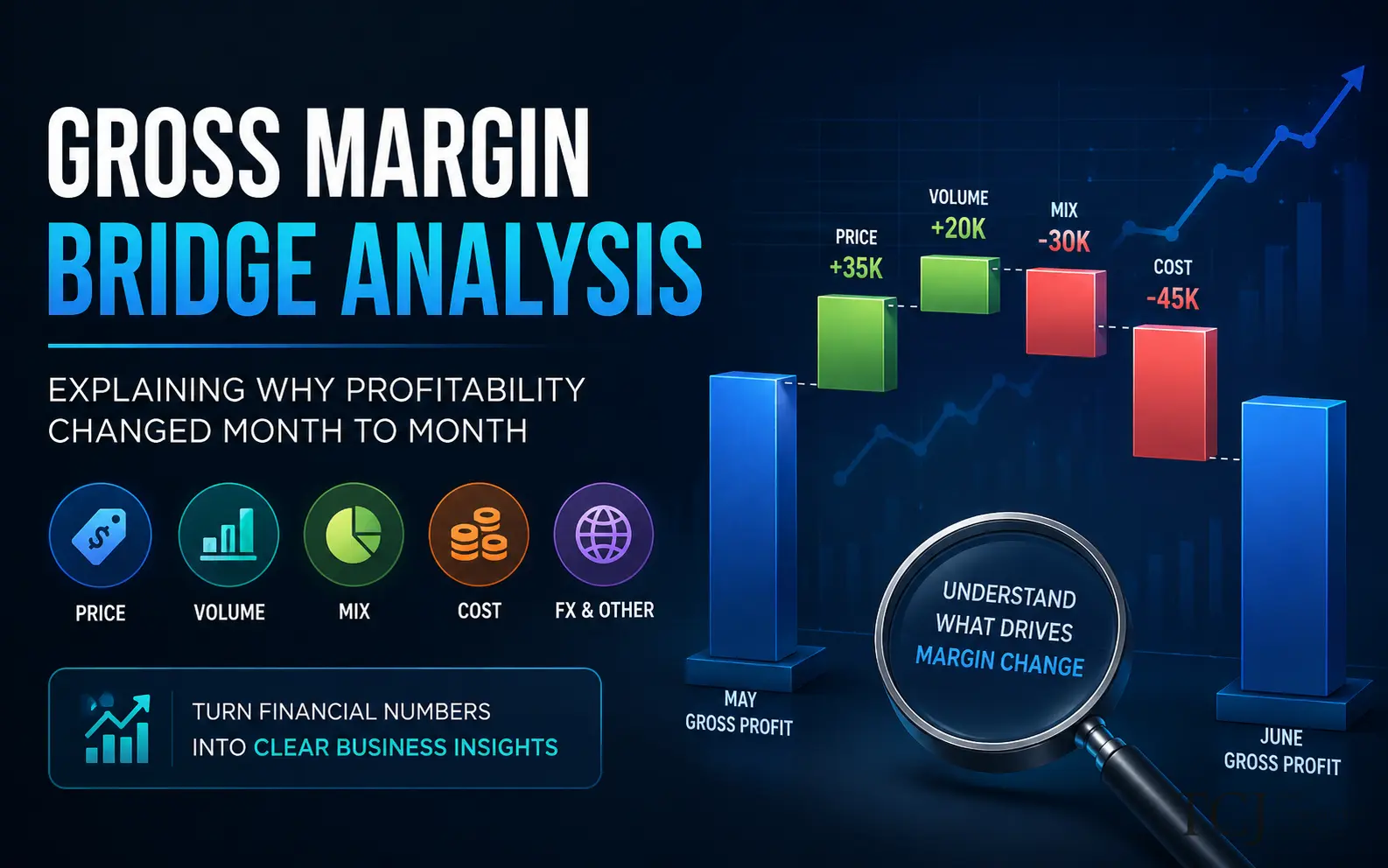
Gross Margin Bridge Analysis: Explaining Why Profitability Changed Month to Month
Gross margin bridge analysis helps finance teams explain monthly profitability changes by separating the impact of price, volume, sales mix, cost, and other operational drivers.

Cash Conversion Cycle in the UAE: Where Working Capital Gets Trapped
A practical guide for UAE business owners and finance teams on calculating the cash conversion cycle, identifying trapped working capital, and improving inventory, collections, supplier terms, and cash flow.