How UAE Companies Can Build a Faster, More Reliable Month-End Close
A practical UAE finance guide to shortening the month-end close through better reconciliations, cut-off controls, automation, tax readiness, data quality, and clear accountability.
Key takeaways
- A faster UAE month-end close should shorten the time to reliable numbers, not remove necessary Accounting controls.
- Weekly reconciliations, earlier cut-off reviews and clearer ownership can reduce the volume of work left until month-end.
- Automation works best after finance processes have been simplified and standardised.
- VAT and Corporate Tax considerations should be integrated into routine accounting rather than addressed only near filing deadlines.
- UAE eInvoicing readiness should be considered when companies redesign ERP, invoicing and Financial close workflows.
Why does a faster month-end close matter for UAE businesses?
A faster close gives management earlier visibility over revenue, margins, operating costs, cash flow, receivables, payables and other financial movements. The benefit is not speed by itself. It is reducing the time between the end of a reporting period and the point when decision-makers can confidently use the numbers.
For a growing company in Dubai, for example, waiting two or three weeks for reliable monthly figures can make it harder to identify deteriorating collections, cost overruns or unexpected pressure on working capital.
A disciplined close can help management see:
- revenue and gross-margin movements;
- cash and liquidity positions;
- aged customer balances;
- supplier liabilities;
- payroll and operating costs;
- budget-versus-actual variances;
- unusual balance-sheet movements;
- VAT-sensitive transactions; and
- items that may affect UAE Corporate Tax reporting.
Speed, however, should not come from removing necessary controls.
The most useful close is not necessarily the fastest one; it is the shortest process that still produces numbers management can rely on. — KPM Global Services UAE consultant observation
A three-day close followed by repeated corrections may be less useful than a controlled five-day close with properly reviewed reconciliations.
What usually makes the month-end close slow?
Most delayed closes are caused by accumulated dependencies rather than complex accounting alone. Finance may be waiting for procurement, sales, operations, HR, treasury or management to provide information that could have been captured or reviewed earlier in the month.
Common causes include:
- unclear ownership of closing activities;
- excessive reliance on spreadsheets;
- invoices submitted after cut-off;
- missing supplier documentation;
- manual journal entries;
- unreconciled bank transactions;
- poor customer or supplier master data;
- inconsistent VAT coding;
- late payroll information;
- slow intercompany confirmations;
- unresolved reconciliation differences;
- unnecessary approval stages; and
- corrections carried forward from previous months.
The important distinction is that many of these are operational process problems. Increasing the size of the accounting team will not necessarily solve them.
How should a UAE company structure its close calendar?
A close calendar should define every material activity, its owner, deadline, reviewer and dependency. Instead of telling the finance team to complete the accounts by Day 5, management should establish what must happen on Days 1, 2, 3 and 4 for that outcome to be realistic.
A typical sequence might include bank and accounts-payable cut-off reviews on Day 1, revenue and payroll reconciliations on Day 2, accruals and fixed assets by Day 3, balance-sheet review on Day 4, and management reporting after the key balances have been validated.
The precise timetable depends on transaction volume, systems, business complexity and group reporting requirements.
Finance should also identify what happens when an upstream department misses its deadline. A close calendar without accountability can quickly become another checklist that people ignore.
Move recurring work before the final day
One of the simplest ways to reduce pressure is to stop treating every accounting task as a month-end task.
Finance teams can consider:
- reconciling high-volume bank accounts weekly;
- reviewing aged receivables during the month;
- clearing unidentified receipts promptly;
- reviewing supplier statements before month-end;
- maintaining the fixed-asset register continuously;
- checking recurring accruals before close;
- resolving intercompany differences during the month; and
- correcting master-data issues when they arise.
This continuous-close approach does not mean producing full financial statements every day. It means preventing unresolved items from accumulating until the first few working days of the next month.
How can reconciliations be made faster without weakening control?
Standardisation is usually more effective than simply asking accountants to work more quickly. Each material reconciliation should clearly show the general-ledger balance, supporting information, reconciling items, responsibility for resolving those items, expected resolution dates and evidence of review.
Companies should also apply risk and materiality.
Cash, VAT, Corporate Tax-related balances, receivables, payables, payroll, inventory, fixed assets, intercompany balances and significant provisions may require closer attention than accounts with limited activity and low financial impact.
Persistent differences deserve particular attention.
If the same reconciliation item appears every month, finance may be maintaining a workaround rather than addressing the source of the problem.
Example 1:
A fictional Dubai trading company closes in eight working days because its finance team waits until month-end to reconcile several bank accounts and investigate unidentified customer receipts.
The company introduces weekly bank reconciliations and assigns sales administrators responsibility for helping identify unmatched collections during the month. The closing process becomes less dependent on a large backlog of cash transactions appearing on Day 1.
The improvement comes from changing when the work happens, not from reducing the review standard.
Where should automation be used in the financial close?
Automation is most useful for frequent, repetitive and rules-based processes. Businesses should first simplify and standardise a process, then assess whether technology can reduce manual work. Automating a badly designed workflow can simply reproduce existing problems more quickly.
Potential areas include:
- bank-data imports;
- customer receipt matching;
- recurring journal entries;
- depreciation;
- prepaid expense releases;
- invoice matching;
- intercompany matching;
- exchange-rate updates;
- reconciliation workflows;
- close-task monitoring; and
- recurring management-report preparation.
ERP software can support a faster close, but technology alone will not correct poor data, undefined responsibilities or weak cut-off procedures.
Why does data quality affect the close so heavily?
Many month-end adjustments begin with inaccurate information entered earlier. Incorrect account codes, VAT treatments, cost centres, supplier records or project codes create downstream corrections that finance must investigate when time is already limited.
Businesses should therefore strengthen controls over:
- the chart of accounts;
- supplier and customer master data;
- VAT codes;
- purchase orders;
- approval workflows;
- cost-centre structures;
- project codes; and
- mandatory system fields.
The best correction is often one that never has to be posted.
Finance teams should track where recurring adjustments originate. This can reveal whether the real issue sits within accounting, procurement, sales, HR or another operational process.
How should accruals and cut-off procedures be managed?
Accruals and cut-off procedures should capture material revenue and expenses in the correct reporting period without creating unnecessary estimates. A structured process reduces the need for finance teams to chase departments for invoices after month-end and helps management receive more complete financial information sooner.
Department managers can be asked to identify significant goods or services received but not yet invoiced. Purchase-order information, contracts and appropriate historical information may support the review.
Revenue cut-off also requires consistency. Businesses should have clear accounting policies for determining when revenue is recognised and ensure transactions are recorded in the appropriate period.
Example 2:
Consider a fictional UAE professional-services company with projects across Abu Dhabi and Dubai. Its finance team repeatedly receives subcontractor invoices after monthly reporting is prepared.
Rather than delaying the entire close, the company introduces a pre-close confirmation process. Project managers identify material work completed but not yet invoiced, and finance reviews the supporting information for appropriate accruals.
This gives management a more complete view of project profitability while reducing late adjustments.
How should UAE Tax requirements be built into month-end accounting?
VAT and Corporate Tax should be considered within routine accounting controls rather than reconstructed only when a return or year-end calculation is due. Strong monthly records can make it easier to identify classification issues, missing documents and unusual tax-sensitive transactions while the underlying information is still accessible.
The FTA's Corporate Tax guidance explains the interaction between accounting standards, financial statements and Corporate Tax calculations. The FTA has also emphasised the need for taxable persons to maintain records and documentation supporting information included in Corporate Tax returns.
Depending on the business, monthly checks may cover:
- VAT control accounts;
- tax invoices and credit notes;
- input and output VAT classifications;
- transactions requiring particular tax treatment;
- related-party balances where relevant;
- potentially non-deductible or restricted expenditure;
- fixed assets;
- provisions and accruals; and
- supporting documentation.
VAT-registered persons are also required to maintain specified records relating to supplies, imports, tax invoices, tax credit notes and adjustments.
Integrating these checks into normal Accounting processes is typically more efficient than trying to rebuild the information shortly before a filing or review.
What does UAE eInvoicing mean for the month-end close?
UAE eInvoicing should be treated as a finance-process issue as well as a Tax and technology requirement. Structured invoice information can affect invoice validation, accounts payable, transaction completeness, system integrations, audit trails and the quality of data available during the monthly financial close.
The Ministry of Finance defines an eInvoice as structured invoice data issued and exchanged electronically between supplier and buyer and reported electronically to the FTA. Ordinary PDFs, Word files, images, scans and email attachments do not by themselves qualify as eInvoices.
The UAE programme is being implemented in phases. For persons within scope whose annual revenue is at least AED 50 million, the deadline to appoint an Accredited Service Provider was extended to 30 October 2026, while mandatory implementation remains 1 January 2027.
For businesses with revenue below AED 50 million that are within scope, the published timetable requires appointment of an Accredited Service Provider by 31 March 2027 and implementation from 1 July 2027.
Businesses reviewing ERP, invoicing or Financial system changes should therefore consider whether current processes will support the required structured-data environment rather than building workflows that may require another redesign.
Which month-end close KPIs should management track?
Companies should measure both speed and reliability. Close duration is useful, but it should be assessed alongside late journals, unresolved reconciliation items, missed deadlines and post-close corrections.
Practical measures can include:
- total working days to close;
- percentage of close tasks completed on time;
- number of journals posted after the target date;
- number of manual journals;
- unresolved reconciliation exceptions;
- aged reconciling items;
- post-close adjustments; and
- date management reporting becomes available.
Avoid setting a target based on close speed alone. Teams may respond by postponing difficult adjustments or reducing the depth of review.
What mistakes do business owners commonly make?
Common month-end close mistakes include:
- treating the close as the finance department's responsibility alone;
- waiting until month-end to reconcile high-volume accounts;
- relying on spreadsheets without clear version control;
- allowing old reconciliation differences to roll forward repeatedly;
- accepting late invoices as unavoidable;
- automating processes before simplifying them;
- applying the same review effort to every balance;
- separating VAT and Corporate Tax reviews entirely from routine Accounting;
- closing quickly but allowing repeated post-close corrections; and
- failing to conduct a short post-close review to identify what caused delays.
Improvement usually comes from removing one recurring bottleneck at a time.
What documents and preparation should be ready before close?
A practical month-end preparation checklist may include:
bank statements and reconciliations;
customer receivable ageing;
supplier payable ageing;
supplier statements where relevant;
unbilled expense information;
revenue cut-off support;
payroll reports and related reconciliations;
fixed-asset additions, disposals and depreciation records;
inventory reports where applicable;
intercompany confirmations;
loan and financing schedules;
prepaid expense schedules;
accrual and provision support;
VAT reconciliation information;
significant Corporate Tax-sensitive transactions;
supporting tax invoices and credit notes;
unusual journal entries and approval evidence; and
explanations for significant month-on-month variances.
The exact list should reflect the company's activity, material balances, accounting policies and reporting requirements.
How can KPM Global Services UAE assist?
KPM Global Services UAE can support business owners and finance teams that want to strengthen their Accounting and Financial close processes without compromising control or Tax readiness.
Depending on the organisation's needs, support may include reviewing the existing month-end workflow, identifying recurring bottlenecks, improving reconciliation procedures, strengthening accounting documentation, reviewing management-reporting processes, supporting VAT and Corporate Tax accounting readiness, and helping businesses assess finance-process requirements around UAE eInvoicing.
The objective should be a practical process that fits the company's transaction volume, team structure, systems and reporting needs rather than imposing an unnecessarily complex finance model.
A practical approach to redesigning the close
Businesses looking to improve their close can start with a straightforward sequence:
- Map every current close activity, owner, system and dependency.
- Identify the tasks responsible for recurring delays.
- Remove reports, approvals or activities that no longer serve a meaningful purpose.
- Move suitable reconciliations and reviews earlier in the month.
- Standardise recurring journals and reconciliation procedures.
- Improve data quality at the point transactions are created.
- Automate high-volume, rules-based work where appropriate.
- Incorporate VAT and Corporate Tax checks into recurring finance processes.
- Assign an owner and reviewer to each material close activity.
- Review the close after each month and address the root causes of delays.
For many UAE SMEs, the most effective improvement is not a major ERP replacement. It is better discipline around responsibilities, cut-offs, reconciliations and documentation.
Final advisory view
A faster month-end close is primarily a finance-process design exercise.
UAE companies can often shorten reporting timelines by spreading Accounting discipline throughout the month, resolving reconciliation items earlier, improving source data and defining clearer responsibilities. Automation can then support the parts of the process that are repetitive and rules-based.
The target should remain reliable Financial information delivered sooner, supported by appropriate documentation and controls.
With UAE Corporate Tax, VAT obligations and the developing eInvoicing framework increasing the importance of structured and traceable financial information, businesses have an additional reason to make the monthly close more disciplined rather than viewing it only as an internal reporting exercise.
This article is for informational purposes and does not constitute legal, tax, accounting, or financial advice.
Questions and answers
Q: How long should a month-end close take for a UAE company?
A: There is no single correct number of days. The appropriate target depends on company size, transaction volume, systems, group-reporting requirements and complexity, but management should focus on eliminating avoidable delays while maintaining reliable controls.
Q: What is the fastest way to improve the month-end close?
A: Start by identifying the activities that repeatedly delay reporting. Moving bank reconciliations, receivable reviews, supplier checks and recurring accounting work earlier in the month can often deliver improvements before major automation is required.
Q: Does UAE Corporate Tax make monthly accounting more important?
A: Yes, accurate accounting information and supporting documentation are important to Corporate Tax reporting. Regular review of classifications, reconciliations and tax-sensitive transactions can reduce the amount of reconstruction required during annual Tax preparation.
Q: Can accounting software or ERP automatically fix a slow close?
A: Not by itself. ERP and automation can reduce repetitive manual work, but unclear responsibilities, bad source data, weak cut-off procedures and unresolved reconciliation issues normally need to be corrected at process level first.
Q: Should UAE businesses prepare for eInvoicing as part of their finance close?
A: Yes, businesses within the relevant scope should consider eInvoicing when reviewing invoice processing, ERP integration and accounting workflows. The UAE system uses structured invoice data, so preparation can affect data quality, transaction processing and the information available for the financial close.
More in Finance
View all Finance →
How to Build a Monthly Cash-Flow Dashboard for a UAE SME
A practical guide for UAE SME owners and finance teams on building a monthly cash-flow dashboard that tracks liquidity, collections, payments, tax obligations, forecasts, and working capital.
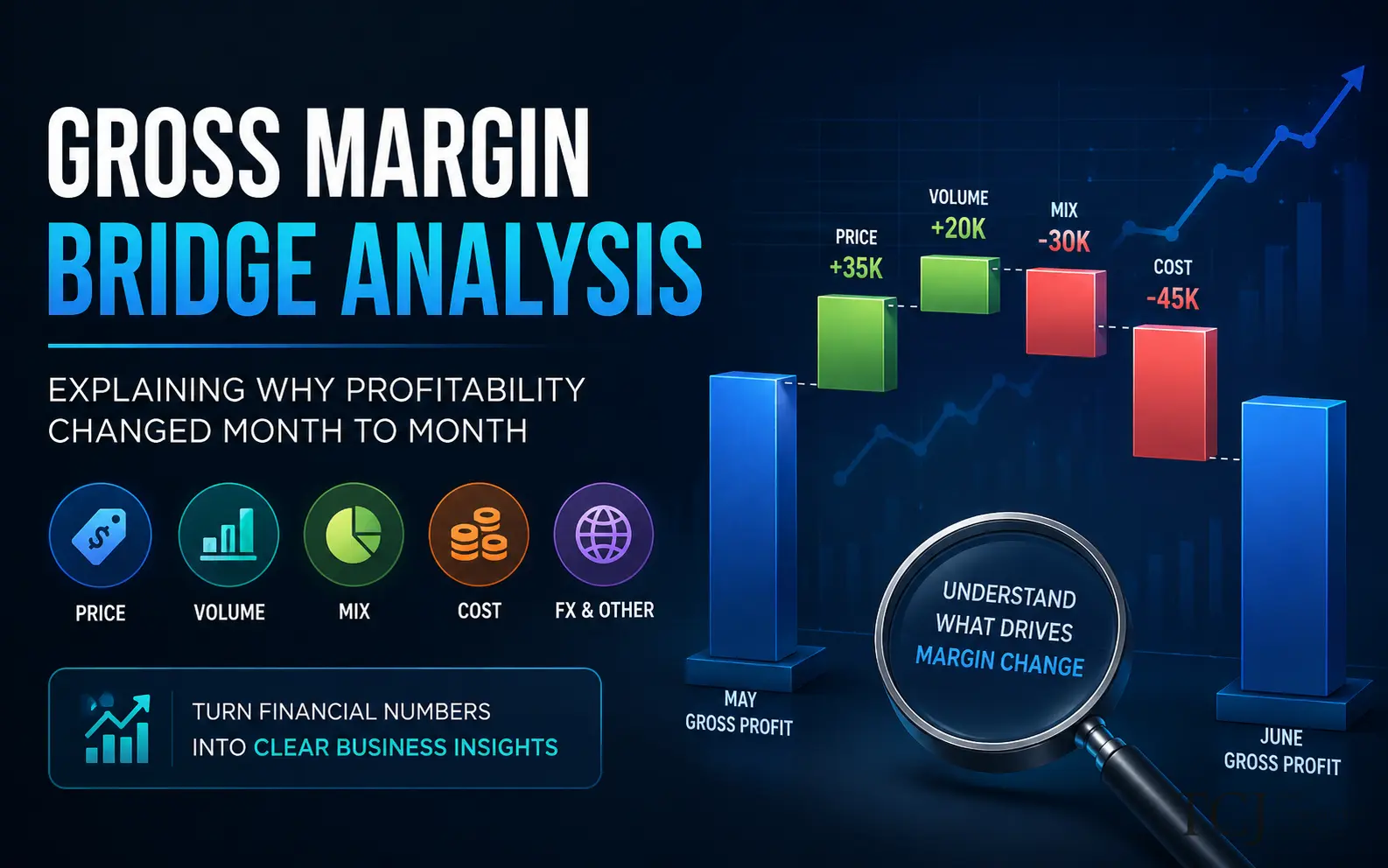
Gross Margin Bridge Analysis: Explaining Why Profitability Changed Month to Month
Gross margin bridge analysis helps finance teams explain monthly profitability changes by separating the impact of price, volume, sales mix, cost, and other operational drivers.

Revenue Quality Analysis: Durable vs One-Off Revenue in UAE Businesses
Revenue growth can look impressive while masking customer concentration, weak cash collection or temporary sales. Here is how UAE businesses, CFOs and investors can assess the durability of reported revenue.