How to Build a Monthly Cash-Flow Dashboard for a UAE SME
A practical guide for UAE SME owners and finance teams on building a monthly cash-flow dashboard that tracks liquidity, collections, payments, tax obligations, forecasts, and working capital.
Key takeaways
- A UAE SME cash-flow dashboard should track actual cash movements as well as future liquidity.
- Profit and cash are different, particularly when customer payment terms create collection delays.
- Receivables, payables, VAT, Corporate Tax and major scheduled payments should be incorporated into cash planning where applicable.
- A monthly dashboard works best when supported by a rolling short-term cash forecast.
- Reconciled Accounting data and realistic collection assumptions are more valuable than complicated dashboard visuals.
- - Management should review forecast variances regularly and assign specific actions when cash risks appear.
What is a monthly cash-flow dashboard?
A monthly cash-flow dashboard is a management view of the cash entering and leaving a business, its current liquidity, and its expected future cash position. For a UAE SME, it can bring together bank balances, customer collections, supplier payments, payroll, tax requirements and forecasts in one practical financial management process.
A cash-flow dashboard is not the same as a profit and loss statement.
A business may record revenue when it raises an invoice, but the customer may not pay for another 30, 60 or 90 days. Meanwhile, salaries, rent, suppliers and other operating costs still require cash.
That timing difference explains why a profitable business can still experience cash pressure.
A useful dashboard should quickly answer questions such as:
- How much cash did the business start the month with?
- How much money was actually collected from customers?
- How much cash was paid out?
- What is the closing bank position?
- Which customer invoices remain unpaid?
- Which supplier payments are approaching?
- How much cash should be protected for VAT or Corporate Tax?
- What is the expected cash position next month?
A useful cash-flow dashboard should help management decide what needs attention, not simply show management what happened. — Consultant observation
Why do UAE SMEs need a monthly cash-flow dashboard?
For many UAE SMEs, the main cash-flow challenge is timing rather than revenue alone. Customer credit terms, payroll, supplier commitments, rent, licence renewals, tax payments and other obligations can fall on different dates. A monthly dashboard makes these timing gaps visible and gives management an opportunity to plan ahead.
Consider a Dubai professional services company that invoices AED 300,000 during a month.
That AED 300,000 may appear as revenue in its accounting records. But if only AED 150,000 has been collected while payroll, rent and supplier payments total AED 220,000, the immediate cash position tells a different story.
The issue is not necessarily poor sales. It is the timing between invoicing and collection.
This is why UAE business owners should avoid managing liquidity from revenue figures alone.
Tax obligations also need to form part of the cash plan. For VAT-registered businesses, VAT filing and payment requirements can create recurring cash outflows. Corporate Tax may create a larger, less frequent requirement.
These amounts should not first become visible when the payment deadline is approaching. They should be reflected in financial planning based on the business's actual tax position and applicable filing periods.
What should a UAE SME cash-flow dashboard include?
A practical dashboard should focus on a limited number of figures that explain liquidity rather than filling the screen with unnecessary charts. Opening cash, actual receipts, actual payments, closing cash, receivables, payables, tax reserves and forecast cash usually provide a useful starting point.
Consider tracking:
- Opening cash balance
- Customer collections
- Other cash inflows
- Payroll payments
- Supplier payments
- Rent and operating expenses
- VAT and Corporate Tax payments where applicable
- Financing payments
- Capital expenditure
- Total cash inflows
- Total cash outflows
- Net cash flow
- Closing cash
- Accounts receivable
- Overdue receivables
- Accounts payable
- Forecast closing cash
The dashboard should reflect the company's business model.
A UAE trading company may need to monitor inventory purchases, supplier deposits and import-related cash movements closely. A consultancy may place greater emphasis on project billing, receivables and payroll.
A growing business may also need to track cash burn and available runway.
There is no benefit in adding a metric simply because another company uses it. Every metric should answer a management question.
What financial information should you gather first?
Reliable dashboards begin with reliable accounting records. Before designing charts or KPI cards, gather reconciled bank balances, receivables, payables, payroll commitments, tax information, financing schedules and planned expenditure. If these inputs are incomplete or outdated, a visually impressive dashboard can still give management the wrong picture.
The preparation process should typically include the following sources:
- Reconciled business bank accounts
- Accounting system transactions
- Customer invoice and receivables reports
- Supplier bills and accounts payable reports
- Payroll records
- VAT records
- Corporate Tax estimates where applicable
- Loan and financing schedules
- Planned capital expenditure
- Rent and lease commitments
- Insurance renewals
- Trade licence and other renewal costs
- Recurring software and operating commitments
Bank reconciliation deserves particular attention.
If the opening cash figure does not agree with the accounts included within the dashboard, the closing position and forecast can become unreliable.
How do you build the monthly cash-flow calculation?
Start with a simple cash bridge rather than complicated financial modelling. The core calculation is opening cash plus actual cash inflows minus actual cash outflows. The result becomes closing cash, which normally carries forward as the following month's opening position, subject to reconciliations and the accounts included in the model.
The basic formula is:
Opening Cash + Cash Inflows − Cash Outflows = Closing Cash
For example, assume a UAE SME starts the month with AED 400,000.
During the month, it collects AED 250,000 from customers and receives another AED 10,000 of cash inflows. It pays AED 230,000 for payroll, suppliers, overheads, taxes and other expenses.
The calculation becomes:
AED 400,000 + AED 260,000 − AED 230,000 = AED 430,000
The following month would normally start with AED 430,000.
Should cash movements be separated by type?
Yes. As the dashboard develops, separating operating, investing and financing cash flows can help owners understand why the bank balance changed.
Operating cash flow may include customer collections, salaries, suppliers, rent, marketing and normal business expenses.
Investing cash flow may include equipment purchases, technology investments, vehicles and proceeds from asset disposals.
Financing cash flow may include new loans, shareholder funding, financing repayments and distributions where relevant.
This distinction matters.
An AED 200,000 increase in cash resulting from stronger customer collections is different from an AED 200,000 increase created by new borrowing. The closing bank balance may be identical, but the financial story is not.
Example 1: A Dubai consultancy finishes the month with AED 500,000 in the bank, up from AED 350,000. At first glance, liquidity appears to have improved substantially. The dashboard shows, however, that AED 200,000 came from new financing while operating activities consumed AED 50,000. Management can now see that the higher bank balance does not represent stronger operating cash generation.
Which cash-flow KPIs should management monitor?
The most useful KPIs explain both the current cash position and what may happen next. UAE SMEs can typically start with net cash flow, closing cash, forecast-versus-actual performance, overdue receivables and forecast closing cash. Businesses consuming cash deliberately may also find cash burn and runway useful.
Net cash flow
Use:
Net Cash Flow = Total Cash Inflows − Total Cash Outflows
A positive number means cash increased during the period. A negative number means cash decreased.
One negative month does not automatically indicate a problem. Annual insurance, equipment purchases, tax settlements or other planned payments can produce temporary negative cash flow.
The reason for the movement matters.
Closing cash
Closing cash shows the amount remaining within the bank accounts or cash pool covered by the dashboard.
It should be reconciled to the relevant bank balances rather than treated purely as a spreadsheet calculation.
Forecast versus actual
Compare what management expected with what actually happened.
Use:
Actual Cash Flow − Forecast Cash Flow = Variance
Then investigate material differences.
A variance may result from delayed customer collections, unexpected supplier costs, higher payroll, postponed sales or expenditure that occurred earlier than planned.
Overdue receivables
Receivables should be divided into useful aging groups, such as:
- Current
- 1–30 days overdue
- 31–60 days overdue
- 61–90 days overdue
- More than 90 days overdue
The objective is not merely to report overdue invoices. Management should identify which overdue balances could materially affect liquidity.
Cash runway
For businesses consistently consuming cash, a basic calculation is:
Cash Runway = Available Cash ÷ Average Monthly Net Cash Burn
The calculation should be treated carefully. Seasonal companies and businesses with significant one-off payments may find that a simple average gives a misleading picture.
Use the detailed forecast alongside the headline runway figure.
How should VAT and Corporate Tax appear in the dashboard?
VAT and Corporate Tax should be treated as expected cash requirements rather than ordinary available cash where a liability is anticipated. Management can separately track the estimated liability, amount reserved and expected payment period, based on the company's actual tax position and applicable UAE requirements.
For VAT, the dashboard can show:
- Estimated VAT payable
- Cash provision or reserve
- Applicable tax period
- Expected payment date
For Corporate Tax, management can similarly monitor:
- Estimated Corporate Tax provision
- Cash reserved
- Expected payment amount
- Expected payment period
The purpose of these figures is not to calculate the final tax liability inside the dashboard. That calculation should come from the company's Accounting and Tax records and appropriate professional review.
The dashboard makes the expected cash consequence visible.
How do receivables and payables affect cash flow?
Receivables and payables explain much of the difference between accounting performance and available cash. Sales growth can increase working-capital pressure when customers pay slowly while employees and suppliers must be paid sooner. A useful dashboard therefore connects outstanding invoices and supplier obligations to expected payment dates.
Example 2: A mainland UAE trading business experiences a strong sales month, but several large customers have 60-day payment terms. The company must pay suppliers substantially earlier. Revenue is growing, yet its forecast shows a temporary liquidity gap. Management responds by prioritising collections and reviewing the timing of non-essential purchases.
For major customers, management should be able to see:
- Total amount outstanding
- Amount overdue
- Oldest unpaid invoices
- Expected collection date
- Person responsible for follow-up
The same principle applies to suppliers.
Knowing that the business owes AED 150,000 is useful. Knowing that AED 120,000 is due before a major customer payment is expected is much more useful for cash management.
Should you add a cash-flow forecast?
Yes. A dashboard that only explains the previous month remains backward-looking. Adding a three-to-six-month forecast allows management to anticipate future collections, payroll, suppliers, tax payments, financing commitments and major expenditure before those cash movements reach the bank account.
Forecasts can include:
- Expected customer collections
- Recurring cash receipts
- Payroll
- Supplier payments
- Rent and overheads
- Inventory purchases
- Marketing expenditure
- Capital expenditure
- Financing repayments
- VAT
- Corporate Tax
- Licence and insurance renewals
- Other known commitments
Collection assumptions deserve particular care.
Do not automatically assume every invoice will be paid on its contractual due date. Where sufficient history exists, forecast based on realistic customer payment behaviour.
Management can also maintain base, downside and upside scenarios.
For example, a downside scenario might assume that one or two major customers pay 30 days later than expected. This helps management see the effect before a delay actually occurs.
Why connect the dashboard to a 13-week cash forecast?
A monthly dashboard is useful for management reporting, but monthly totals can hide short-term liquidity gaps.
Suppose AED 250,000 is expected from customers on the 28th of the month, while AED 220,000 of payroll and supplier payments must be made on the 20th.
The monthly forecast may appear healthy. The weekly cash position may not.
A rolling 13-week forecast provides a more detailed view of near-term receipts and payments. In practice, the monthly dashboard can provide the management view while the 13-week forecast supports short-term liquidity control.
How should management review the dashboard?
Reviewing the dashboard consistently is as important as building it. A monthly finance meeting should reconcile the closing position, explain forecast variances, review overdue invoices, assess upcoming payments, update tax requirements and refresh future assumptions. Cash-sensitive businesses may need more frequent short-term reviews.
A practical monthly process is:
- Reconcile the closing cash balance.
- Compare actual cash flows with forecast.
- Investigate significant variances.
- Review overdue receivables.
- Review upcoming supplier commitments.
- Update VAT and Corporate Tax requirements where applicable.
- Refresh the next three to six months of forecasts.
- Review the rolling 13-week cash position.
- Identify the lowest forecast cash point.
- Assign specific actions and owners.
Actions should be measurable.
"Improve collections" is too vague.
"Finance manager to follow up the AED 80,000 overdue customer balance by Thursday" gives the dashboard an operational purpose.
What common cash-flow dashboard mistakes should UAE businesses avoid?
Most dashboard problems come from poor inputs or unrealistic assumptions rather than complicated formulas. Common issues include confusing profit with cash, relying on unreconciled balances, forecasting invoices instead of actual collections, overlooking tax and annual commitments, and allowing outdated forecasts to remain unchanged.
Common mistakes include:
- Confusing profit with cash. Revenue and accounting profit do not automatically represent available bank cash.
- Using unreconciled bank balances. Errors at the opening position flow through the rest of the dashboard.
- Forecasting invoices instead of collections. The forecast should consider when customers are realistically expected to pay.
- Forgetting VAT or Corporate Tax. Applicable tax payments can create concentrated cash requirements.
- Missing one-off expenses. Licence renewals, insurance, bonuses, equipment and annual commitments can materially affect a particular month.
- Adding too many KPIs. The dashboard should highlight decisions, not overwhelm management with data.
- Reporting history without forecasting. Historical numbers explain what happened but do not identify future cash gaps.
- Leaving assumptions unchanged. Forecasts need updating when projects, customers, payment dates or spending plans change.
- Having no clear owner. Someone should be responsible for data accuracy, forecast updates and follow-up actions.
What documents should you prepare?
A reliable dashboard depends on a repeatable monthly preparation process. Before each reporting cycle, collect the financial records that explain current cash and future commitments.
The preparation checklist should typically include:
- Latest bank statements
- Completed bank reconciliations
- Accounts receivable aging
- Accounts payable aging
- Customer collection schedule
- Supplier payment schedule
- Payroll information
- VAT records and expected liabilities
- Corporate Tax estimates where applicable
- Loan and financing schedules
- Lease and rent commitments
- Trade licence renewal dates and expected costs
- Insurance renewal information
- Planned capital expenditure
- Major contracts affecting receipts or payments
- Previous cash-flow forecast
- Current budget
- Notes explaining material forecast-versus-actual variances
How can KPM Global Services UAE assist?
KPM Global Services UAE can support SMEs that need clearer Financial and Accounting information for cash-flow management. Depending on the business and scope, this can include reviewing Accounting records, management reporting, receivables and payables information, cash-flow forecasting, budgeting and the financial information used for Tax planning.
The objective should be to establish a reporting process management can maintain and use regularly, rather than creating a complicated dashboard that becomes outdated after a few months.
For businesses in Dubai and across the UAE, the appropriate structure will depend on transaction volume, business activity, number of entities, bank accounts, currencies and the quality of existing Accounting records.
A practical starting point for UAE business owners
A useful cash-flow dashboard does not need to begin with sophisticated software.
Start with reconciled cash. Add actual receipts and payments. Connect receivables and payables to expected dates. Include material VAT and Corporate Tax requirements. Build a realistic forecast and compare it with actual results every month.
As the business grows, reporting can become more automated and detailed.
The test remains simple: can management look at the dashboard and understand what cash is available, what is expected to arrive, what must be paid and where pressure could emerge?
If the answer is yes, the dashboard is doing useful work.
This article is for informational purposes and does not constitute legal, tax, accounting, or financial advice.
Questions and answers
Q: What should a UAE SME cash-flow dashboard include?
A: A practical dashboard should include opening cash, actual receipts, cash payments, net cash flow, closing cash, receivables, overdue invoices, payables, major upcoming commitments and forecast cash. VAT and Corporate Tax cash requirements should also be included where applicable.
Q: Can a UAE SME build a cash-flow dashboard in Excel?
A: Yes. Excel can be sufficient for many SMEs with straightforward Financial and Accounting requirements. Keep source data, assumptions and dashboard calculations clearly separated so figures can be reviewed and reconciled.
Q: How often should a cash-flow dashboard be updated?
A: A formal management dashboard can typically be reviewed monthly, while businesses with tighter liquidity may need weekly cash updates. A rolling 13-week forecast can complement the monthly dashboard when payment timing needs closer monitoring.
Q: What is the difference between a cash-flow dashboard and a cash-flow forecast?
A: A cash-flow dashboard summarises current and historical cash information alongside management KPIs. A cash-flow forecast estimates future receipts, payments and balances, so a useful dashboard will often incorporate forecast information.
Q: Should VAT and Corporate Tax be included in UAE cash-flow planning?
- A: Yes, where they create expected cash obligations for the business. The amounts and timing should be based on the company's actual Tax position, applicable periods and current UAE requirements rather than generic assumptions.
More in Finance
View all Finance →
How UAE Companies Can Build a Faster, More Reliable Month-End Close
A practical UAE finance guide to shortening the month-end close through better reconciliations, cut-off controls, automation, tax readiness, data quality, and clear accountability.
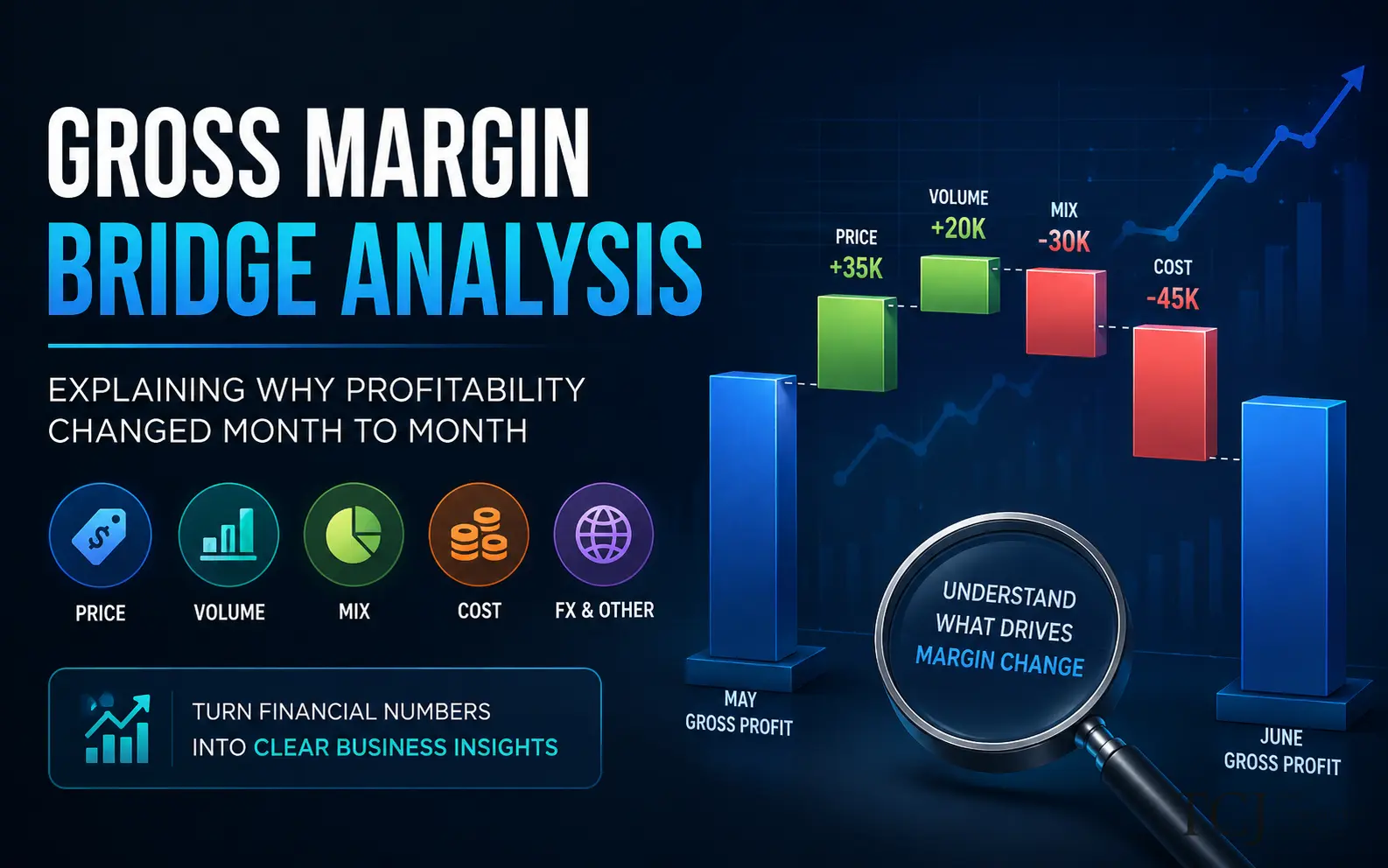
Gross Margin Bridge Analysis: Explaining Why Profitability Changed Month to Month
Gross margin bridge analysis helps finance teams explain monthly profitability changes by separating the impact of price, volume, sales mix, cost, and other operational drivers.

Revenue Quality Analysis: Durable vs One-Off Revenue in UAE Businesses
Revenue growth can look impressive while masking customer concentration, weak cash collection or temporary sales. Here is how UAE businesses, CFOs and investors can assess the durability of reported revenue.