Crypto Payment Gateways for International Businesses
Crypto payment gateways let international businesses accept digital-asset payments and settle in the currency they actually want. Here is how they work, what they cost, the compliance you cannot skip, and how to choose one from the UAE.
Key takeaways
- A crypto payment gateway accepts digital-asset payments from customers and can settle to the merchant in crypto, stablecoins, or fiat — removing most price-volatility risk when you settle to fiat or stablecoins instantly.
- The strongest use case is cross-border: faster settlement, fewer intermediaries, and access to customers in markets where cards and correspondent banking are slow or unreliable.
- Crypto payments are push-based, so there are effectively no card-style chargebacks — but that shifts the burden onto refunds policy and fraud screening rather than removing risk.
- Compliance is the real work: KYC/AML, sanctions screening, travel-rule data, and clean records. In the UAE, virtual-asset payment activity can fall under VARA or Central Bank oversight.
- Choose a gateway on settlement options, supported chains and stablecoins, fee transparency, payout reliability, and the quality of its compliance tooling — not on the lowest headline rate.
For an international business, getting paid is harder than it looks. Card networks charge meaningfully on cross-border transactions, correspondent banking can take days, and customers in some of your fastest-growing markets may not have access to the payment rails you assume are universal. Crypto payment gateways exist to close that gap: they let a customer pay in a digital asset and let you, the merchant, receive funds in the currency you actually want to hold — often faster and with fewer intermediaries than the traditional route.
This article explains how these gateways work, where they genuinely help international businesses, the fees and risks you should price in, the compliance you cannot skip, and a concrete checklist for choosing a provider from the UAE.
What a crypto payment gateway actually does
A crypto payment gateway sits between your customer and your bank account, much like a card processor does. The difference is what it accepts and how it settles.
At checkout, the customer chooses to pay with a digital asset. The gateway generates a payment request, the customer sends the funds from their wallet, and the gateway confirms the transaction on the relevant blockchain. Then comes the part that matters most for a business: settlement. A good gateway lets you decide what you receive. You can settle to:
- Fiat (for example, dirhams or US dollars) paid into your bank account;
- a stablecoin designed to track a fiat currency, held in a wallet you control; or
- the original crypto, if you specifically want to hold the asset.
For the vast majority of merchants, instant settlement to fiat or a stablecoin is the right default. It means the customer's choice of asset is their problem, not yours — the gateway absorbs the brief conversion window, and you receive a predictable amount. The popular fear that "accepting crypto means betting on crypto" only applies if you choose to hold the asset.
Accepting crypto and speculating on crypto are two different decisions. A well-configured gateway lets you do the first without doing the second.

Why international businesses are the natural fit
Domestic businesses with reliable card processing and fast local banking often have little reason to add crypto. The case gets much stronger the moment your customers, suppliers, or contractors are spread across borders.
Settlement speed and fewer intermediaries
Cross-border card and bank payments pass through multiple intermediaries, each adding time and cost. On-chain settlement can clear in minutes regardless of geography. For a business waiting days for international funds to land, faster access to working capital is a real operational gain, not a novelty.
Reach into underbanked or card-light markets
In several high-growth markets, card penetration is low, but smartphone and wallet usage is high. A crypto option can let you capture customers who simply cannot pay you any other way. For a business pursuing international expansion, that reach can be decisive — and it pairs naturally with a deliberate market-entry plan, which is exactly what launching your brand overseas is about.
Predictable cross-border pricing
Card interchange and FX margins on international transactions can be opaque and variable. Stablecoin settlement gives you a clearer, more predictable cost per transaction, which makes pricing and margin planning easier across markets.
Paying out, not just collecting
Gateways are increasingly two-way. If you pay international contractors, suppliers, or affiliates, settling in stablecoins can be faster and cheaper than wires — provided you handle the compliance properly, which we return to below.
The chargeback question — a feature and a trap
One of the most cited advantages of crypto payments is the absence of chargebacks. It is true, but it needs to be understood precisely.
Card payments are pull-based: the merchant pulls funds, and the network can reverse them if the cardholder disputes the charge. This enables a category of "friendly fraud" where customers receive goods and then claw back the payment. On-chain crypto payments are push-based: the customer sends the funds, and there is no central authority that can unilaterally reverse a confirmed transaction.
For merchants plagued by chargeback fraud, this is genuinely valuable. But finality cuts both ways:
- Refunds become a policy, not a network feature. If a customer deserves a refund, you must send it deliberately. Your refund terms and operational process now carry the weight the card network used to.
- Mistakes are final. Send to the wrong address or refund the wrong amount, and there is no reversal. Process discipline matters.
- You must screen for tainted funds. No chargebacks does not mean no fraud. You need sanctions and risk screening so you are not receiving proceeds of crime, which is both a legal obligation and a reputational risk.
So "no chargebacks" is better understood as "risk moves from disputes to compliance and process." That is usually a good trade for an international business, but only if you build the process.
Fees: what you actually pay
Headline rates are the wrong thing to optimise. Look at the full stack:
- Gateway processing fee — the provider's percentage or flat fee per transaction. Often lower than cross-border card rates, but compare like for like.
- Network (gas) fees — the cost of the blockchain transaction itself, which varies enormously by chain. Low-fee networks and stablecoins on efficient chains keep this small; congested networks can spike.
- Conversion spread — when the gateway converts crypto to your settlement currency, there is a spread. Ask for it explicitly.
- Payout fees — moving settled fiat to your bank, or stablecoins to your wallet, may carry a charge.
- FX, if any — if you settle in a currency different from your pricing currency.
The lowest advertised rate frequently hides a wide conversion spread or unreliable payouts. A slightly higher, fully transparent fee from a provider that always pays out on time is the better business decision.
Compliance is the real project
This is the part founders underestimate, and it is where regulators focus. Accepting digital-asset payments touches anti-money-laundering law directly, because crypto's speed and reach make it attractive to bad actors. You are expected to manage that.
Practically, a compliant crypto payments operation needs:
- KYC on customers where required, proportionate to risk and transaction size;
- AML monitoring for suspicious patterns;
- Sanctions screening so you do not transact with prohibited parties or addresses;
- Travel-rule data — for transfers above thresholds, originator and beneficiary information must travel with the transaction between regulated providers;
- Clean, auditable records of every payment, conversion, and payout.
In the UAE, virtual-asset payment activity can fall under VARA in Dubai, the regimes of free zones such as ADGM and DIFC, or the Central Bank where payment tokens are involved. The good news is that you usually do not have to build all of this yourself: a properly licensed gateway carries much of the regulated burden. But you remain responsible for your own licensing, activity codes, and internal controls. The exposure here is significant enough that we treat it separately in Common Legal Risks in Crypto Business Models — read it before you go live.
Regulators rarely punish businesses for accepting crypto. They punish businesses for accepting crypto without controls. The technology is fine; the absence of process is the offence.
If your business model genuinely runs on digital-asset payments, expect this to surface in any future fundraise or sale, where investors will test exactly these controls — a theme we cover in how crypto startups can prepare for due diligence.
VAT, accounting, and the records you must keep
A crypto payment is still a sale, and the UAE's tax rules still apply. Every transaction has a value in your reporting currency at the time of sale, a settlement amount, and fees — all of which must be recorded for VAT and corporate tax purposes. If you choose to hold crypto rather than settle instantly, disposals later can create gains or losses that also need to be tracked.
This is not optional bookkeeping. Weak records around digital-asset flows are one of the fastest ways to create a tax problem and to fail an audit. A specialist VAT expert and a digital-asset-literate accountant are worth engaging early, and the discipline involved is the subject of why crypto founders need strong financial reporting. For the broader tax posture, the Corporate Tax and Compliance desk has more.
A checklist for choosing a gateway
Use this to compare providers on what actually matters:
- Settlement options. Can you settle to fiat, stablecoins, and crypto, and switch easily? Instant fiat or stablecoin settlement should be available.
- Supported assets and chains. Does it support the assets your customers hold and efficient, low-fee networks for settlement?
- Fee transparency. Are the processing fee, network fees, and conversion spread all disclosed clearly?
- Payout reliability. What is the track record on payout timing? Talk to existing merchants if you can.
- Compliance tooling. Does it provide KYC, sanctions and AML screening, and travel-rule support out of the box?
- Licensing. Is the provider appropriately licensed in the relevant jurisdictions, including for UAE activity?
- Integration. Does it fit your stack — hosted checkout, plugins for your platform, and a clean API?
- Refund and dispute handling. How are refunds processed, given finality? Is there tooling to help?
- Reporting and exports. Can you export clean transaction data for your accountant and auditors?
- Support. Is there responsive human support when a payout or integration issue arises?
A provider that scores well on compliance, settlement, and payout reliability beats one with a marginally lower rate every time.
A sensible rollout
You do not have to flip your entire business to crypto overnight. A measured rollout looks like this:
- Pilot with instant fiat or stablecoin settlement. Remove price risk from day one and learn the operational rhythm.
- Offer it as an option, not a replacement. Let customers who prefer crypto use it while everyone else pays as before.
- Instrument everything. Capture clean records and watch settlement timing, fees, and fraud signals.
- Tighten compliance before you scale volume. Make sure KYC, screening, and travel-rule handling are solid before payments grow.
- Expand assets and payouts once the basics are proven. Add support for paying contractors and suppliers in stablecoins when your controls can handle it.
The bottom line
Crypto payment gateways are not a gimmick for international businesses — they are a practical answer to slow cross-border settlement, expensive interchange, and customers your existing rails cannot reach. The technology has matured to the point where you can accept digital assets while receiving clean, predictable fiat or stablecoin settlement, with no card-style chargebacks. The catch is that the value sits on top of real compliance work: KYC, screening, travel-rule data, clean records, and correct licensing. Treat that as the core of the project, not an afterthought, and a crypto gateway becomes a genuine competitive advantage.
If you are weighing whether and how to add crypto payments from a UAE base — including licensing, settlement, and the tax treatment — book a free consultation and we will help you scope it properly. You can also explore more on the Crypto and Banking desks.
This article is general information for businesses operating internationally and is not legal, tax, or financial advice. Confirm licensing and tax obligations with qualified advisers before accepting digital-asset payments.
Questions and answers
Will I be exposed to crypto price swings if I accept crypto payments?
Not if you configure instant settlement to fiat or a stablecoin. Most reputable gateways convert the customer's payment at the moment of the transaction and pay you in the currency you choose, so the volatility risk sits with the gateway during the brief conversion window, not with you. You only carry price risk if you deliberately choose to hold the crypto you receive.
Are there chargebacks with crypto payments?
On-chain crypto payments are push transactions initiated by the payer, so there is no card-network mechanism to claw funds back unilaterally. That eliminates classic chargeback fraud, but it does not eliminate disputes. You still need a clear refund policy, and you should screen for fraud and stolen funds, because once you refund or send funds on-chain the transfer is final.
Is it legal to accept crypto payments from the UAE?
Accepting digital-asset payments is possible within the UAE's regulatory framework, but the activity can fall under the Virtual Assets Regulatory Authority (VARA) in Dubai, free-zone regulators such as ADGM or DIFC, or the Central Bank where payment tokens are involved. The practical path for most businesses is to use a licensed gateway that handles the regulated parts, and to confirm your own licensing and activity codes are correct.
Should I accept Bitcoin, or stablecoins, or both?
For commerce, stablecoins are usually the better default because their value is designed to track a fiat currency, which makes pricing and accounting simpler. Many businesses accept major assets like Bitcoin and Ether for reach but settle everything to a stablecoin or fiat immediately. Let customers pay in what they hold, and you receive what you can account for cleanly.
How are crypto payments taxed and recorded in the UAE?
You still need proper books. Each transaction has a value at the time of sale, a settlement amount, and gateway fees, all of which must be recorded for VAT and corporate tax purposes. If you hold crypto rather than settling instantly, gains or losses on disposal also matter. Strong reporting from day one prevents painful reconstruction later — work with an accountant who understands digital-asset flows.
More in Crypto
View all Crypto →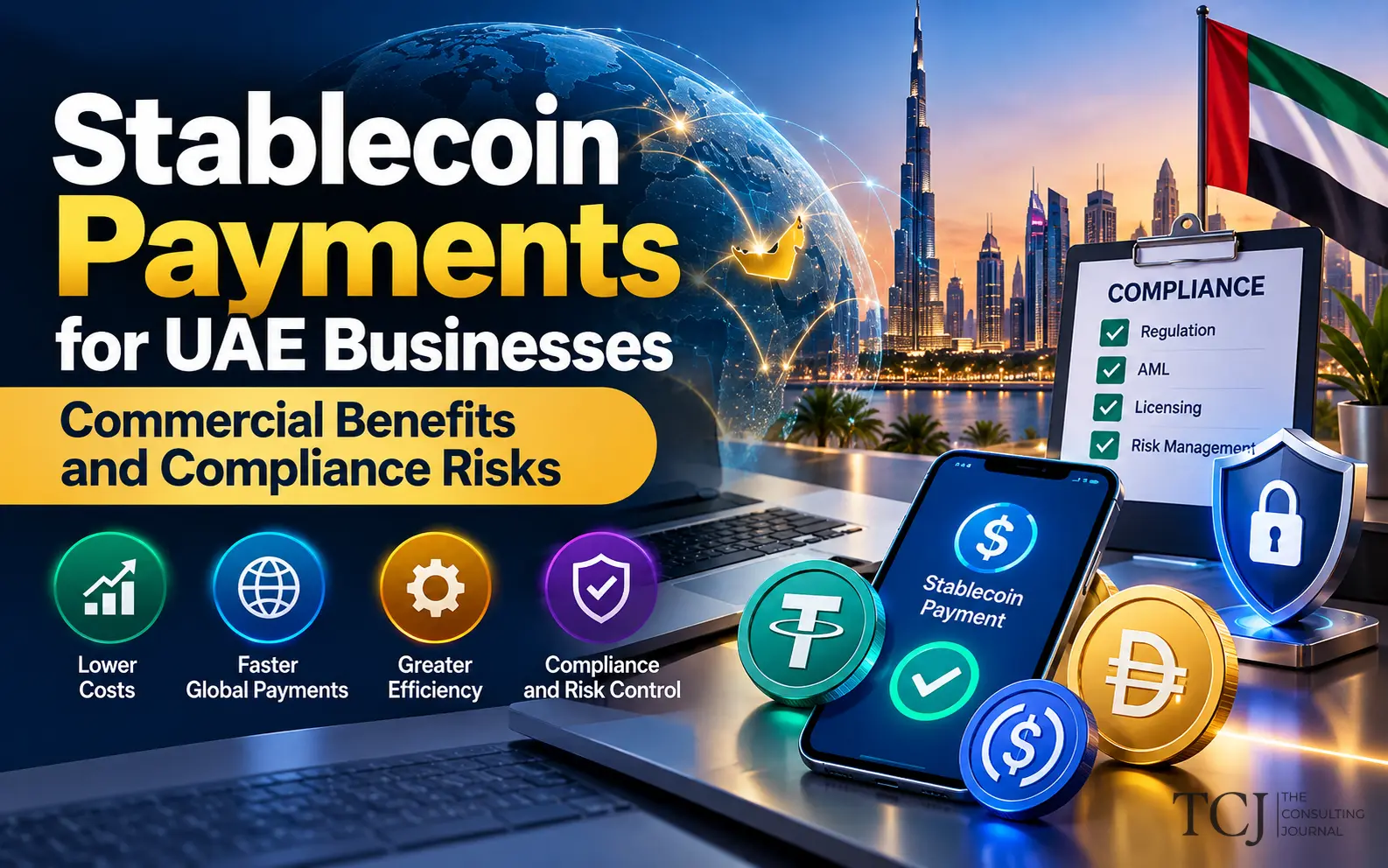
Stablecoin Payments for UAE Businesses: Benefits, Regulations and Risks
Stablecoin payments offer UAE businesses new possibilities for cross-border settlements and financial operations. Explore commercial benefits, CBUAE regulations, compliance risks, and practical steps before adoption.

VARA Licence Categories Explained: Which Dubai Virtual-Asset Activity Fits Your Model?
Dubai’s virtual-asset framework is activity based, meaning there is no single generic crypto licence. This guide explains the eight VARA licence categories, how different business models may fall within them, and what founders should assess before launching a virtual-asset business in Dubai.

When Does a Spanish Digital-Asset Business Need a VARA Licence in Dubai?
Spanish crypto and digital-asset firms expanding to Dubai need to assess activities, entity location, marketing and licensing separately. This guide explains when VARA may apply, how MiCA fits, and what businesses should prepare before launch.