Italian-Owned Web3 Company in Dubai: 2026 Setup Guide
Italian founders can establish Web3 companies in Dubai, but the right licence, jurisdiction and regulatory pathway depend on the actual business model and whether VARA-regulated virtual-asset activities are involved.
Key takeaways
- Italian founders can own eligible Web3 companies in Dubai, subject to the applicable commercial and regulatory requirements.
- A Web3 company does not automatically require the same licence as a virtual-asset exchange, broker, custodian or investment business.
- VARA regulates specified virtual-asset activities across Dubai mainland and free zones except DIFC.
- A Dubai free-zone company is not automatically entitled to 0% Corporate Tax on all income.
- Italian founders should consider personal tax residence, company management and cross-border arrangements alongside UAE incorporation.
Establishing an Italian-Owned Web3 Company in Dubai
Dubai offers Italian entrepreneurs several routes for establishing blockchain, Web3 and virtual-asset businesses. The practical challenge is not simply registering a company. Founders first need to determine what the Dubai entity will actually do, how it will earn revenue, whether it will handle virtual assets and which regulatory approvals apply.
A blockchain software developer, for example, can have a very different licensing profile from a crypto exchange, custodian, broker, token issuer or virtual-asset investment platform.
For this reason, the commercial licence should follow the business model rather than define it.
“For Web3 founders, the licence should follow the business model—not the other way around.” — KPM Global Services UAE, consultant observation
Can an Italian citizen own a Web3 company in Dubai?
Yes. Italian nationality does not prevent an entrepreneur from establishing or owning an eligible Dubai company. VARA also states that there are no nationality restrictions on persons submitting a VASP licence application, although the application must be made through an eligible Dubai legal entity established with DET or a Dubai free zone outside DIFC.
This makes Dubai accessible to Italian founders, technology groups and investors considering a UAE presence.
Ownership, however, should not be confused with tax residence.
An Italian shareholder can own a UAE company while remaining personally tax resident in Italy. Similarly, incorporating a company in Dubai does not by itself settle questions about where strategic management is exercised or how cross-border income should be treated.
These questions become especially relevant where the founder continues living in Italy, manages the Dubai company substantially from Italy, employs Italian personnel or operates related businesses in both jurisdictions.
Why is Dubai attractive to Web3 founders?
Dubai combines company-formation options with a dedicated regulatory system for virtual assets. For founders seeking a structured regional base, this can provide greater clarity than entering a market where blockchain activities have no clearly identifiable regulatory pathway. The benefit, however, depends on using the correct licence and regulatory structure.
VARA regulates virtual-asset activities in and from Dubai mainland and Dubai free zones, excluding the Dubai International Financial Centre. DIFC operates under a separate regulatory framework.
Depending on the business model, founders may also consider Dubai for:
- access to an international investor and technology ecosystem;
- mainland and free-zone company structures;
- UAE residence visa options connected to qualifying establishments;
- proximity to regional customers and counterparties;
- established banking, Financial and professional-services infrastructure;
- a dedicated framework for regulated virtual-asset businesses.
These factors should be considered alongside licensing expenses, compliance staffing, physical-presence requirements, banking readiness and UAE Tax obligations.
Does every Web3 company in Dubai need a VARA licence?
No. “Web3” is a commercial description rather than a single regulated activity. Whether VARA authorisation is required depends on what the company actually provides. A blockchain software developer may have a different position from a business exchanging, safeguarding, arranging, transferring, managing or issuing virtual assets.
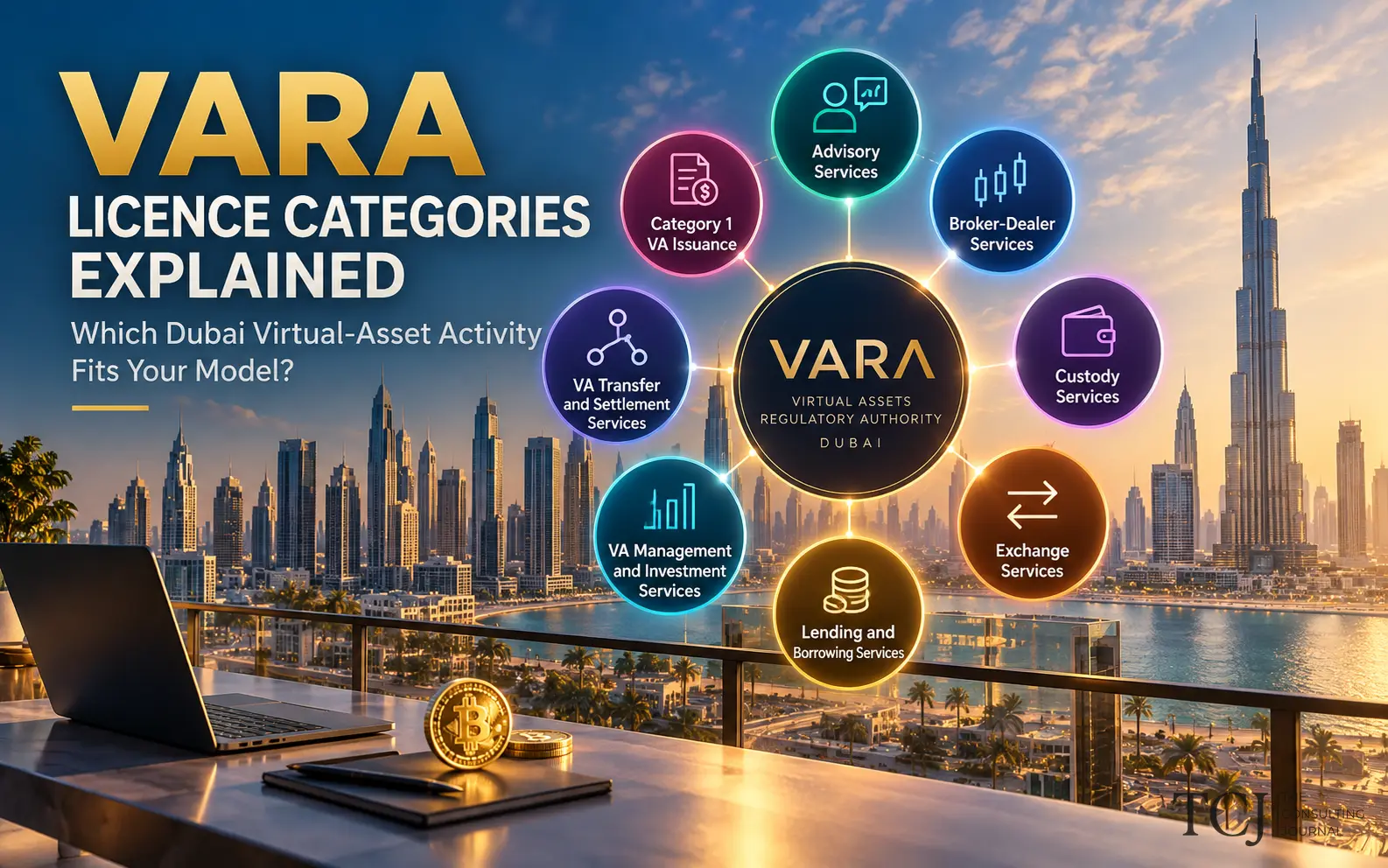
VARA currently identifies eight licensed virtual-asset activities:
- Advisory Services
- Broker-Dealer Services
- Custody Services
- Exchange Services
- Lending and Borrowing Services
- Management and Investment Services
- Transfer and Settlement Services
- Virtual Asset Issuance Category 1
A business seeking to undertake these activities in or from Dubai must obtain the relevant VARA licence before beginning the regulated activity.
VARA also distinguishes other virtual-asset activities. Proprietary virtual-asset trading, for example, requires a VARA No Objection Certificate, and additional registration requirements apply above specified trading-volume levels. DLT service providers carrying out regulated virtual-asset activities require the relevant licence, while DLT businesses that do not provide such activities may have a different regulatory position.
This is why founders should prepare an activity map before selecting a company-formation package.
What should an activity map cover?
The founders should document:
- what the company sells;
- who its customers are;
- how customers pay;
- whether client assets are ever held;
- whether the company controls wallets or private keys;
- whether virtual assets are exchanged or transferred;
- whether the company advises on virtual assets;
- whether tokens are issued;
- whether investments are arranged or managed;
- whether the company acts only as a software provider.
The answers help determine whether the business is primarily a technology company or enters a regulated virtual-asset activity.
Should an Italian Web3 founder choose Dubai mainland or a free zone?
There is no universally better option. Mainland and free-zone structures can both work, depending on commercial activity, customer model, office needs, staffing, visa requirements and regulatory approvals. A free zone should not be selected simply because its entry-level incorporation package appears cheaper.
VARA's jurisdiction extends to Dubai mainland and Dubai free zones except DIFC, so forming a free-zone entity does not automatically remove VARA requirements.
Founders should compare:
- permitted commercial activities;
- VARA compatibility where relevant;
- physical-office requirements;
- establishment and annual renewal costs;
- employee and visa requirements;
- customer and contracting arrangements;
- banking expectations;
- UAE Corporate Tax treatment;
- operational substance requirements.
Example 1:
An Italian software founder establishes a fictional Dubai company called Veneto Chain Labs FZCO. The company builds smart-contract infrastructure for overseas technology clients but does not hold customer virtual assets, operate an exchange or provide investment services. Its regulatory assessment may therefore differ materially from a VASP. The founder should still document the activity carefully before relying on a general software licence.
Example 2:
A fictional Milan-based founder plans to establish Gulf Digital Markets LLC to arrange virtual-asset transactions for clients. Although the founder initially describes the business as a “Web3 platform,” the proposed service may enter VARA's regulated perimeter. Incorporating a general technology company first would not eliminate the need for the relevant regulatory approval.
How do you establish a Web3 company in Dubai?
The practical sequence starts with regulatory classification, not incorporation. Founders should understand the service, licensing perimeter and jurisdiction before committing to a company structure. Where VARA approval is required, commercial licensing and regulatory authorisation should be treated as connected but separate workstreams.
A sensible process is:
1. Define the business model
Prepare a written description of services, customers, revenue streams, asset flows and technology.
Avoid broad descriptions such as “crypto consulting” or “blockchain platform” where the actual service can be explained more precisely.
2. Assess the regulatory perimeter
Determine whether the proposed activity requires a VARA licence, approval, registration or No Objection Certificate, or falls under another regulatory framework.
3. Select the jurisdiction
Compare suitable mainland and free-zone structures based on the actual activity rather than headline formation cost.
4. Complete preliminary regulatory steps where required
VARA applications are coordinated through DET for mainland businesses or the relevant Dubai free-zone commercial licensor. Documentation and assessment requirements depend on the proposed activity.
5. Incorporate and establish operational substance
The company can then complete the appropriate incorporation, office, visa, governance and operational requirements.
6. Build the compliance framework
VARA's current application documentation can include UBO details, source-of-funds evidence, organisational and governance structures, key-personnel information, financial projections, proof of capital, insurance documentation, succession planning and a wind-down plan.
7. Obtain final authorisation before regulated operations
An In-Principle Approval is not permission to commence virtual-asset services. VARA states that IPA holders cannot start VA activities or serve clients until a full VASP licence has been obtained.
How does UAE Corporate Tax apply to a Dubai Web3 company?
A Dubai Web3 company is not automatically tax-free. Under the general UAE Corporate Tax regime, taxable income up to AED 375,000 is subject to 0%, while the portion exceeding AED 375,000 is generally subject to 9%, subject to the Corporate Tax legislation and the company's circumstances.
Free-zone incorporation also does not mean that every source of profit receives a 0% Corporate Tax rate.
A Qualifying Free Zone Person can benefit from a 0% rate on Qualifying Income when the applicable requirements are satisfied. The FTA identifies conditions including adequate UAE substance, Qualifying Income and transfer-pricing compliance. Income that does not qualify can be subject to 9%.
For a Web3 business, founders should therefore review the activity, customers, related-party arrangements, intellectual property, operating substance and revenue streams before basing a jurisdiction decision on tax assumptions.
When does VAT registration become relevant?
For a UAE-resident business, mandatory VAT registration generally applies when taxable supplies and imports exceed AED 375,000 during the previous 12 months or are expected to exceed that amount during the next 30 days. Voluntary registration can generally be available once the AED 187,500 threshold is met.
Web3 businesses should also avoid assuming that every revenue stream has the same VAT treatment.
Software-development fees, subscriptions, advisory revenue and virtual-asset-related transactions may require separate analysis depending on the underlying supply.
Good Accounting records should identify each revenue category clearly rather than combining unrelated transactions under a generic “crypto revenue” account.
What should Italian owners consider about Italy–UAE Tax exposure?
Italian founders should examine UAE and Italian taxation separately. Italy and the UAE have a double-taxation convention signed in Abu Dhabi on 22 January 1995, which entered into force on 5 November 1997. The existence of the treaty does not by itself determine the tax outcome for an Italian-owned Dubai company.
Relevant questions can include:
- Where is the shareholder personally tax resident?
- Where are important management decisions made?
- Are employees or management functions located in Italy?
- Does an Italian entity control the UAE business?
- Are the Italian and UAE companies undertaking related-party transactions?
- Could transfer-pricing requirements apply?
- Is there potential permanent-establishment exposure?
- How are dividends and other distributions treated?
- What foreign-asset or ownership reporting obligations apply to the Italian founder?
Italian founders remaining resident in Italy should obtain Italian tax advice in addition to UAE Tax and Accounting advice.
Why are banking and source-of-funds records important?
For Web3 businesses, incorporation is only one part of becoming operational. Banks, regulators, payment providers and commercial counterparties may request detailed information about ownership, funding, customers, expected transactions and the economic purpose of the company.
Founders should prepare:
- passports and shareholder identification;
- ultimate beneficial ownership records;
- source-of-funds information;
- source-of-wealth evidence where required;
- business plan and Financial projections;
- customer and supplier agreements;
- expected transaction values and jurisdictions;
- wallet and custody arrangements where relevant;
- AML and sanctions policies where applicable;
- management responsibilities;
- proof of capital where required;
- Accounting and bookkeeping arrangements;
- invoices and supporting commercial records.
Banking readiness is particularly important because obtaining a commercial licence does not guarantee that a bank will open an account. Each institution applies its own onboarding and risk procedures.
What common mistakes do Italian Web3 founders make?
The most costly setup problems often start with an inaccurate activity description. Registering a general technology company while the real business carries out regulated virtual-asset services can create licensing, banking and compliance problems later.
Common mistakes include:
- selecting a licence before mapping the business activity;
- assuming a commercial licence is sufficient for regulated crypto services;
- choosing a free zone only because of a low advertised setup cost;
- assuming all free-zone profits receive 0% Corporate Tax;
- starting regulated activity while holding only preliminary approval;
- ignoring Italian tax residence and management issues;
- using vague descriptions of token or wallet activities;
- underestimating AML and source-of-funds documentation;
- approaching banks without a clear business and transaction profile;
- failing to maintain proper Financial and Accounting records from the start.
VARA also maintains a public register of licensed and IPA-stage VASPs, which businesses can use when checking the regulatory status of potential counterparties.
What documents should founders prepare before starting?
Before incorporation or regulatory submission, prepare a working file containing:
- shareholder and director identification;
- proposed company names;
- detailed business-activity description;
- business plan;
- ownership and UBO chart;
- source-of-funds documentation;
- expected customer profile;
- countries in which customers will be located;
- expected transaction volumes;
- revenue model;
- technology and wallet architecture where relevant;
- token documentation where applicable;
- proposed governance structure;
- AML and compliance policies where required;
- Financial forecasts;
- office and staffing plan;
- Italian ownership and tax-residence information;
- related-company information;
- preliminary UAE Tax and VAT assessment.
The more complex the Web3 activity, the more useful it is to prepare these documents before paying for incorporation.
How can KPM Global Services UAE assist?
KPM Global Services UAE can support Italian founders with the practical coordination required to establish and operate a Dubai business, including company-formation planning, activity assessment, UAE Tax registration, VAT considerations, Accounting setup and compliance preparation.
Depending on the proposed Web3 activity, support can include:
- reviewing the proposed business model before company formation;
- comparing suitable Dubai mainland and free-zone options;
- coordinating commercial licence requirements;
- identifying areas requiring specialised regulatory advice;
- assisting with Corporate Tax and VAT registration requirements;
- establishing Accounting and bookkeeping processes;
- preparing Financial information and business documentation;
- supporting banking-readiness documentation;
- reviewing UBO and company-record requirements;
- coordinating with legal, regulatory or other specialist advisers where necessary.
For an Italian-owned structure, UAE implementation should also be coordinated with qualified Italian tax advice where ownership, management or income creates Italian considerations.
KPM Global Services UAE does not guarantee regulatory licences, banking approvals, tax outcomes or authority decisions.
What should Italian founders do before launching?
An Italian-owned Web3 company can be established in Dubai, but the structure should be built around the actual activity. Founders should classify the service first, determine whether VARA requirements apply, select an appropriate jurisdiction, prepare compliance and banking documentation, and understand UAE and Italian tax consequences before launching.
For regulated businesses, a practical sequence is:
activity definition → regulatory assessment → jurisdiction selection → incorporation → compliance preparation → final authorisation → operations.
For technology businesses outside the regulated virtual-asset perimeter, accurate licensing, Accounting, VAT, Corporate Tax, banking and documentation remain important.
This article is for informational purposes and does not constitute legal, tax, accounting, or financial advice.
Questions and answers
Q: Can an Italian citizen open a Web3 company in Dubai?
A: Yes. Italian nationality does not itself prevent a founder from establishing an eligible Dubai company. The required commercial licence and any VARA or other regulatory approvals depend on the activities the company intends to perform.
Q: Does every Web3 company in Dubai need a VARA licence?
A: No. A software or blockchain-development business can have a different regulatory position from an exchange, broker, custodian or virtual-asset investment provider. The business activities should be classified before incorporation.
Q: Can a crypto or Web3 business be established in a Dubai free zone?
A: Potentially, yes. However, operating from a free zone does not automatically remove VARA requirements because VARA's jurisdiction covers Dubai mainland and Dubai free zones except DIFC. The selected free zone must also permit the proposed commercial activity.
Q: Is an Italian-owned Dubai Web3 company automatically tax-free?
A: No. UAE Corporate Tax rules apply to Dubai businesses, and special free-zone treatment is conditional rather than automatic. Italian tax considerations may also remain relevant depending on the shareholder's residence, management arrangements and cross-border structure.
Q: Can a Web3 company start operating after receiving VARA In-Principle Approval?
A: Not if it intends to conduct regulated virtual-asset activities. VARA states that IPA holders cannot commence VA activities or service clients until the full VASP licence has been obtained. Commercial incorporation and final regulatory authorisation should therefore be treated as separate milestones.
More in Crypto
View all Crypto →
Stablecoin Payments for UAE Businesses: Benefits, Regulations and Risks
Stablecoin payments offer UAE businesses new possibilities for cross-border settlements and financial operations. Explore commercial benefits, CBUAE regulations, compliance risks, and practical steps before adoption.
VARA Licence Categories Explained: Which Dubai Virtual-Asset Activity Fits Your Model?
Dubai’s virtual-asset framework is activity based, meaning there is no single generic crypto licence. This guide explains the eight VARA licence categories, how different business models may fall within them, and what founders should assess before launching a virtual-asset business in Dubai.

When Does a Spanish Digital-Asset Business Need a VARA Licence in Dubai?
Spanish crypto and digital-asset firms expanding to Dubai need to assess activities, entity location, marketing and licensing separately. This guide explains when VARA may apply, how MiCA fits, and what businesses should prepare before launch.