Outsourced CFO Services in UAE: Why SMEs Need More Than Bookkeeping
UAE SMEs are moving beyond basic bookkeeping as cash flow, tax compliance, investor reporting, and growth planning become more demanding.
Why outsourced CFO services are becoming relevant in the UAE
A growing UAE business can run for a while with a bookkeeper, an accountant, and a determined founder watching the bank balance every morning. But that setup starts to show its limits when the company takes on larger contracts, hires staff, opens new sales channels, prepares for bank finance, or begins dealing with VAT and corporate tax obligations.
This is where outsourced CFO services in UAE are becoming more practical for SMEs. The need is not always for a full-time finance executive sitting inside the business every day. Many companies need senior financial judgment at specific points: cash flow planning, pricing decisions, banking preparation, tax readiness, investor discussions, cost control, and monthly performance reviews.
A useful outsourced CFO does not replace bookkeeping. They build on it. Bookkeeping tells the owner what happened. CFO support helps the owner understand what the numbers mean and what should happen next.
The real value of CFO support is not more reports; it is better commercial decisions from the reports already available. — The Consulting Journal
The difference between accounting and CFO support
Accounting is mainly concerned with correct records, reconciliations, invoices, payroll entries, VAT records, and financial statements. These are essential. Without them, a business has no reliable base.
CFO support is different. It looks at the business as a financial system. A CFO asks whether margins are improving, whether cash will tighten in three months, whether the company can afford a new hire, whether the pricing model is realistic, and whether the business is prepared for a bank, investor, audit, or tax review.
In practice, UAE SMEs usually need both. A trading company in Dubai may have accurate invoices and VAT records but still suffer because customer collections are too slow. A free zone consultancy may be profitable on paper but have weak documentation for banking or corporate tax filing. A mainland service business may show revenue growth but lose money because payroll and subcontractor costs are not being reviewed by project.
Why SMEs are moving beyond basic bookkeeping
The UAE has a highly active SME and startup market. Founders often move quickly, which is useful for sales but risky for finance. As the company grows, decisions become less forgiving. A delayed collection cycle, incorrect VAT assumption, weak pricing model, or poorly prepared forecast can affect payroll, supplier confidence, and expansion plans.
There is also a regulatory reason. UAE companies, including many free zone entities, need to consider corporate tax registration, filing, accounting periods, and records. The Ministry of Finance states that UAE companies and juridical persons incorporated or effectively managed in the UAE are broadly within corporate tax scope, and free zone juridical persons are also within scope, subject to specific qualifying conditions.
For SMEs, this has changed the finance conversation. The question is no longer only, “Are the books updated?” It is also, “Can the numbers support a filing position, a bank request, an investor discussion, and a management decision?”
What an outsourced CFO typically does
The exact scope depends on the business, but outsourced CFO services usually cover several practical areas:
- Monthly management reporting
- Cash flow forecasting
- Budgeting and variance analysis
- Profitability review by product, project, branch, or client
- Working capital and collection planning
- Investor or bank reporting packs
- Internal control review
- VAT and corporate tax readiness coordination
- Finance team supervision
- Scenario planning for expansion or cost reduction
The best engagements are not built around thick reports. They are built around a monthly decision rhythm. The owner, finance team, and CFO review the numbers, identify pressure points, agree actions, and track progress.
Cash flow is often the first reason SMEs seek CFO help
Many UAE SMEs are profitable but still short of cash. This usually happens when revenue is recognized before money is collected, suppliers are paid faster than customers pay, inventory is overstocked, or project costs are not matched properly against billing milestones.
A CFO looks at cash flow in a forward-looking way. They may prepare a 13-week cash forecast, review ageing receivables, identify slow-paying customers, and set collection priorities. They may also recommend better payment terms, deposit structures, credit checks, or supplier negotiation.
Example 1:
A Dubai-based fit-out contractor may win larger projects and appear to be growing well. But if material purchases, subcontractor advances, and payroll are due before milestone payments arrive, the company can run into pressure despite having strong sales. An outsourced CFO would review project cash flow before each contract is accepted, not after the shortage appears.
Better reporting for better decisions
Many SME owners receive financial statements too late or in a format that does not help them make decisions. A profit and loss statement is useful, but it may not answer the owner’s practical questions.
Which product line is underperforming? Which customer segment pays slowly? Which branch has high staff cost compared with revenue? Which services look profitable only because owner time is not included? Which expenses are fixed, and which can be reduced if sales slow down?
A CFO turns accounting data into management information. This can include dashboards, monthly commentary, margin analysis, debtor ageing, cash forecasts, and board-style reporting packs. For a growing company, this creates discipline. Decisions become less emotional and more evidence-led.
Investor and bank readiness
Banks and investors usually want more than enthusiasm. They want organized financial statements, realistic forecasts, clear assumptions, tax compliance status, ownership documents, and evidence that management understands its numbers.
An outsourced CFO can help prepare a company before it approaches a lender or investor. This may include cleaning up old receivables, separating personal and business costs, preparing a forecast model, explaining working capital needs, and building a funding narrative that matches the actual business.
Example 2:
A UAE technology startup may have strong revenue growth but weak monthly reporting. Before speaking to investors, the company needs a clean revenue bridge, customer concentration analysis, burn-rate calculation, hiring plan, and realistic runway forecast. CFO support helps the founder enter investor meetings with numbers that can be defended.
Compliance, VAT, and corporate tax readiness
CFO support is not a substitute for specialist tax advice, but it helps the business stay organized. This matters because tax compliance depends heavily on accounting quality, documentation, and internal processes.
For VAT, the Federal Tax Authority confirms that a business must register when taxable supplies and imports exceed the mandatory registration threshold of AED 375,000, while voluntary registration may be available above AED 187,500.
For corporate tax, the Ministry of Finance states that taxable persons are required to file a corporate tax return for each tax period within nine months from the end of the relevant period, with payment generally due by the same deadline.
In practical terms, an outsourced CFO may help management prepare by improving record quality, reviewing accounting policies, coordinating with tax advisers, monitoring deadlines, and ensuring the finance team understands what information must be retained.
Technology and finance systems
Many SMEs still rely on spreadsheets long after the business has outgrown them. Spreadsheets are useful, but they become risky when multiple people edit files, formulas break, or management relies on outdated versions.
A CFO can help select or improve cloud accounting systems, invoicing workflows, expense approval tools, payroll integrations, and reporting dashboards. The aim is not technology for its own sake. The aim is cleaner data, faster reporting, and fewer manual errors.
A good finance system should allow the owner to see cash, receivables, payables, sales, gross margin, and tax-related information without waiting weeks for manual consolidation.
Common mistakes business owners make
One common mistake is treating CFO support as something needed only by large companies. In reality, many SMEs need CFO judgment before they can afford a full-time CFO.
Another mistake is assuming profit means cash is healthy. A company can show profit and still struggle if customers pay late or stock levels are too high.
Many businesses also delay financial cleanup until a bank, investor, auditor, or tax adviser asks difficult questions. By then, the work becomes more expensive and stressful.
A further mistake is hiring finance support without defining outcomes. Outsourced CFO work should have clear priorities: cash flow visibility, monthly reporting, margin improvement, funding readiness, tax preparation, or internal control improvement.
Practical checklist before hiring an outsourced CFO
Before appointing an outsourced CFO, a UAE SME should prepare:
- Latest financial statements
- Trial balance and general ledger
- Bank statements and reconciliations
- VAT registration and filing records, if applicable
- Corporate tax registration status, if applicable
- Accounts receivable and payable ageing
- Payroll summary
- Loan, lease, and major supplier agreements
- Current budgets or forecasts
- Details of planned expansion, funding, or restructuring
- Access to accounting software and finance workflows
This preparation helps the CFO identify issues quickly and avoid spending the first month searching for basic information.
How to choose the right outsourced CFO partner
The right CFO partner should understand UAE business realities, not only finance theory. Mainland and free zone companies can face different licensing, banking, documentation, tax, and reporting expectations. A CFO who has worked with SMEs will usually be more practical than one who only understands large corporate environments.
Business owners should look for someone who can explain numbers clearly, challenge assumptions respectfully, work with the existing accountant, and provide advice that fits the size of the company. A good CFO should not overwhelm an SME with unnecessary complexity. The role is to bring structure, not bureaucracy.
Final advisory view
Outsourced CFO services in UAE are becoming more relevant because SMEs need stronger financial control without always hiring a senior finance executive full-time. The businesses that benefit most are usually those entering a new stage: preparing for tax compliance, seeking funding, expanding teams, opening new locations, improving reporting, or trying to understand why growth is not translating into cash.
For business owners, the decision should be practical. If the company’s numbers arrive late, cash flow feels uncertain, margins are unclear, or funding discussions are approaching, CFO support may be worth considering.
This article is for informational purposes and does not constitute legal, tax, accounting, or financial advice.
Questions and answers
What are outsourced CFO services in UAE?
Outsourced CFO services give businesses access to senior financial guidance without hiring a full-time chief financial officer. The support typically covers cash flow planning, budgeting, management reporting, investor readiness, and financial strategy.
Outsourced CFO services give businesses access to senior financial guidance without hiring a full-time chief financial officer. The support typically covers cash flow planning, budgeting, management reporting, investor readiness, and financial strategy.
Yes, especially when the business is growing, facing cash flow pressure, preparing for funding, or dealing with more complex reporting needs. The service can usually be scaled according to the company’s size and budget.
How is an outsourced CFO different from an accountant?
An accountant records and reports financial transactions. A CFO interprets those numbers and helps management make decisions on pricing, hiring, expansion, funding, risk, and profitability.
Can an outsourced CFO help with VAT and corporate tax compliance?
A CFO can help improve records, reporting systems, documentation, and deadline monitoring. For technical tax positions, businesses should also work with qualified tax advisers or registered tax agents where appropriate.
When should a UAE SME consider hiring an outsourced CFO?
A business should consider CFO support when cash flow is unclear, reports are delayed, margins are weak, investors or banks are involved, or the owner needs better financial visibility before making growth decisions.
More in Finance
View all Finance →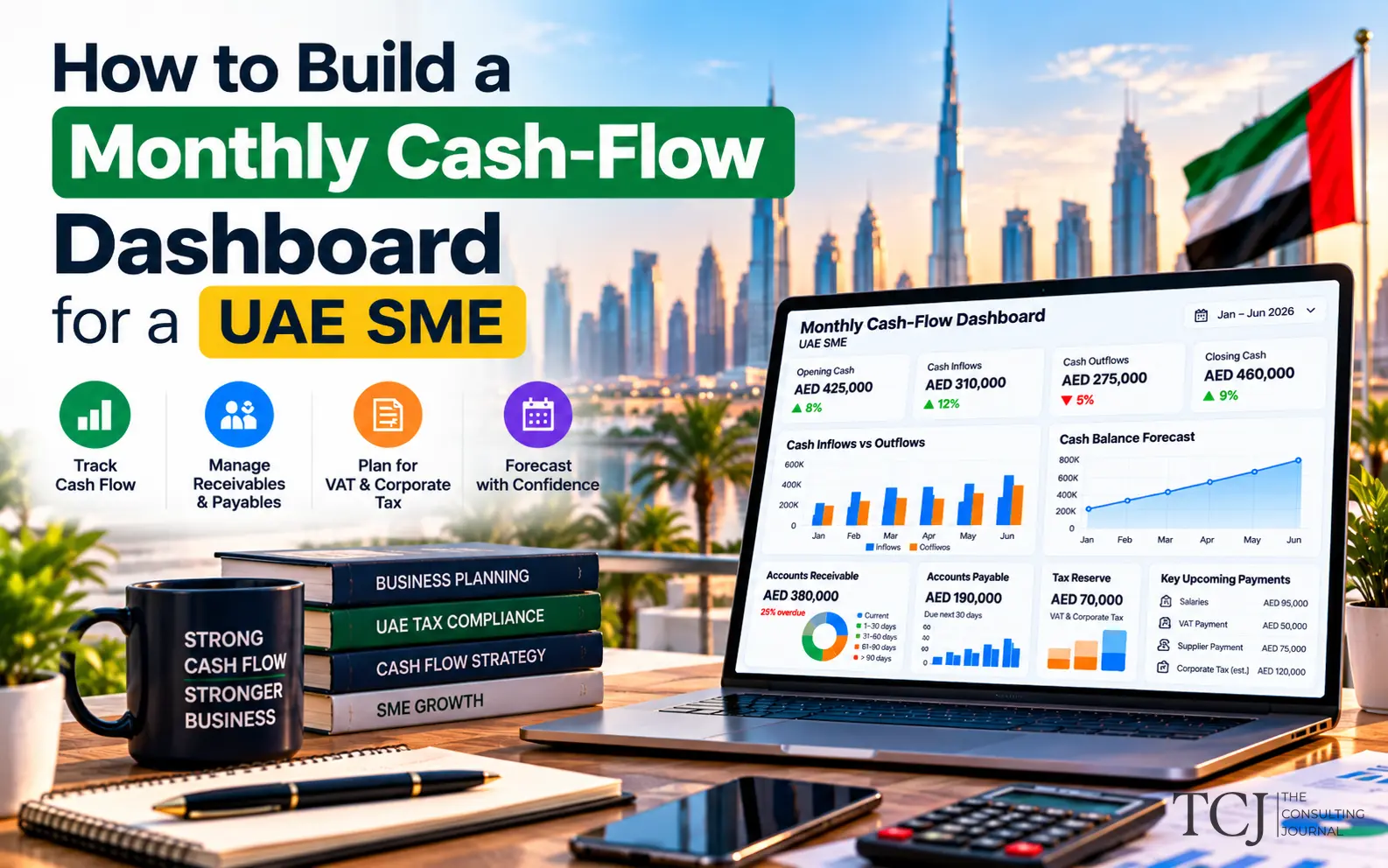
How to Build a Monthly Cash-Flow Dashboard for a UAE SME
A practical guide for UAE SME owners and finance teams on building a monthly cash-flow dashboard that tracks liquidity, collections, payments, tax obligations, forecasts, and working capital.
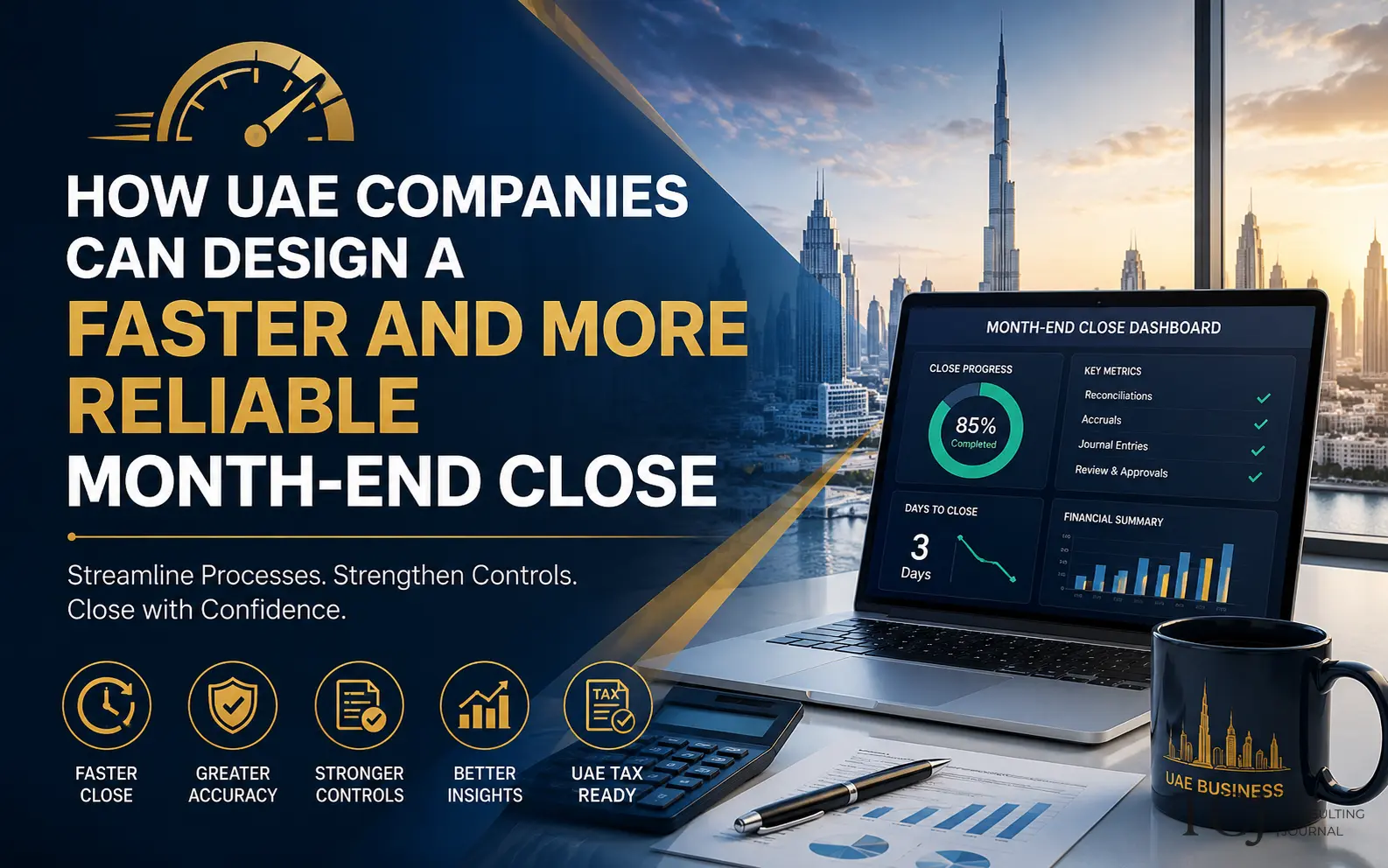
How UAE Companies Can Build a Faster, More Reliable Month-End Close
A practical UAE finance guide to shortening the month-end close through better reconciliations, cut-off controls, automation, tax readiness, data quality, and clear accountability.
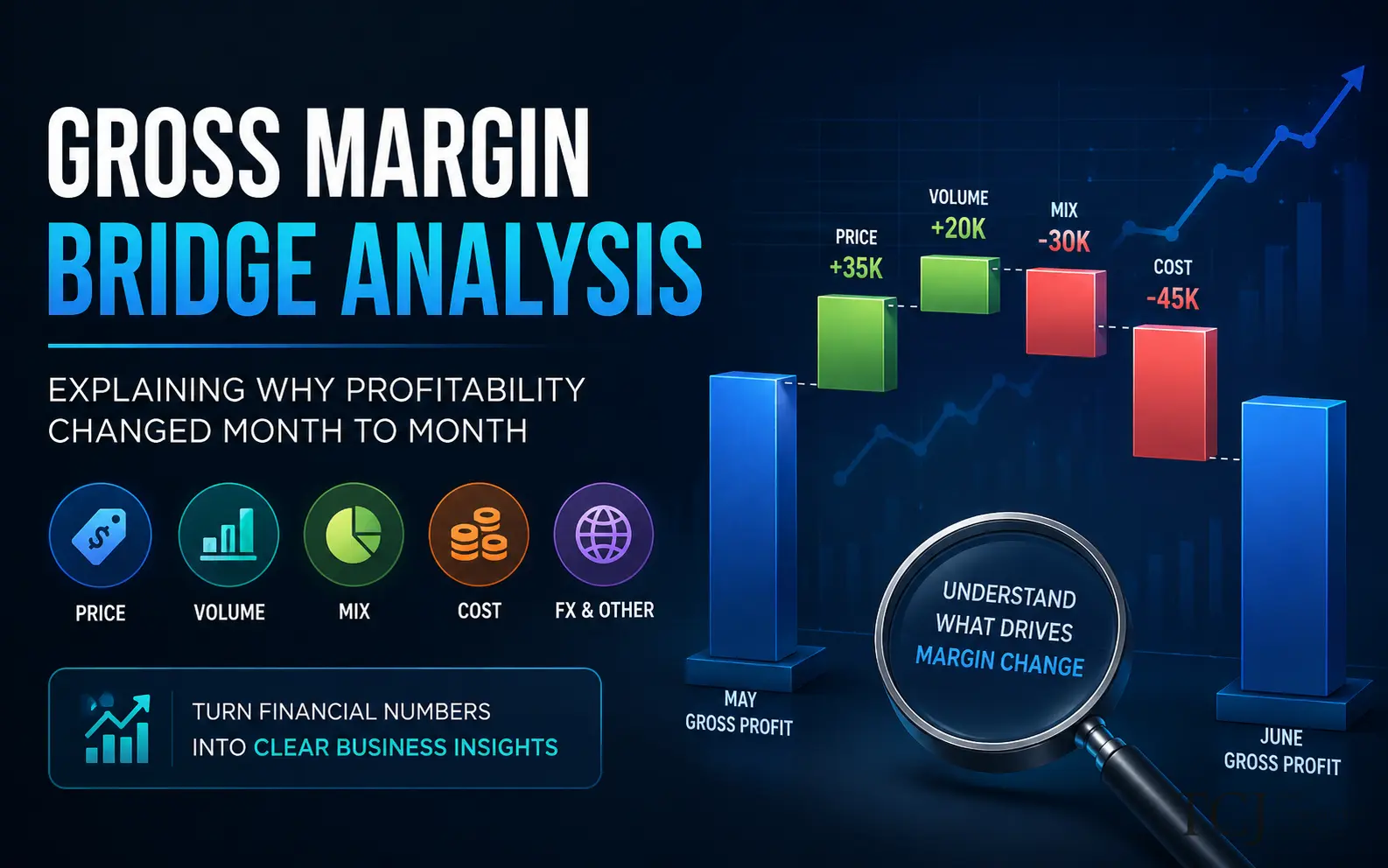
Gross Margin Bridge Analysis: Explaining Why Profitability Changed Month to Month
Gross margin bridge analysis helps finance teams explain monthly profitability changes by separating the impact of price, volume, sales mix, cost, and other operational drivers.