Tayseer Payment Plans for Service Charges in Dubai
Dubai property owners with overdue service charges may be able to use Tayseer payment plans. Here is what owners should verify about instalments, enforcement, ongoing charges, and property sales.
Key takeaways
- Tayseer is designed to help eligible Dubai property owners settle overdue service charges through instalment arrangements.
- DLD states that Tayseer payment plans have a minimum duration of six months.
- Tayseer does not automatically cancel, waive or reduce approved service-charge liabilities.
- Owners should confirm current availability and specific terms with their participating JOP management company.
- Outstanding service charges can affect enforcement and the ability to dispose of a property.
- Owners should retain invoices, account statements, Mollak communications and payment evidence until the account is fully reconciled.
What is the Tayseer initiative in Dubai?
Tayseer is a RERA and Dubai Land Department initiative for settling existing overdue property service fees through instalment plans arranged with participating JOP management companies. DLD states that the plans have a minimum duration of six months and are intended to reduce immediate financial pressure while helping owners regularise outstanding accounts.
The initiative was announced on 24 March 2025. DLD said at launch that registration would be opened through management companies for a two-month period and that participating companies would refrain from initiating enforcement action while an agreed payment plan was being implemented.
There is an important practical point for owners checking Tayseer now. DLD's Tayseer page remained published and listed participating JOP management companies when reviewed in August 2026, but the page continues to describe the original two-month registration period. Owners should therefore confirm directly with their management company whether Tayseer participation or a related payment arrangement is currently available for their particular unit and arrears.
Who may benefit from a Tayseer payment plan?
Owners with outstanding service fees may benefit where their jointly owned property is managed by a participating company and an acceptable payment arrangement can be agreed.
Tayseer may be particularly relevant to an investor with several units, a landlord experiencing a temporary cash-flow mismatch, or an owner who has accumulated arrears but wants to regularise the account without making one large payment.
It should not be assumed that every overdue account automatically qualifies. DLD directs owners to participating JOP management companies, which means the practical starting point is the company managing the property.
Owners should ask:
- Is the management company currently accepting Tayseer arrangements?
- Is the specific unit and outstanding balance eligible?
- What amount will be covered by the payment plan?
- Is any initial payment required?
- How many instalments will apply?
- What are the exact payment dates?
- How will new service-charge invoices be treated?
- What happens if an instalment is late or missed?
Getting these points in writing can prevent misunderstandings later.
How do Tayseer instalment plans work?
DLD states that Tayseer payment plans have a minimum duration of six months. That describes the minimum period, not a guarantee that every owner will receive identical terms, instalment amounts or repayment dates. The arrangement should be confirmed with the relevant participating management company.
An owner should look beyond the monthly instalment amount. The more useful question is whether the full repayment schedule is sustainable alongside mortgage payments, utilities, property maintenance and any new service charges that become payable.
A payment plan is useful only when the owner understands both the arrears being restructured and the new property costs that continue to fall due. — Consulting Journal editorial observation
Example 1: A Dubai landlord has accumulated AED 30,000 in approved service-charge arrears after several months of vacancy and repair expenses. A structured instalment arrangement may ease short-term cash-flow pressure, but the landlord should still budget separately for new service-charge invoices issued during the repayment period.
Example 2: An investor plans to sell an apartment within four months but enters a longer instalment plan for existing arrears. Although the monthly payment may appear manageable, the investor may still need to address the remaining balance before completing the sale. The planned exit date therefore matters when evaluating the arrangement.
Does Tayseer stop legal action over service-charge arrears?
DLD states that Tayseer offers owners an opportunity to avoid legal action relating to current outstanding fees and says participating management companies should refrain from initiating enforcement action while the payment plan remains in effect. Owners should still comply carefully with the agreed terms and confirm the consequences of default.
This does not mean an owner should assume that every existing dispute or enforcement matter is automatically suspended or resolved.
Where legal proceedings have already started, or where a payment deadline has been missed, the owner should obtain case-specific confirmation from the management company and, where appropriate, qualified UAE legal advice.
Dubai's jointly owned property legislation also provides a formal mechanism for collecting unpaid service charges. Article 32 of Law No. 6 of 2019 gives the management entity a lien over a unit for unpaid service charges. It also provides for written notice and potential enforcement through the Rental Disputes Center if the owner does not pay within the prescribed process.
Does Tayseer reduce or cancel Dubai service charges?
No. Tayseer should be treated as a payment-management arrangement for overdue fees, not as an automatic waiver or reduction of service charges. DLD's published description focuses on settling outstanding amounts through flexible instalments.
Law No. 6 of 2019 states that an owner or sub-developer may not refrain from paying service charges or usage charges approved by RERA. The law also prevents an owner from avoiding the obligation simply by giving up an interest in common parts.
For rented units, the position also deserves attention. Article 16 provides that the owner is generally liable for service and usage charges unless the lease agreement states otherwise, and the owner is not discharged from liability if a tenant who was supposed to pay fails to do so.
What do service charges cover in a jointly owned property?
Dubai service charges typically fund the management, operation, maintenance and repair of common parts of jointly owned properties. The legislation provides for expenditure such as cleaning, security, maintenance, repairs, insurance, management-related costs and approved reserve requirements.
This distinction is useful when reviewing arrears. An owner should separate two questions:
- What service charges have been approved and invoiced?
- How will the outstanding approved balance be repaid?
Owners can check common service-charge information through DLD's Service Charge Index and Dubai REST. DLD's current Service Charge Index allows users to review information by project, use and year.
DLD also states that service charges should be paid into RERA-approved accounts following the relevant communication through the Mollak system and approved payment channels.
Can overdue service charges affect a property sale?
Yes. Outstanding service charges can become a significant issue where an owner intends to sell a Dubai property.
Article 32 of Law No. 6 of 2019 states that the management entity has a lien over a unit for unpaid service charges and that the unit may not be disposed of unless those charges are paid to the management entity.
An owner considering a sale should therefore avoid assuming that an instalment plan automatically removes the need to address the outstanding balance during the transaction.
Before marketing or transferring the property, consider requesting:
- A current service-charge statement
- Confirmation of the remaining Tayseer balance
- Details of any new service charges
- Confirmation of payments already credited
- Information on what must be cleared before the intended transfer
For investors, this becomes part of financial planning rather than simply property administration.
What should owners check before agreeing to a Tayseer plan?
A good payment arrangement should be understood in full before the first instalment is made.
Owners should confirm:
- The total arrears included. Obtain a current statement and check which service-charge periods are covered.
- The repayment duration. Confirm the number of months and exact instalment dates.
- The payment method. Verify the approved account or electronic channel before transferring money.
- Treatment of current charges. Ask whether new invoices must be paid separately.
- Default consequences. Understand what happens if a payment is late or missed.
- Enforcement status. Obtain written confirmation where enforcement is a concern.
- Property-sale implications. If a sale is planned, ask what must be settled before transfer.
- Account reconciliation. Check that each instalment appears correctly against the property account.
What documents should property owners prepare?
Before discussing an instalment arrangement, it helps to organise the financial and property records that may be needed.
A practical preparation checklist includes:
- Current service-charge statement
- Previous service-charge invoices
- Title deed or unit ownership information
- Management-company correspondence
- Mollak notifications
- Payment receipts and bank confirmations
- Details of previous disputed or unpaid amounts
- Existing payment-plan documentation, if any
- Records of ongoing service-charge invoices
- Sale documentation if the property is being prepared for transfer
- A simple cash-flow forecast showing whether the proposed instalments are sustainable
Keeping these records together can also help an Accounting or Financial team reconcile investment-property expenses correctly.
Common mistakes Dubai property owners make
One common mistake is treating Tayseer as a discount programme. The official initiative is framed around payment flexibility, not automatic debt reduction.
Another is focusing only on the first instalment. A lower monthly payment may still create pressure if new service charges, mortgage obligations and maintenance expenses are due at the same time.
Owners also sometimes fail to confirm whether their management company currently participates or whether the specific arrears qualify. DLD's page directs property owners to participating JOP management companies, so availability should be checked rather than assumed.
Poor record-keeping is another avoidable problem. Receipts, payment confirmations and account statements should be retained until the balance has been fully reconciled.
Finally, owners planning a sale should not leave service-charge reconciliation until the transfer stage. Unpaid charges can directly affect the ability to dispose of the unit under Dubai's jointly owned property law.
How can KPM Global Services UAE assist?
For property investors who hold units personally or through UAE businesses, service-charge arrears can also affect wider Financial and Accounting planning.
Depending on the engagement, KPM Global Services UAE can assist with areas such as:
- Reviewing service-charge statements against internal Accounting records
- Reconciling payments and outstanding balances
- Preparing cash-flow forecasts around proposed instalments
- Organising supporting Financial documentation
- Reviewing property-related expense records for business reporting purposes
- Helping investor-owned companies maintain clearer records around property costs and liabilities
Where a matter involves legal enforcement, interpretation of property law or a dispute with a management entity, owners should obtain advice from an appropriately qualified UAE legal professional.
This article is for informational purposes and does not constitute legal, tax, accounting, or financial advice.
What should Dubai property owners remember about Tayseer?
Tayseer can provide a practical route for dealing with overdue service charges, but owners should treat it as a structured repayment arrangement rather than a waiver.
The minimum six-month period can help reduce immediate cash-flow pressure, while DLD's framework also contemplates participating management companies refraining from enforcement while an agreed plan is in effect.
The strongest approach is to verify the outstanding balance first, confirm current availability with the management company, obtain the terms in writing, budget for ongoing charges and consider any planned property sale before committing to the schedule.
Questions and answers
Q: What is the Tayseer initiative in Dubai?
A: Tayseer is a RERA and Dubai Land Department initiative designed to help property owners settle overdue service fees through flexible payment plans arranged with participating JOP management companies. DLD states that the plans have a minimum duration of six months.
Q: Is Tayseer still available to Dubai property owners?
A: DLD's Tayseer information page remained published and listed participating management companies when reviewed in August 2026. However, the page also refers to the original two-month registration period, so owners should confirm current availability directly with their management company before relying on the initiative.
Q: Does Tayseer waive overdue service charges?
A: No. DLD describes Tayseer as a mechanism for settling outstanding service fees through payment plans rather than a general waiver. Dubai law also provides that owners may not refuse to pay service charges approved by RERA.
Q: Can a management company take legal action while I am paying through Tayseer?
A: DLD states that participating management companies refrain from initiating enforcement action while the payment plan is in effect. Owners should still comply with the agreed schedule and obtain case-specific advice where enforcement proceedings have already begun.
Q: Can unpaid service charges prevent me from selling my Dubai property?
A: They can affect the transaction. Article 32 of Law No. 6 of 2019 provides that the management entity has a lien over a unit for unpaid service charges and that the unit may not be disposed of unless those charges are paid to the management entity.
More in Real Estate
View all Real Estate →
Off-Plan Property Due Diligence in Dubai: 12 Checks Before Paying a Deposit
Buying off-plan property in Dubai requires more than reviewing a brochure. Check the developer, DLD project status, escrow account, SPA, unit details, payment plan, registration and exit conditions before transferring a deposit.

How to Start a Holiday Home Business in Dubai: DET Guide
Starting a holiday home business in Dubai requires the right owner or operator structure, DET registration, individual unit permits, guest compliance, Tourism Dirham administration, and annual renewals.
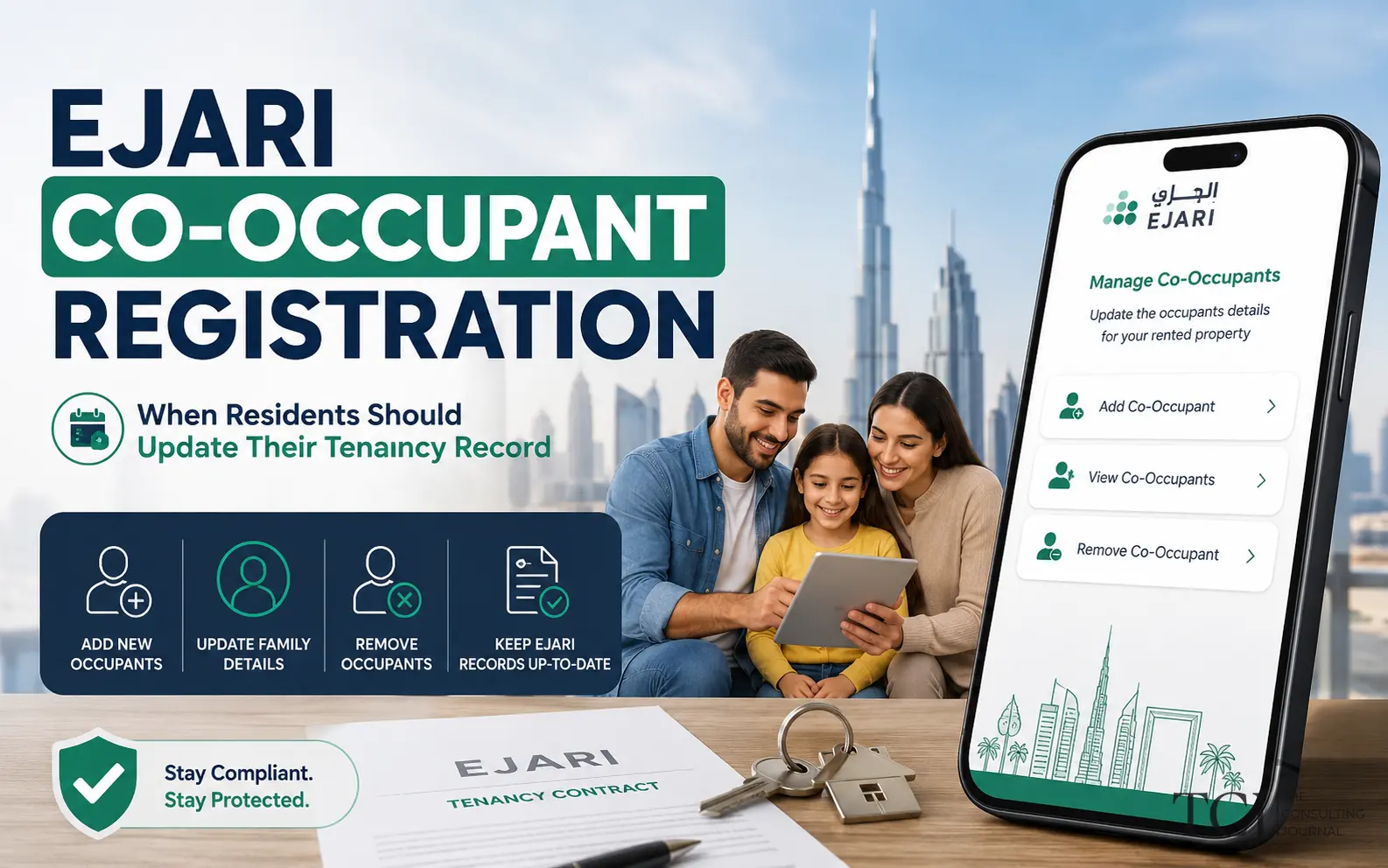
Ejari Co-Occupant Registration in Dubai: When Should Records Be Updated?
Dubai tenants should review Ejari co-occupant information when the people actually living at a rented property change. Here is when to update records, how Dubai REST works, and why occupant registration is different from changing the tenancy contract.