UAE Business Bank Account Requirements for Newly Formed Companies
A practical guide to UAE business bank account requirements for new companies, covering documents, KYC, shareholder checks, proof of activity, banking preparation, VAT and Corporate Tax considerations.
Key takeaways
- A newly formed UAE company can apply for a business bank account even without a long corporate banking history.
- A UAE trade license alone is typically not sufficient because banks also conduct KYC, ownership and business activity checks.
- Company, shareholder, signatory and address records should be current and consistent across the application.
- New businesses should retain genuine contracts, invoices, purchase orders and other evidence supporting their commercial activity.
- Corporate banking, VAT registration and Corporate Tax registration are separate processes and should be managed accordingly.
- Bank approval and document requirements depend on the institution, account product, ownership structure and business profile.
Can a newly formed UAE company open a business bank account?
Yes. A newly incorporated UAE company can apply for a corporate bank account even when it does not yet have a long trading history. The bank will typically compensate for the absence of historical company records by reviewing the shareholders, ownership structure, expected activity, financial background and supporting commercial information.
A startup established only recently cannot provide several months of transactions from a company account that did not previously exist. Some banking products therefore provide alternatives. Emirates NBD currently states that an existing company should provide a six-month company bank statement, while a new company can provide a partner's bank statement.
This does not mean every bank follows the same approach. Founders should check the eligibility criteria for the specific business banking product before submitting an application.
What documents are commonly required for a UAE business bank account?
A newly established company should generally prepare its incorporation documents, ownership records, identity documents and address evidence before applying. Depending on the bank and legal structure, additional financial or commercial evidence may also be requested to understand how the company will operate and how the account will be used.
Company documents
A practical company file may include:
- Valid UAE trade or commercial license
- Certificate of incorporation, where applicable
- Commercial registration documents, where applicable
- Memorandum of Association
- Articles of Association, where applicable
- Partnership agreement for relevant structures
- Board or shareholder resolution where required
- Power of Attorney where authority has been delegated
- Documents recording amendments to company ownership or constitutional records
- Registered or operating address evidence
The exact documents depend on the company's legal form and licensing authority. A mainland LLC, free zone company and sole establishment will not necessarily have identical corporate documentation.
Shareholder and authorized signatory documents
Banks also need to identify the individuals who own, control or operate the company account.
Applicants should be ready to provide, where applicable:
- Valid passports
- Emirates IDs for UAE residents
- Residence visa information where required
- Personal address information
- Ownership details
- Documents confirming signing or account-operating authority
Consistency matters. Names, shareholding percentages, passport information and signing authority should correspond with the company's official records.
For a new UAE company, bank-account preparation is less about producing the largest document file and more about presenting a clear, consistent picture of who owns the business, what it does and how money is expected to move through it. — Consulting Journal editorial observation
Why does a bank need more than a UAE trade license?
A trade license confirms that a company has been licensed for specified activities, but it does not answer every question a bank must consider when establishing a customer relationship. Banks may need information about ownership, control, customers, suppliers, operating markets, expected transactions and the source of funds.
This is why founders should approach corporate bank onboarding as a verification process rather than simply submitting a license.
A bank may want to understand:
- What products or services the company provides
- Who ultimately owns the business
- Who is authorized to operate the account
- Where customers are located
- Where suppliers are located
- How the company expects to receive revenue
- What transaction volumes and currencies are anticipated
- How the business is initially funded
Broad descriptions such as "consulting", "general trading" or "online business" may not explain the commercial model sufficiently. The description should accurately reflect the licensed and actual activity.
How do KYC and beneficial ownership checks affect a new company?
KYC checks allow the bank to establish the identity of the company and the people behind it. For a straightforward company owned directly by one or two individuals, the ownership structure may be relatively easy to document. Corporate shareholders or multi-layer structures can require additional records.
Founders with more complex structures should keep an ownership chart showing the chain from the UAE company to the ultimate individual beneficial owners.
Documents should tell the same story. A bank application can require clarification when shareholder information, corporate documents, addresses or authorization records are inconsistent.
Example 1:
A fictional Dubai mainland consultancy has two individual shareholders and has recently obtained its trade license. It has no company banking history but has signed client agreements and its owners have personal banking records. Its preparation file could include the license, MOA, shareholder identification, address evidence, contracts and an accurate explanation of expected customer payments.
How can a new company demonstrate genuine business activity?
A pre-revenue company may have limited financial history, but it should still be able to explain its business model and provide genuine evidence supporting expected operations. Depending on the bank's request, contracts, purchase orders, supplier arrangements, invoices, a company profile or other commercial records may help demonstrate the intended activity.
Useful records can include:
- Signed customer contracts
- Supplier agreements
- Purchase orders
- Issued invoices
- Business plans or company profiles
- Website or service information
- Details of expected customers and suppliers
- Documents supporting expected revenue
These are not universal banking requirements. Banks decide what supporting information they need for a particular application.
The value of keeping genuine commercial evidence is also visible in UAE tax administration. The Federal Tax Authority's VAT registration service lists supporting documents such as invoices, local purchase orders, contracts and lease agreements where applicable, and notes that expected revenues can be supported by valid purchase orders or contracts.
Does a new UAE company need an office or tenancy document?
Company address evidence is commonly relevant to banking and company administration. The exact evidence depends on the company's structure, licensing authority, premises arrangement and bank. Founders should ensure that the address given to the bank is accurate and consistent with their official company records.
The UAE Ministry of Economy and Tourism states that businesses should have a physical address for conducting their activities and that commercial premises must meet the requirements of the relevant emirate and competent authorities. It also notes specific tenancy requirements, including Ejari registration in Dubai where applicable.
Free zone companies may operate under different premises arrangements provided by their respective zones. Businesses should therefore use documents appropriate to their actual setup rather than assuming that one address document works for every company.
Do shareholders need UAE residency to open the account?
Residency requirements should be checked against the particular bank and business account rather than treated as a single UAE-wide rule. A bank may have different onboarding routes or eligibility conditions depending on whether shareholders, partners or authorized signatories are UAE residents.
Non-resident founders should investigate this point before choosing an account solely because of its advertised fees, digital application process or minimum-balance conditions.
Are free zone and mainland companies treated differently?
Both mainland and free zone companies can seek corporate banking services. In either case, the bank will typically need to understand the company's legal status, owners, authorized signatories, business activity, operating location and expected transactions.
The documentation differs because the incorporation structures and licensing authorities differ.
A free zone license should not be interpreted as automatic bank approval. Equally, forming a mainland company does not remove normal KYC and onboarding requirements.
Example 2:
A fictional free zone e-commerce company has a foreign shareholder, suppliers in several countries and customers across the GCC. Its banking application may require more explanation of expected cross-border transactions than a locally focused professional-services company. Preparing supplier information, business activity evidence and realistic transaction expectations can help the bank understand the operating model.
How should founders prepare to open a UAE company bank account?
Start with a document audit before selecting or applying for an account. The objective is to make sure the company's legal records, shareholder information, commercial explanation and supporting evidence are complete and consistent before they reach the bank.
A practical process is:
- Complete the appropriate UAE company formation and licensing process.
- Compare business accounts based on actual eligibility and operating requirements.
- Collect current company and shareholder documents.
- Prepare a concise explanation of the business model.
- Document expected customers, suppliers, markets and transaction flows.
- Submit accurate information and respond to requests for clarification.
- Review account fees, balance conditions, currencies and transaction capabilities before activation.
Emirates NBD currently describes its online process as application initiation, verification and assessment, followed by account activation. Its application includes business, financial and shareholder or Power of Attorney information.
What common mistakes do business owners make?
One frequent mistake is assuming that incorporation automatically establishes banking eligibility. Another is applying before the company's ownership, address or commercial documentation has been properly organized.
Other avoidable problems include:
- Submitting expired identification
- Providing inconsistent shareholder information
- Missing resolutions or authorization documents
- Giving an unclear description of the business
- Failing to explain expected transaction activity
- Providing incomplete address evidence
- Applying for a banking product whose eligibility conditions do not fit the company
- Using unrealistic estimates for turnover or transactions
- Failing to keep early contracts, invoices and purchase orders
- Assuming every bank follows identical requirements
Additional review does not necessarily mean an application will be rejected. It can simply mean the bank needs further information to complete its assessment.
What should be in the preparation checklist?
Before submitting an application, founders should consider preparing:
- Current trade license
- Certificate of incorporation where applicable
- MOA and AOA where applicable
- Commercial registration records where applicable
- Shareholder and beneficial ownership details
- Passports of relevant owners and signatories
- Emirates IDs and visa information where applicable
- Board or shareholder resolutions where required
- Power of Attorney where applicable
- Company address evidence
- Personal or company bank statements requested by the bank
- Customer or supplier contracts where available
- Purchase orders or invoices where relevant
- Short company profile
- Expected transaction and turnover information
- Explanation of key operating countries and currencies
The documents should be current, genuine and consistent with the company's actual operations.
How do Corporate Tax and VAT fit into the banking setup?
Corporate banking, UAE Corporate Tax registration and VAT registration are separate processes. A company should not assume that opening a bank account completes its tax obligations. Newly established businesses should assess the applicable registration requirements and establish suitable Accounting and Financial records from the beginning.
The Federal Tax Authority states that taxable persons required to register for Corporate Tax must obtain a Corporate Tax Registration Number. Its current registration requirements include documents such as a certificate of incorporation or MOA where available, commercial registration documentation, a valid trade license, and identification for relevant owners and authorized signatories.
VAT has separate thresholds. For UAE-resident businesses, mandatory VAT registration generally applies when taxable supplies and imports exceed AED 375,000 over the previous 12 months or are expected to exceed that amount within the next 30 days. Voluntary registration may be available when the relevant amount exceeds AED 187,500, subject to the applicable rules.
The FTA also states that where bank information is provided in a VAT registration application for a legal entity, the bank account must be in the company's name.
For founders, the broader lesson is to establish banking, bookkeeping, invoicing and tax administration as connected parts of the company's financial setup, while recognising that each has separate requirements.
How can KPM Global Services UAE assist?
KPM Global Services UAE can assist business owners with preparing the financial and compliance side of establishing and operating a UAE company.
Depending on the business and engagement scope, support may include organizing Accounting records, reviewing financial documentation, helping businesses prepare for Corporate Tax and VAT obligations, and improving the consistency of information used across banking and compliance processes.
For newly established businesses in Dubai and the wider UAE, early organization can be particularly useful. Maintaining reliable invoices, contracts, bookkeeping records and supporting documents creates a stronger administrative foundation for banking, Tax and Financial reporting requirements.
Bank-account approval remains entirely subject to the chosen financial institution's eligibility criteria, compliance procedures and internal assessment.
This article is for informational purposes and does not constitute legal, tax, accounting, or financial advice.
Final advisory perspective
Opening a UAE business bank account is best treated as part of the company's wider operational setup rather than an administrative task that begins only after incorporation.
Founders should prepare current corporate records, clear ownership information, accurate identification, address evidence and a credible explanation of how the company will conduct business. New companies without historical financial activity should also keep genuine early commercial documents that can help explain expected operations when requested.
Bank requirements can change and differ between products. Before applying, businesses should review the current eligibility criteria of the selected institution and ensure the application accurately reflects the company's legal structure and commercial plans.
Questions and answers
Q: What documents are required to open a business bank account in the UAE?
A: Banks typically request a valid trade license, relevant incorporation documents, shareholder and authorized-signatory identification, ownership information and company address evidence. Additional financial or commercial documents may be requested depending on the bank, legal structure and business profile.
Q: Can a new UAE company open a bank account without six months of company statements?
A: Potentially, yes. A newly incorporated company cannot have historical company statements from before it existed, and some banks provide alternatives. Emirates NBD currently states that a new company may provide a partner's six-month bank statement, although other banks may use different requirements.
Q: Is a UAE trade license enough to open a corporate bank account?
A: Typically, no. A trade license establishes the licensed business activity, while the bank must separately review matters such as identity, ownership, authorized signatories, expected transactions and other KYC information.
Q: Can a UAE free zone company open a business bank account?
A: Yes, a properly established free zone company can apply for corporate banking, subject to the selected bank's eligibility and compliance requirements. Holding a free zone license does not by itself guarantee account approval.
Q: Does opening a UAE company bank account automatically complete VAT or Corporate Tax registration?
A: No. Corporate banking and tax registration are separate processes. Businesses should independently assess their Corporate Tax registration obligations and whether they meet the applicable VAT registration thresholds and conditions.
More in Banking
View all Banking →
UAE Market Entry for Swiss Wealth Management and Fintech Companies
Swiss wealth managers and fintech companies entering the UAE need to align regulated activities, jurisdiction, licensing, governance and commercial strategy before establishing a local operation.
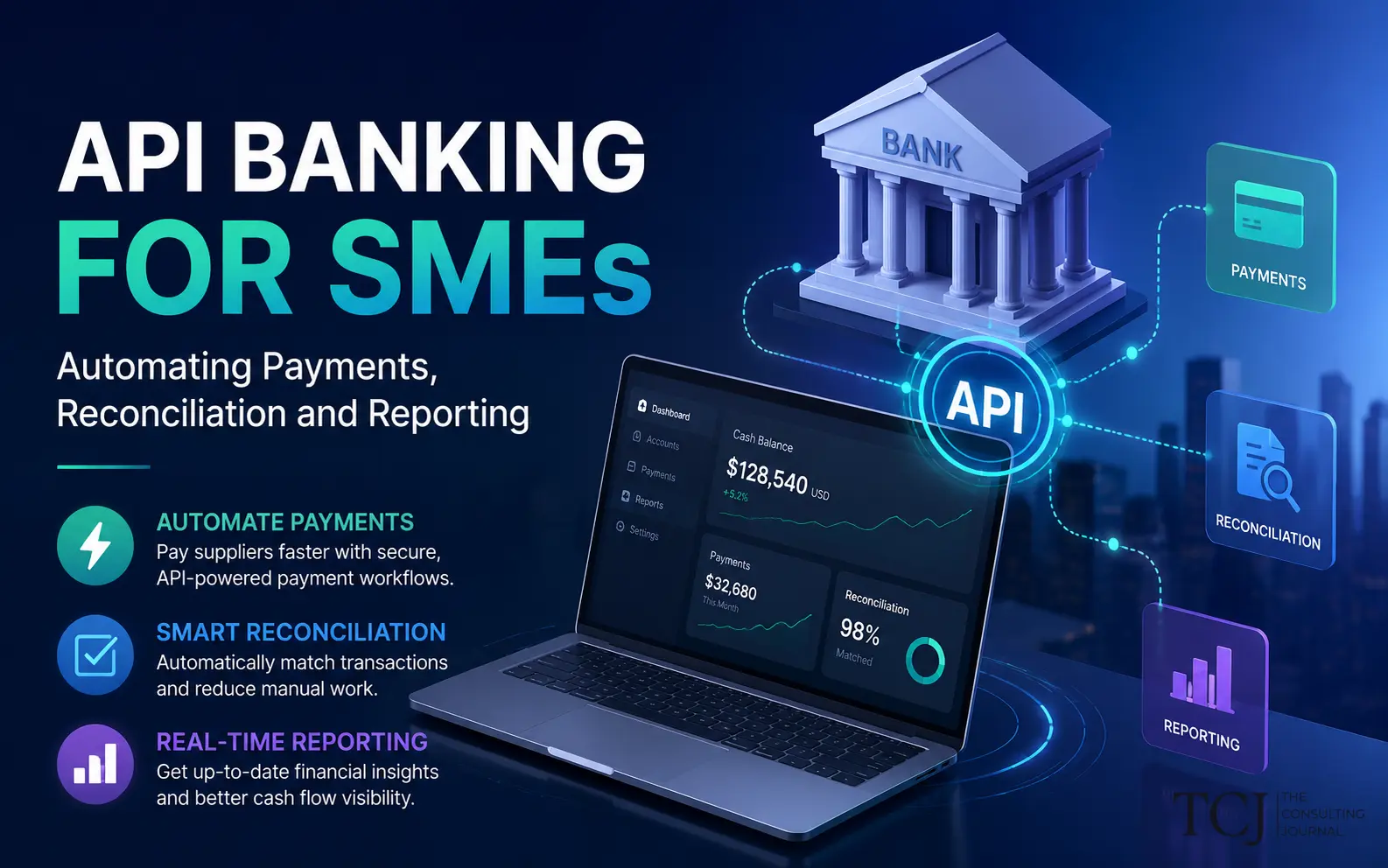
API Banking for SMEs in UAE: Automating Payments, Reconciliation and Reporting
API banking can help UAE SMEs connect banking with Accounting and Financial systems, reducing manual payment work, improving reconciliation and providing more timely cash visibility.

Instant Payments for UAE Businesses: How Real-Time Settlement Changes Cash Management
Instant payments can shorten settlement cycles, improve cash visibility and support faster reconciliation. Here is what UAE business owners and finance teams should consider before adapting treasury and accounting processes.