Can You Get a UAE Doctor License Without the Licensing Exam? Complete Guide for PLAB, USMLE and EMREE Holders
A practical UAE guide for doctors, clinics and healthcare investors on licensing exam exemptions, PLAB, USMLE, EMREE, DHA, DOH, MOHAP, documents and approval risks.
Can you get a UAE doctor license without the licensing exam?
Yes, some doctors can obtain UAE licensing eligibility without sitting the standard licensing exam. But in practice, this is one of the most misunderstood areas of healthcare licensing in the UAE.
Doctors often hear that PLAB, USMLE or an international board certificate can help them “skip the exam”. That may be true for certain categories, but it is never a shortcut around the full licensing process. The applicant still needs to meet the Professional Qualification Requirements, complete credential checks, submit the right documents, and receive approval from the relevant authority.
The article brief provided the core focus for this Sanity-ready version: UAE doctor licensing, DHA, DOH, MOHAP, exam exemption, PLAB, USMLE, EMREE, documents, rejection risks and practical application steps.
For healthcare investors, clinic owners and doctors planning a UAE move, the main question should not be “Can I avoid the exam?” The better question is: “Which authority, title and pathway match my qualifications?”
The UAE healthcare licensing framework in practice
Healthcare professionals in the UAE are licensed through different authorities depending on where they intend to practise. Dubai is regulated through the Dubai Health Authority, Abu Dhabi through the Department of Health Abu Dhabi, and the Northern Emirates through the Ministry of Health and Prevention.
The Unified Healthcare Professional Qualification Requirements, commonly called the PQR, are central to this process. DOH describes the PQR as the basis used by authorities to assess education, experience and licensure requirements for healthcare professionals within their jurisdictions. DHA also explains that the PQR is followed by MOHAP, DOH and DHA and lists licensing titles and requirements for each title.
This matters because a doctor’s outcome depends heavily on category selection. A general practitioner, specialist physician and consultant physician are not assessed in the same way. A clinic hiring a doctor also needs to understand this before promising a start date to patients or investors.
What exam exemption actually means
Exam exemption means the authority may allow the applicant to proceed without taking the local licensure assessment. It does not mean the doctor is licensed immediately.
In practice, the doctor may still need:
- Primary source verification
- Valid professional registration or licence history
- Good standing certificates
- Experience letters
- Correct title selection
- Eligibility review
- Employer-linked licence activation
DHA’s licensing process shows the usual sequence: self-assessment, primary source verification through DataFlow, CBT assessment if required, registration eligibility review, registration and professional licence activation by the hiring facility.
That final point is important. A registration or eligibility outcome is usually not the same as permission to start clinical work. DHA states that active registration is an eligibility proof to start job searching in Dubai, and it must be activated into a licence by a hiring facility before the professional can practise.
The most expensive licensing mistake is not a failed exam; it is applying under the wrong title with documents that do not support the story being presented. — The Consulting Journal
PLAB holders and UAE exam exemption
PLAB holders are among the most common candidates asking about UAE doctor licensing without an exam.
Under the current PQR exam equivalency criteria for general practitioners, the UAE authorities list valid PLAB I and II for the UK route. The same PQR section also refers to UK medical graduates accredited by the General Medical Council and valid GMC registration for certain non-UK graduates whose PLAB exams have passed the five-year validity period.
This is helpful, but it should be read carefully. A doctor with PLAB should not assume that every authority, title or clinical profile will be treated identically. The applicant still needs to match the selected title, show acceptable experience, and complete verification.
Example 1:
A Dubai clinic wanted to hire a GP who had completed PLAB I and II and had recent UK-linked registration documents. The clinic assumed the doctor could begin work quickly. During review, the real issue was not the PLAB result; it was whether the doctor’s experience letters, licence history and selected title matched the PQR pathway. The application moved better once the file was reorganised around the title being requested, not around the doctor’s CV narrative.
USMLE holders and UAE exam exemption
USMLE can also support an exam exemption pathway, but the detail matters.
For general practitioner equivalency, the PQR specifically lists proof of passing United States Medical Licensing Examination Part III under the USA route. This means a doctor who has only completed part of the USMLE sequence should not assume automatic exemption.
From a consultant’s perspective, this is where many applicants lose time. They focus on the prestige of the qualification but do not check whether the exact examination record appears under the relevant PQR category. The licensing officer reviews documents against criteria, not against broad reputation.
EMREE and UAE-based examination records
The PQR also lists proof of passing the Emirates Medical Residency Entrance Examination for the UAE route under general practitioner exam equivalency.
For UAE medical graduates or doctors who have already moved through parts of the UAE training system, this can be relevant. However, EMREE should still be connected to the intended title, clinical experience, internship status and authority requirements. A single examination record rarely solves a weak file by itself.
Specialist and consultant physicians
Specialists and consultants often have stronger exemption potential than junior applicants, especially where they hold recognised specialty certificates and have a clean practice history.
The PQR states that consultant physicians falling under one of the listed criteria may be exempted from the licensure examination, including holders of recognised Tier 1 specialty certificates from listed countries. The specialist physician section also identifies exemption criteria for recognised Tier 1 specialty certificates and other senior professional conditions.
Example 2:
An Abu Dhabi medical centre was reviewing a specialist physician with a strong overseas board certificate. The qualification looked suitable, but the application still needed a clean Good Standing Certificate, current licence evidence and properly structured experience proof. The board certificate supported the exemption argument, but the licensing decision still depended on the whole file.
DHA, DOH and MOHAP: why the authority matters
DHA, DOH and MOHAP all operate within the UAE healthcare licensing environment, but applicants should not treat them as one identical portal.
For Dubai, DHA provides a self-assessment tool that allows applicants to verify whether they meet the PQR to work in a DHA-licensed healthcare facility. If the result is “not eligible,” DHA says the applicant may still apply for a review of registration eligibility.
For Abu Dhabi, DOH positions the PQR as a benchmarked standard for assessing healthcare professional documents and eligibility within its jurisdiction.
For MOHAP, the evaluation service allows health professionals to obtain an evaluation certificate for licensing and verification of knowledge through required examinations. MOHAP also states that exemption documents may be submitted as per PQR or DHA eligibility.
This is why a doctor moving from Dubai to the Northern Emirates, or from Abu Dhabi to Dubai, should not rely only on what happened in a previous application. Authority transfer may be possible, but the file still has to be reviewed properly.
Common mistakes business owners make
Healthcare business owners often underestimate the licensing stage when planning a clinic launch, expansion or new service line.
The most common mistake is making a hiring commitment before checking whether the doctor’s title can actually be approved. A clinic may sign an offer letter for a “consultant” role when the applicant’s documents only support a specialist or GP category.
Another mistake is treating exam exemption as guaranteed. DHA’s FAQ is clear that assessment exemptions are listed in the PQR and licensing policy. If the doctor does not fall within the relevant criteria, the authority may still require an assessment.
A third mistake is ignoring gaps in practice. DHA notes that a professional who has not practised clinically for more than two years is considered to have a gap of practice, subject to limits and further requirements. MOHAP also sets conditions around gaps in professional practice and requires candidates to pass prescribed examinations where applicable.
Documents and preparation checklist
Before applying for a UAE doctor licence without an exam, prepare the file as if the authority will test every claim.
Key documents usually include:
- Passport copy and personal details
- Medical degree and academic transcript
- Internship certificate
- Postgraduate certificates, if applicable
- Current and previous professional licences
- Certificate of Good Standing
- Experience letters matching the requested title
- PLAB, USMLE, EMREE or board examination evidence, where applicable
- DataFlow or previous PSV reports
- Surgical logbook for surgical specialties, where required
- Legal translations for documents not in Arabic or English
MOHAP’s evaluation service lists education documents, academic records, experience documents, licence documents, good conduct documents, surgical records where relevant, passport copy, exemption documents and previous DataFlow reports among its required document categories.
How a UAE licensing consultant can assist
A good licensing consultant should not promise guaranteed approval or guaranteed exemption. That would be unrealistic and risky.
The useful role is more practical: reviewing the doctor’s qualifications against the correct title, identifying gaps before submission, checking whether the authority route is sensible, organising documents for DataFlow, and helping the clinic understand likely timing and dependencies.
For healthcare investors, this can prevent expensive delays. A clinic fit-out, marketing plan and recruitment budget can all be affected if the key physician’s licensing file is weaker than expected.
Final advisory view
A UAE doctor licence without the licensing exam is possible, especially for certain PLAB, USMLE, EMREE, specialist and consultant profiles. But it is not automatic, and it is not a way to bypass regulatory scrutiny.
The strongest applications usually have three things in common: the right licensing title, clean verification documents and a qualification pathway that clearly matches the PQR. Doctors and clinic owners should check these points before spending money, signing contracts or promising joining dates.
This article is for informational purposes and does not constitute legal, tax, accounting, or financial advice.
Questions and answers
Can PLAB doctors get a UAE doctor licence without the DHA exam?
Some PLAB doctors may qualify for exam exemption, especially where their PLAB I and II record or GMC registration fits the relevant PQR criteria. The doctor must still complete eligibility review, verification and licence activation before practising.
Does USMLE automatically exempt a doctor from the UAE licensing exam?
No. The PQR lists USMLE Part III under the USA route for general practitioner equivalency, but the full application still depends on title, experience, licence history and authority review.
Is exam exemption the same as getting a UAE medical licence?
No. Exam exemption only means the applicant may not need to sit the local assessment. The doctor still needs verification, approval and, in most cases, activation through a hiring healthcare facility.
Which authority should a doctor apply through: DHA, DOH or MOHAP?
The correct authority depends on where the doctor will practise. Dubai uses DHA, Abu Dhabi uses DOH, and the Northern Emirates generally fall under MOHAP, subject to the facility and licence structure.
What is the biggest reason exam exemption applications get delayed?
The most common delays come from mismatched title selection, incomplete experience proof, outdated Good Standing Certificates, practice gaps or missing DataFlow verification. A strong file should connect every document to the exact licensing title requested.
More in Medical Career
View all Medical Career →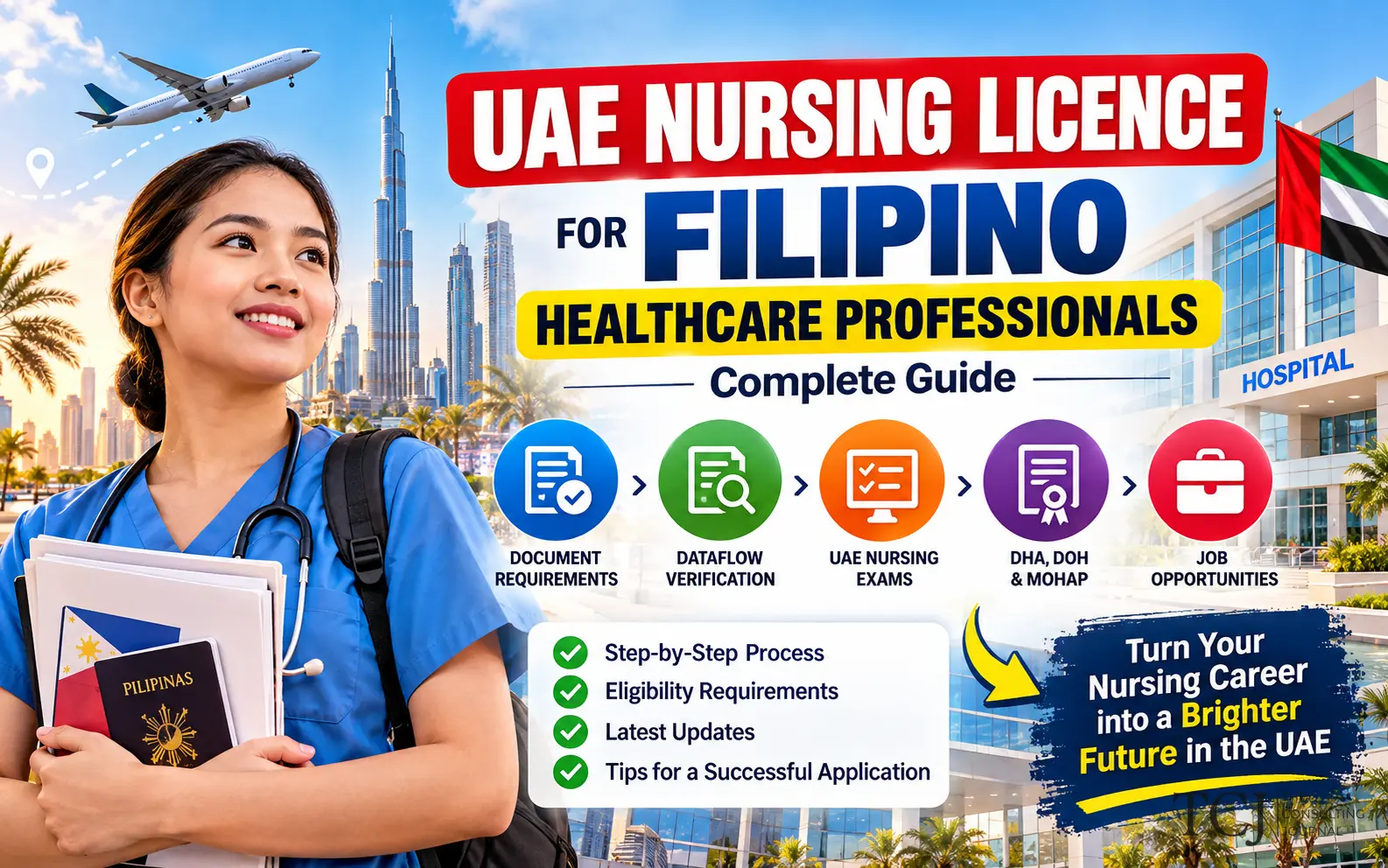
UAE Nursing Licence for Filipino Healthcare Professionals: Requirements and Application Process
Planning to work as a nurse in the UAE? Learn how Filipino healthcare professionals can navigate DHA, DOH and MOHAP licensing, DataFlow verification, nursing assessments, documents and employer licence activation.
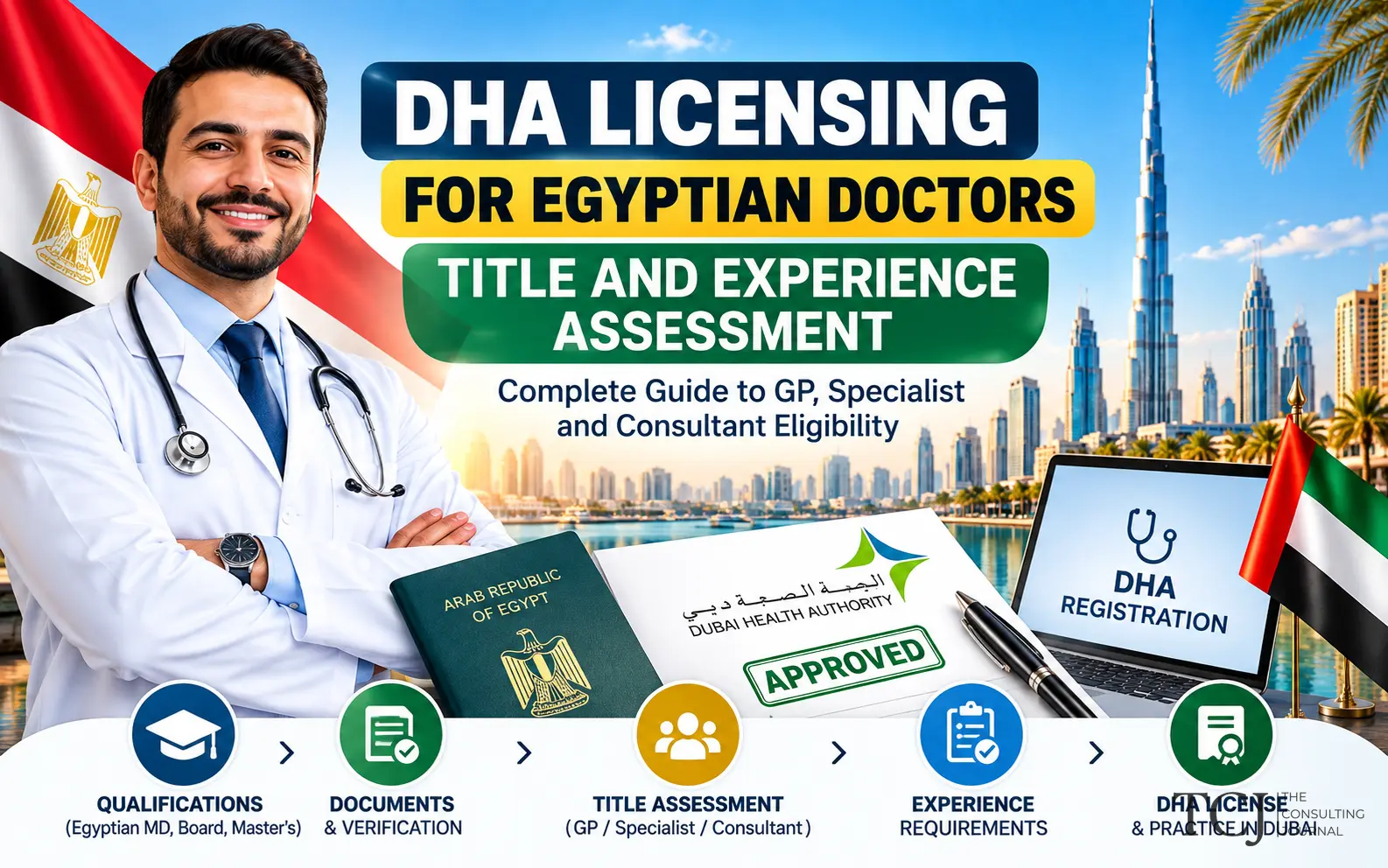
DHA Licensing for Egyptian Doctors: Titles, Tiers and Experience
Egyptian doctors applying for DHA licensing in Dubai need to understand how their MD, Egyptian Board Fellowship, Clinical Master’s and post-qualification experience affect eligibility for GP, Specialist and Consultant titles.

DHA Licence for Nurses in Dubai: Eligibility, DataFlow, Exam and Application Process
A practical 2026 guide to DHA licensing for nurses in Dubai, covering Registered Nurse and Assistant Nurse eligibility, DataFlow verification, assessments, registration, documents and employer-led licence activation.