Why Accounting Is Business Intelligence for UAE Businesses
Accounting is no longer only a recordkeeping function. For UAE businesses, it can act as business intelligence by turning financial data into clearer decisions on cash flow, pricing, tax readiness, growth, and risk.
Why accounting is more than bookkeeping
Many business owners still treat accounting as an after-the-fact exercise. In practice, invoices are entered, bank transactions are reconciled, VAT returns are prepared, and management looks at the numbers only when there is a tax deadline, bank request, or cash shortage.
That approach misses the real value of accounting.
For a UAE company, accounting is not only a compliance requirement. It is one of the most reliable sources of business intelligence available to the owner, founder, CFO, or management team. Sales conversations can be optimistic. Operational teams may focus on activity. Market feedback can be mixed. Accounting, when properly maintained, shows what is actually happening.
It shows whether revenue is growing profitably, whether customers are paying on time, whether costs are rising faster than income, whether stock is tying up cash, and whether the business is ready for VAT, corporate tax, banking, or investor review.
What business intelligence means in practical terms
Business intelligence sounds like a large-company concept. Many owners imagine dashboards, software integrations, and complex data models. Those tools can help, but the basic idea is simpler.
Business intelligence is the use of reliable information to make better decisions.
For an SME in Dubai, Sharjah, Abu Dhabi, or a UAE free zone, this may mean knowing which service line produces the strongest margin. For a trading business, it may mean understanding which products sell well but consume too much working capital. For a consultancy, it may mean reviewing whether monthly retainers are covering payroll and overheads.
Accounting supports these decisions because it organises business activity into usable financial information. Every invoice, supplier bill, salary payment, bank charge, loan repayment, and owner withdrawal tells part of the story. When that story is properly recorded, management can act earlier and with more confidence.
Good accounting does not only explain where the business has been; it helps management see where pressure is building before it becomes visible in the bank balance. — The Consulting Journal
The shift from recordkeeping to intelligence
Traditional accounting was often backward-looking. The accountant prepared financial statements after the period ended. The owner reviewed profit months later. Decisions were made based on instinct, personal experience, or whatever cash happened to be available.
That model is no longer enough.
UAE businesses now operate in a more structured environment. Corporate tax has increased the importance of proper records. VAT-registered businesses need accurate transaction classification. Banks expect clean documentation. Investors and lenders want to see credible numbers. Free zone and mainland companies must maintain records that can support filings, audits, and management decisions.
This does not mean every company needs an expensive finance department. It does mean accounting should be treated as a management tool, not just an administrative task.
A well-maintained accounting system can show:
- Which customers are profitable after discounts and delivery costs
- Which expenses are increasing without clear business benefit
- Whether the company can afford a new hire
- Whether pricing needs to be reviewed
- Whether cash flow can support expansion
- Whether accounting records are ready for tax or bank review
That is business intelligence in a practical form.
How accounting data supports better decisions
The value of accounting intelligence becomes clear when owners use reports to answer real business questions.
Cash flow decisions
Profit and cash are not the same. A company may show strong sales but still struggle to pay suppliers because customers are delaying payment. Accounting helps management see receivables, payables, overdue invoices, payment cycles, and bank movements.
A mainland service business, for example, may notice that several large clients regularly pay 60 to 90 days late. The income statement may look healthy, but the cash flow report will show pressure. With that insight, management can revise payment terms, request advances, or plan working capital earlier.
Pricing and margin decisions
Many SMEs price their services by looking at competitors or adding a rough markup. Accounting provides a better basis.
When costs are recorded properly, management can see gross margin, direct costs, staff time, delivery expenses, software subscriptions, logistics charges, and other cost drivers. A business may discover that one popular service creates revenue but very little profit.
That intelligence allows the owner to adjust pricing, redesign the package, reduce cost leakage, or stop offering low-value work.
Tax and compliance readiness
Accounting intelligence also supports VAT and corporate tax readiness. Proper records help businesses identify taxable income, deductible expenses, related-party transactions, non-business expenses, and documentation gaps.
For a UAE business, waiting until filing season to clean up records is risky. It creates pressure, increases error risk, and may leave management without enough time to correct issues. Monthly accounting review gives owners a clearer view of their position throughout the year.
Growth and investment decisions
Expansion often fails when decisions are based only on revenue ambition. Accounting helps test whether growth is affordable.
Before opening a second branch, hiring a sales team, importing more stock, or applying for financing, management can review cash reserves, margins, debt obligations, fixed costs, and projected break-even points.
This makes growth planning more disciplined. It does not remove risk, but it reduces avoidable surprises.
Example 1:
A Dubai-based startup providing digital services was growing quickly but had no clear view of profitability by client. Revenue looked strong, and the founder assumed the business was ready to hire more staff.
After reviewing the accounting records, management found that two large clients required heavy support hours, frequent revisions, and delayed payments. Smaller retainer clients produced steadier cash and better margins.
The decision changed. Instead of hiring immediately, the company revised client pricing, introduced clearer payment milestones, and focused on recurring retainers. Accounting turned scattered activity into a clearer commercial strategy.
Example 2:
A free zone trading company was preparing documents for a banking review. The business had sales invoices, supplier bills, and customs documents, but records were not well matched. Several supplier payments were recorded without proper descriptions, and inventory costs were not clearly separated from general expenses.
The issue was not only compliance. Management could not see true product margins.
Once the accounting system was cleaned up, the owner could identify which product categories were profitable, which items tied up too much cash, and which customers frequently delayed payment. The same work that improved banking readiness also improved business intelligence.
Accounting reports that matter most for management
Not every report needs to be complicated. In many UAE SMEs, a few well-prepared reports can provide meaningful intelligence.
The income statement helps owners understand revenue, direct costs, operating expenses, and profit trends. It is useful for reviewing whether sales growth is actually improving profitability.
The balance sheet shows assets, liabilities, receivables, payables, loans, owner balances, and retained earnings. It helps management understand the financial position of the business, not just monthly performance.
The cash flow report shows how money moves through the company. For businesses with delayed customer payments, seasonal demand, stock purchases, or loan commitments, this report is often more useful than the profit figure alone.
Aged receivables and aged payables reports are also important. They show who owes the company money and what the company owes others. These reports can prevent cash flow pressure from being noticed too late.
Technology makes accounting intelligence easier, but not automatic
Cloud accounting software, automation tools, bank feeds, and dashboards can improve visibility. They can reduce manual work and help management access numbers faster.
However, software alone does not create intelligence.
If transactions are coded incorrectly, bank accounts are not reconciled, VAT treatment is wrong, or reports are not reviewed, the dashboard may simply present inaccurate information in a modern format.
Good accounting intelligence requires three things working together: clean data, proper review, and business interpretation.
For example, a dashboard may show that expenses increased by 18 percent. That is useful, but management still needs to ask why. Was it due to one-time setup costs, hiring, supplier price increases, marketing spend, or poor cost control? The answer requires accounting discipline and commercial judgement.
Common mistakes business owners make
Many companies have accounting data but do not use it well. The most common mistakes are practical and preventable.
- Reviewing accounts only at year-end or during tax filing
- Mixing personal and business expenses without clear treatment
- Not reconciling bank accounts every month
- Recording sales but not tracking customer collections
- Focusing on revenue while ignoring gross margin
- Treating VAT and corporate tax as separate from daily accounting
- Not keeping supplier contracts, invoices, and payment evidence together
- Using accounting software without proper chart of accounts setup
- Ignoring inventory, work-in-progress, or unbilled revenue
- Making expansion decisions without cash flow forecasting
These mistakes reduce the quality of business intelligence. They also make compliance, banking, audit, and investor conversations more difficult.
Documents and preparation checklist
A business that wants to use accounting as intelligence should start with organised records. The goal is not paperwork for its own sake. The goal is to create a reliable financial picture.
A practical checklist includes:
- Trade licence and company formation documents
- VAT registration details, where applicable
- Corporate tax registration details, where applicable
- Bank statements for all business accounts
- Sales invoices and credit notes
- Supplier invoices and payment records
- Customer contracts and payment terms
- Payroll records and employee cost details
- Loan, lease, and financing agreements
- Inventory and stock movement records, where relevant
- Fixed asset purchase documents
- Related-party transaction details
- Expense approvals and supporting receipts
- Monthly management reports
- Reconciled accounts receivable and accounts payable schedules
For many SMEs, the first improvement is simply moving from reactive bookkeeping to monthly review. Once records are current, management can start using them for planning.
How consulting support can improve accounting intelligence
A consultant’s role is not only to prepare reports. The real value is helping management understand what the reports mean.
A business advisory review may look at whether revenue is sustainable, whether margins are improving, whether cash flow risk is building, whether documentation is strong enough for tax and banking, and whether internal processes support accurate reporting.
For UAE companies, this can be especially helpful during growth stages. A founder may be focused on sales. A finance manager may be focused on entries and reconciliations. A consultant can connect the two perspectives by translating accounting records into management decisions.
This support may include monthly reporting packs, cash flow reviews, VAT and corporate tax readiness checks, accounting system cleanup, chart of accounts redesign, receivables analysis, management dashboards, and owner-level advisory discussions.
The objective is not to make accounting more complex. The objective is to make financial information more useful.
Turning accounting into a management habit
Accounting becomes business intelligence when management builds a rhythm around it.
A useful monthly review may cover five questions:
- Did revenue grow, and was it profitable?
- Are customers paying on time?
- Which costs increased, and why?
- Is cash flow enough for the next 30 to 90 days?
- Are records ready for tax, banking, and management review?
These questions keep the business grounded. They also help owners spot issues early. A small margin decline can be corrected. A recurring payment delay can be addressed. A weak product line can be reviewed before it drains cash.
This article is for informational purposes and does not constitute legal, tax, accounting, or financial advice.
Final advisory note
Accounting should not sit quietly in the background of a business. When properly maintained and reviewed, it becomes one of the most useful intelligence systems a company has.
For UAE business owners, the lesson is practical: do not wait for year-end accounts to understand performance. Build monthly visibility. Review cash flow. Track margins. Keep records clean. Use accounting not only to satisfy requirements, but to make better commercial decisions.
A company that understands its numbers usually moves with more discipline. It prices better, plans better, manages risk earlier, and speaks more confidently with banks, investors, tax advisors, and internal teams. That is why accounting is business intelligence in the most practical sense.
Questions and answers
Why is accounting considered business intelligence?
Accounting is considered business intelligence because it turns daily financial transactions into useful management insight. When reports are accurate and reviewed regularly, they help business owners understand profit, cash flow, customer behaviour, cost pressure, and risk.
Can small UAE businesses use accounting as business intelligence?
Yes. Even a small UAE business can use accounting reports to track receivables, review margins, manage VAT records, plan cash flow, and prepare for corporate tax obligations. The key is keeping records current rather than waiting until year-end.
What accounting reports should business owners review every month?
Business owners should typically review the income statement, balance sheet, cash flow report, aged receivables, aged payables, and key expense movements. Depending on the activity, inventory reports, project profitability, or customer-level margin reports may also be useful.
Does accounting software automatically create business intelligence?
Not by itself. Accounting software can improve speed and visibility, but the information is only useful if transactions are recorded correctly, bank accounts are reconciled, and reports are interpreted properly. Clean data and regular review matter more than the tool alone.
How does accounting help with VAT and corporate tax readiness in the UAE?
Proper accounting helps businesses maintain supporting documents, classify income and expenses correctly, and review taxable positions more clearly. It also reduces last-minute pressure when preparing VAT returns, corporate tax filings, banking documents, or management reports.
More in Finance
View all Finance →
How to Build a Monthly Cash-Flow Dashboard for a UAE SME
A practical guide for UAE SME owners and finance teams on building a monthly cash-flow dashboard that tracks liquidity, collections, payments, tax obligations, forecasts, and working capital.

How UAE Companies Can Build a Faster, More Reliable Month-End Close
A practical UAE finance guide to shortening the month-end close through better reconciliations, cut-off controls, automation, tax readiness, data quality, and clear accountability.
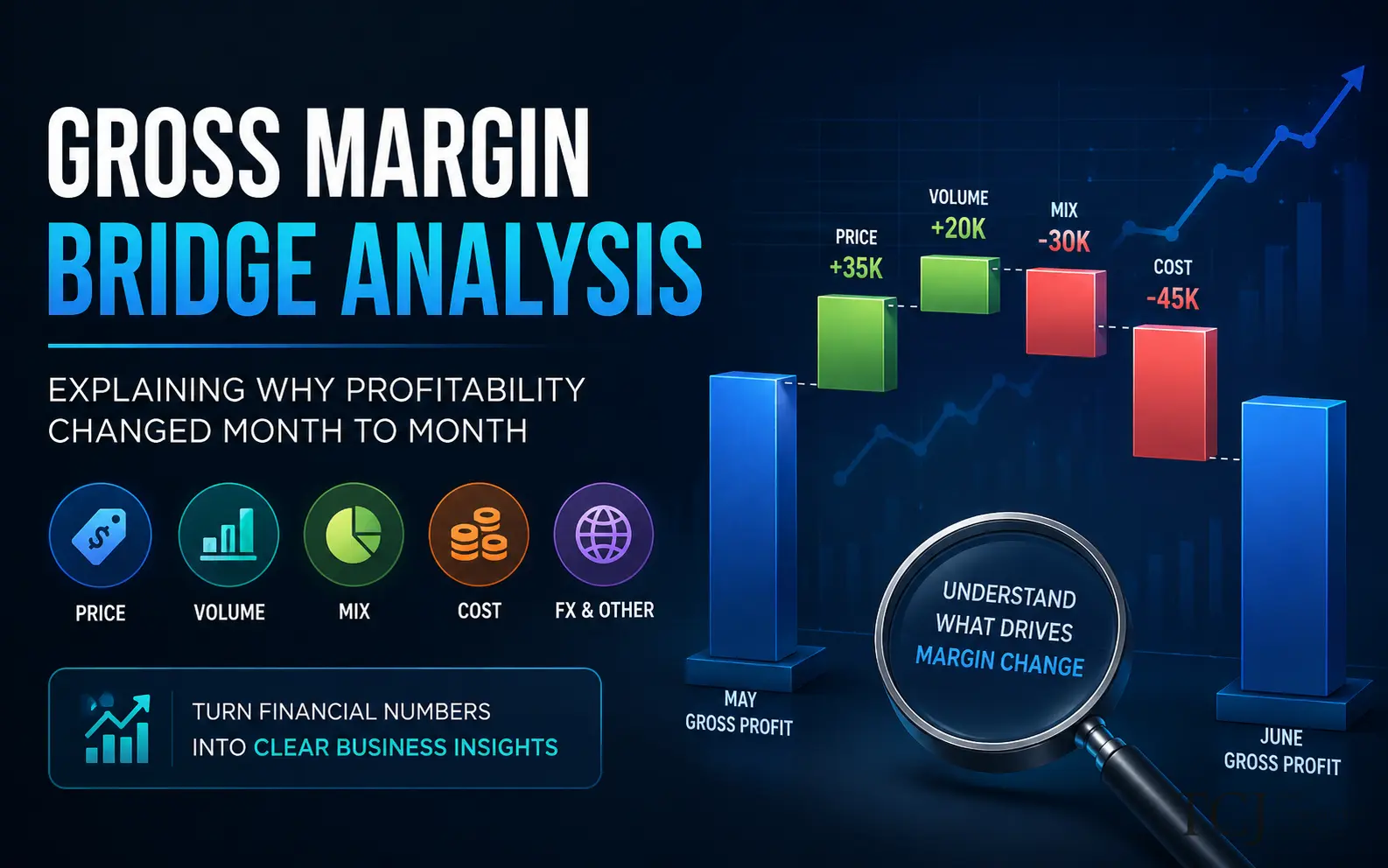
Gross Margin Bridge Analysis: Explaining Why Profitability Changed Month to Month
Gross margin bridge analysis helps finance teams explain monthly profitability changes by separating the impact of price, volume, sales mix, cost, and other operational drivers.