Why UAE Business Bank Accounts Get Rejected and How to Avoid It
UAE business bank account rejections are often avoidable. This guide explains how founders can prepare stronger documents, KYC files, and banking profiles.
Why UAE banks review business accounts carefully
UAE banks operate in a regulated environment. The Central Bank of the UAE supervises licensed financial institutions using a risk-based AML/CFT/CPF framework, and its AML supervision function includes onsite and offsite supervision, corrective actions, and enforcement where required.
For business owners, this means account opening is not a simple administrative formality. Banks have to understand the customer, the beneficial owners, the source of funds, the nature of the activity, and the expected transaction behaviour. The CBUAE rulebook guidance states that licensed financial institutions must perform customer due diligence to understand who the customer is and the purpose of the relationship.
That does not mean banks are trying to block legitimate SMEs or startups. It means the bank needs enough comfort to onboard the company without creating financial crime, sanctions, fraud, or reputational risk.
A strong banking file does not try to impress the bank. It helps the bank understand the business without confusion. — The Consulting Journal
The most common reasons UAE business bank accounts get rejected
1. Incomplete or inconsistent documents
This remains one of the most avoidable reasons for rejection. Founders often submit the trade license, passport copies, and basic incorporation papers, but miss supporting documents that explain the actual business.
A bank may ask for the Memorandum of Association, share certificates, office lease, utility bill, Emirates ID, visa page, board resolution, supplier agreements, invoices, company profile, or previous bank statements. If names, addresses, signatures, shareholding percentages, or license activities do not match, the file may be delayed or rejected.
A small inconsistency can create a large compliance question. For example, if the license says “management consultancy” but the bank statements show trading-style payments from unrelated jurisdictions, the relationship manager may ask for further clarification.
2. The business activity is unclear or too broad
Many UAE companies are formed with broad activities such as general trading, consultancy, project management, marketing services, or commercial brokerage. These activities may be legitimate, but banks usually need a narrower explanation.
A founder who says, “We do consulting,” has not said enough. Consulting for whom? In which industry? From which countries? What is the average invoice value? Will payments come from individuals or companies? Are services delivered from the UAE or remotely?
A free zone company offering cross-border consulting may be approved, but the application needs to show commercial substance. A short company profile, sample engagement letter, service brochure, website, and expected client list can make the activity easier to assess.
3. Weak proof of operations
New companies often struggle because they do not yet have invoices, clients, or transaction history. That is understandable, but the bank still needs evidence that the company is not a shell entity.
For a startup, useful proof may include signed contracts, letters of intent, supplier discussions, investor agreements, a business plan, or founder experience. For an SME, the bank may expect recent invoices, existing customer contracts, accounting records, VAT filings if applicable, and previous banking history.
Example 1:
A Dubai mainland marketing agency applied for an account immediately after licensing. The license was valid, but the company had no website, no proposal deck, no client pipeline, and no explanation of expected payments. The bank asked for more details, and the founder treated the request as a formality. The application stalled.
A stronger file would have included a one-page business profile, sample client proposal, founder CV, expected monthly turnover, and a simple explanation of how clients would be billed.
4. Source of funds or source of wealth is not explained
Banks want to know where the company’s initial funds and future account flows are coming from. This can include shareholder savings, salary income, sale of an asset, retained earnings from another business, investor funds, or intercompany funding.
The CBUAE rulebook explains source of funds as identifying the direct source of money used to initially fund an account or transact through it.
A common mistake is assuming that “personal savings” is enough. It may be enough in a simple case, but supporting documents are often needed. These may include salary certificates, personal bank statements, audited financial statements from another business, dividend records, property sale documents, or investment redemption statements.
5. Ownership structure is difficult to verify
Banks need to identify the real individuals who ultimately own or control the company. The UAE has beneficial ownership rules designed to enhance transparency for UAE-registered entities, and the Central Bank references Cabinet Decision No. 58 of 2020 as introducing minimum obligations for registrars and legal persons to improve entity transparency.
If ownership passes through multiple companies, offshore entities, nominees, trusts, or foreign holding structures, the bank may request additional documents. These can include corporate registers, certificates of incumbency, shareholder registers, board resolutions, ownership charts, and notarised or attested documents.
This is not only a concern for large groups. Even a small business can face delays if the shareholder structure is not presented clearly.
6. Non-resident shareholders and signatories need extra clarity
Foreign shareholders can open UAE business bank accounts, depending on the bank, activity, risk profile, and documents. However, non-resident ownership often leads to deeper due diligence.
Banks may ask why the company is being established in the UAE, whether the owner has a UAE visa, where management decisions are made, whether the business has UAE clients, and whether there is a local office or employee presence.
A non-resident founder should be ready to explain the UAE connection. For example, the company may be serving GCC clients, using the UAE as a regional hub, hiring staff locally, or operating from a UAE free zone with a proper lease.
7. The expected banking activity does not match the company profile
Banks look for consistency. A small consulting company expecting AED 5 million monthly turnover from multiple high-risk jurisdictions will raise questions. A general trading company with no suppliers but high projected incoming transfers may also face concerns.
The account application should explain expected monthly turnover, average transaction size, countries involved, main customers, supplier payments, currencies, and whether cash deposits are expected.
Founders should avoid inflating projections to look more impressive. Realistic figures are usually better than ambitious numbers that cannot be supported.
How UAE banks typically assess a business account application
Banks usually review three areas together.
First, they assess the legal documents. This confirms that the company exists, the license is active, the shareholders are identifiable, and the signatory has authority.
Second, they assess business logic. The bank wants to know what the company does, who it sells to, how it earns money, and whether the expected transactions make sense.
Third, they assess compliance risk. This includes KYC, AML, sanctions screening, politically exposed person checks, source of funds, source of wealth, beneficial ownership, geography, industry risk, and ongoing monitoring obligations.
The CBUAE notes that AML/CFT supervision is based on a risk-based approach and that licensed financial institutions are expected to follow relevant guidance, notices, and international best practices.
Practical ways to reduce rejection risk
Prepare a banking file before applying
Do not wait for the bank to request every document. A clean banking file saves time and makes the first review stronger.
A practical file should include:
- Trade license
- Memorandum and Articles of Association
- Share certificates or ownership documents
- Passport copies of shareholders and signatories
- Emirates ID and UAE residence visa, if applicable
- Office lease or flexi-desk agreement
- Board resolution for account opening
- Company profile
- Website or service brochure
- Business plan or transaction explanation
- Supplier agreements, client contracts, or letters of intent
- Personal or corporate bank statements
- Source of funds documents
- Ownership structure chart, where relevant
Write a clear company profile
A useful company profile is not a marketing brochure. It should explain the business in plain commercial terms.
Include what the company sells, who the customers are, where customers are located, how services or goods are delivered, expected monthly turnover, average invoice value, main suppliers, payment methods, and founder background.
For example, a UAE bookkeeping company should explain whether it serves mainland SMEs, free zone startups, ecommerce businesses, or international clients. It should also explain whether fees are monthly retainers, one-off advisory invoices, or project-based payments.
Align license activity with actual operations
If your license activity is too broad or does not reflect what you actually do, the bank may struggle to assess the application. Business owners should review their activity before account opening and, where needed, amend the license or prepare a written explanation.
This is especially important for companies using activities such as commercial brokerage, general trading, consultancy, management services, virtual asset-related activities, precious metals, or payment-related services.
Choose the bank carefully
Not every bank is suitable for every business. Some banks are more comfortable with established SMEs, while others have better digital onboarding for smaller companies. Some banks may be more selective with non-resident shareholders, certain jurisdictions, or particular activities.
Applying randomly can create unnecessary rejection history. A better approach is to compare account requirements, minimum balance expectations, onboarding timelines, digital banking capability, international transfer needs, and the bank’s appetite for your activity.
Example 2:
A free zone ecommerce company wanted a UAE account but expected payments from international marketplaces and suppliers in several countries. The first application was too brief and did not explain the flow of funds. After preparing a transaction map, supplier list, marketplace screenshots, and projected monthly turnover, the founder had a more credible discussion with a different bank.
The point was not to guarantee approval. The point was to remove avoidable uncertainty.
Common mistakes business owners make
Many rejections happen before the bank has even formed a full view of the business. Common mistakes include:
- Applying with a license only and no business explanation
- Giving vague answers about customers, suppliers, or revenue
- Submitting documents with inconsistent names or expired details
- Using personal email addresses instead of a business domain
- Having no website, profile, proposal, or proof of activity
- Overstating expected turnover without support
- Failing to explain source of funds clearly
- Applying to multiple banks without understanding their requirements
- Ignoring UBO and ownership transparency documents
- Treating bank compliance questions as unnecessary delays
A founder may see these points as minor. A bank may see them as risk indicators.
Documents and preparation checklist
Before applying for a UAE business bank account, business owners should prepare a practical checklist.
Company documents
- Valid trade license
- Incorporation certificate, where applicable
- MOA or AOA
- Shareholder register or share certificates
- Lease agreement, Ejari, or free zone office document
- Board resolution or account opening authorisation
Shareholder and signatory documents
- Passport copies
- Emirates ID, if applicable
- UAE visa, if applicable
- Proof of address
- CV or professional background summary
- Personal bank statements, where requested
Business proof
- Company profile
- Website or brochure
- Client contracts or draft agreements
- Supplier invoices or quotations
- Business plan for startups
- Transaction flow explanation
- Expected monthly turnover and countries involved
Financial and compliance support
- Source of funds documents
- Source of wealth documents, where relevant
- Ownership structure chart
- VAT registration certificate, if applicable
- Accounting records or management accounts
- Previous corporate bank statements, if available
When to involve a consultant
A consultant can be useful when the business has non-resident shareholders, multiple owners, foreign holding companies, broad license activities, complex transaction flows, or previous bank rejections.
The consultant’s role is not to promise approval. No responsible adviser should guarantee a banking outcome. The useful work is preparation: reviewing documents, identifying gaps, clarifying the activity, building a transaction narrative, and helping the founder approach suitable banks with a cleaner file.
For SMEs, this preparation often improves more than the bank application. It also strengthens accounting records, VAT readiness, corporate tax documentation, supplier due diligence, and investor confidence.
Final advisory note
A UAE business bank account application should be treated as a compliance and business presentation exercise, not just a form submission.
The strongest applications are usually simple, consistent, and well supported. The bank can see who owns the company, what it does, where money will come from, where money will go, and why the expected activity is reasonable.
For founders, the practical lesson is clear: prepare before you apply. A well-organised file cannot guarantee approval, but it can reduce avoidable questions, shorten delays, and present the business in a way that a bank can properly understand.
This article is for informational purposes and does not constitute legal, tax, accounting, or financial advice.
Questions and answers
Why do UAE business bank accounts get rejected?
Rejections usually happen because the bank cannot verify the business clearly enough. Common issues include missing documents, vague business activity, unclear source of funds, complex ownership, weak proof of operations, or high-risk transaction patterns.
Can a new UAE company open a business bank account without invoices?
Yes, it may be possible, but the founder should provide alternative proof of business intent. A business plan, client pipeline, letters of intent, supplier discussions, founder experience, and projected transaction details can help explain the company’s commercial purpose.
Do UAE free zone companies face more banking checks?
Free zone companies can open business bank accounts, but banks may ask more questions when the business is internationally focused or has limited UAE presence. A clear office arrangement, website, client contracts, and transaction explanation can improve the quality of the file.
Is a UAE residence visa required for a business bank account?
Requirements vary by bank and by risk profile. Some banks may consider non-resident shareholders, while others prefer UAE resident signatories or stronger local presence. Non-resident founders should prepare more detailed KYC and source of funds documents.
Can a consultant guarantee UAE bank account approval?
No consultant should guarantee bank approval because the final decision rests with the bank. A good consultant can help prepare the documents, clarify the business model, identify weak points, and approach banks that may be more suitable for the company profile.
More in Finance
View all Finance →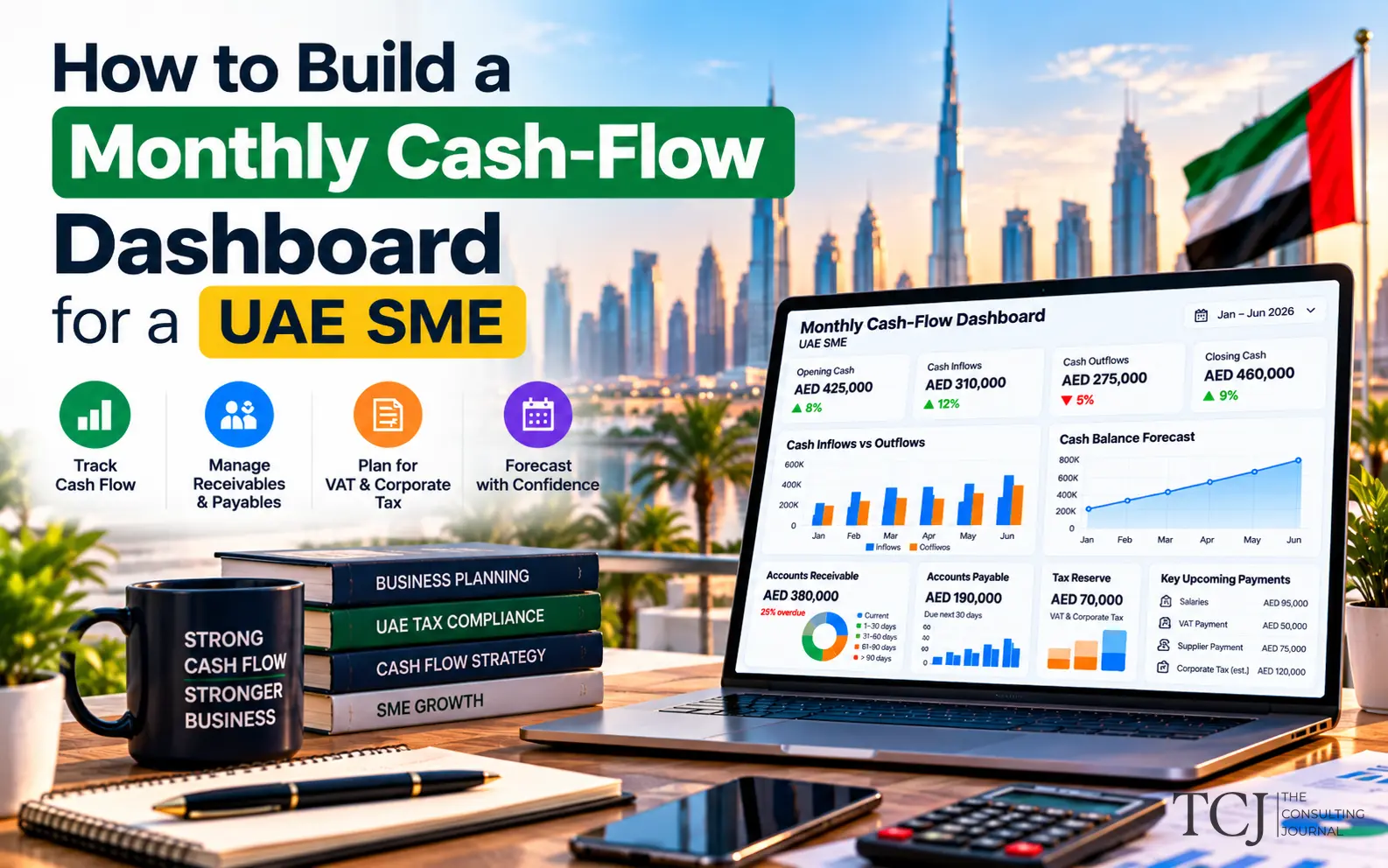
How to Build a Monthly Cash-Flow Dashboard for a UAE SME
A practical guide for UAE SME owners and finance teams on building a monthly cash-flow dashboard that tracks liquidity, collections, payments, tax obligations, forecasts, and working capital.

How UAE Companies Can Build a Faster, More Reliable Month-End Close
A practical UAE finance guide to shortening the month-end close through better reconciliations, cut-off controls, automation, tax readiness, data quality, and clear accountability.

Gross Margin Bridge Analysis: Explaining Why Profitability Changed Month to Month
Gross margin bridge analysis helps finance teams explain monthly profitability changes by separating the impact of price, volume, sales mix, cost, and other operational drivers.