Can UAE Businesses Combine In-House and Outsourced Accounting?
A hybrid accounting model allows UAE businesses to retain internal financial knowledge while using outsourced specialists for reporting, tax, controls, payroll, forecasting, and additional capacity.
Key takeaways
- UAE businesses can retain an in-house accountant while outsourcing selected Accounting and Financial responsibilities.
- Every recurring task should have a named preparer, reviewer, approver, deadline, and document location.
- Management remains responsible for oversight, approvals, recordkeeping, and protecting access to company funds and data.
- A hybrid model is most effective when internal knowledge is combined with specialist expertise and documented processes.
- Businesses should assess reporting quality and control improvements, not only the cost of outsourced services.
Can UAE Businesses Combine In-House and Outsourced Accounting?
Yes. A UAE business can retain an in-house accountant while outsourcing selected Accounting, Tax, payroll, reporting, or Financial management responsibilities.
The two arrangements are not mutually exclusive. In practice, many growing businesses need both internal knowledge and external expertise. The in-house accountant understands customers, suppliers, employees, operational issues, and management priorities. The outsourced provider adds capacity, specialist review, structured processes, and access to professionals with different levels of experience.
This approach is usually described as a hybrid accounting model. It may suit a Dubai mainland company, a free zone business, a family-owned enterprise, or an SME that has outgrown a one-person finance function but does not require a large internal department.
The arrangement works best when responsibilities, approval rights, deadlines, document access, and communication procedures are agreed in writing.
What is a hybrid accounting model?
A hybrid accounting model combines an internal accountant or finance department with an external Accounting services provider. The business keeps selected activities in-house and assigns other functions to specialists. The objective is not simply to move work outside the company, but to create a more reliable and appropriately supervised finance function.
The internal accountant may continue handling daily transactions, document collection, supplier queries, customer invoicing, expense checks, and communication with management.
The outsourced team may handle:
- Monthly closing and account reconciliations
- Management accounts and Financial reporting
- VAT and Corporate Tax support
- Payroll processing or review
- Cash-flow forecasting
- Accounting system improvements
- Internal control reviews
- Controller or part-time CFO support
- Temporary support during audits, staff leave, or business expansion
The exact structure should reflect the company’s activity, transaction volume, reporting expectations, internal capabilities, and regulatory obligations.
“The strongest hybrid finance teams do not divide work by job title; they divide it by risk, context, frequency, and required expertise.” — Consultant observation
Why should a business keep an in-house accountant?
An in-house accountant provides immediate access to company knowledge. This can be particularly useful when financial transactions depend on operational context, unusual customer agreements, project milestones, supplier relationships, or internal approval procedures that an external provider may not see without explanation.
An internal accountant may understand:
- Which customers regularly delay payment
- How different departments approve expenses
- Which projects require separate cost tracking
- When seasonal purchases affect cash flow
- Where contracts and supporting records are stored
- Which transactions require management clarification
- How the company’s licensing activity affects invoicing
The employee can also act as the main link between management, operational teams, auditors, tax advisers, banks, and the outsourced provider.
Rather than replacing the employee, outsourcing may allow the accountant to move away from repetitive processing and spend more time on reconciliations, cash management, analysis, controls, and management support.
Which Accounting tasks can be outsourced?
UAE businesses can outsource one function, several recurring processes, or most of the finance department. Suitable tasks are generally those that require additional capacity, specialist knowledge, independent review, regular deadlines, or documented procedures that can be completed securely outside the office.
Common options include:
Bookkeeping and reconciliations
An external provider may record transactions, categorise expenses, reconcile bank accounts, maintain ledgers, and investigate unmatched balances.
The internal accountant can remain responsible for collecting documents and explaining unusual entries.
Accounts payable and receivable
The outsourced team may prepare supplier payment schedules, issue invoices, monitor receivables, and produce ageing reports.
Bank access and final payment approval should normally remain subject to controlled internal authorisation.
Payroll support
A provider may calculate salaries, deductions, leave adjustments, and payroll reports. The business should retain responsibility for approving employee data, salary changes, final payroll amounts, and bank transfers.
Month-end reporting
An outsourced accountant or controller may review balance-sheet accounts, post approved adjustments, prepare management accounts, and identify missing or unusual entries.
This can help an internal accountant who manages daily work but lacks time to complete a disciplined monthly close.
VAT and Corporate Tax support
External specialists may review accounting records, prepare calculations, identify documentation gaps, and assist with return preparation.
This is increasingly relevant because UAE Corporate Tax calculations generally begin with the accounting income shown in the business’s financial statements. Corporate Tax returns and related payments are generally due within nine months from the end of the relevant Tax Period.
Management should remember that appointing an external provider does not transfer the company’s underlying responsibility for maintaining complete and supportable records.
How should responsibilities be divided?
Every recurring activity should have a named preparer, reviewer, approver, deadline, and document location. Without this structure, a hybrid team may duplicate work, overlook important tasks, or assume that another person has completed a filing, reconciliation, payment, or management report.
A practical allocation may be:
- The internal accountant collects invoices and confirms operational details.
- The outsourced provider records or reviews the transactions.
- The internal accountant verifies supplier and customer information.
- The provider prepares bank and ledger reconciliations.
- Management approves payments and material adjustments.
- The provider prepares the monthly reporting package.
- The internal accountant explains results to department managers.
- The provider prepares tax calculations or filing schedules.
- The business reviews and approves information before submission.
- Management retains control over banking, access rights, and commercial decisions.
The division should also identify who communicates with auditors, tax advisers, banks, free zone authorities, or other external parties.
Example 1:
A fictional Dubai trading company employs one accountant who manages sales invoices, supplier documents, daily banking records, and customer follow-up. As transaction volume grows, the company outsources monthly reconciliations, VAT review, Corporate Tax schedules, and management reporting. The internal employee remains central to the process but gains more time to monitor collections and inventory-related cash flow.
What are the benefits of using both models?
Combining internal and outsourced Accounting support can improve capacity, continuity, specialist access, and management reporting. The model is particularly useful when the company values its existing accountant but requires services that are too specialised, seasonal, or time-consuming for one employee to manage consistently.
Key benefits include:
Internal knowledge is retained
The company continues to benefit from an employee who understands its commercial arrangements, people, systems, and working practices.
Specialist support becomes available
An outsourced provider may offer access to bookkeepers, senior accountants, tax professionals, controllers, systems specialists, and CFO-level advisers without requiring separate full-time appointments.
Reporting can become more consistent
A structured external review may help the business complete reconciliations, close its accounts, investigate unusual balances, and prepare management reports on a regular timetable.
Business continuity improves
Documented processes and backup resources reduce dependence on one employee. This can be valuable during annual leave, staff turnover, illness, system migrations, audits, or rapid growth.
The finance function can scale gradually
A business may begin with monthly reporting support and later add payroll, budgeting, cash-flow forecasting, or controller services as its needs change.
What challenges should management prepare for?
A hybrid accounting arrangement can create confusion when roles, systems, and expectations are not clearly managed. Business owners should address these risks during implementation rather than waiting for missed deadlines or reporting errors to expose weaknesses.
Common challenges include:
- Unclear ownership of tasks
- Duplicate processing or reconciliations
- Delays in answering external-provider questions
- Different spreadsheet versions or account classifications
- Excessive access to banking or confidential information
- Incomplete supporting documents
- Employee concerns about job security
- Reports that are produced but not reviewed by management
The solution is not additional meetings alone. The business needs documented responsibilities, standard working files, controlled access, a recurring reporting calendar, and a clear escalation process.
Example 2:
A fictional Abu Dhabi consultancy appoints an outsourced provider to prepare monthly management accounts. During the first two months, reports are delayed because consultants submit expense receipts through email, messaging applications, and paper files. The company introduces one submission folder, a monthly cut-off date, and a named internal coordinator. Reporting becomes more predictable because the underlying process is corrected.
How can a UAE business build an effective hybrid team?
The business should begin by assessing its current workload and identifying where delays, errors, dependency risks, or technical gaps occur. Outsourcing an undocumented process without first understanding it may simply transfer confusion from one team to another.
A practical implementation process includes:
- List all daily, weekly, monthly, quarterly, and annual finance tasks.
- Record who currently prepares, reviews, and approves each activity.
- Identify work that depends heavily on internal business knowledge.
- Identify repetitive, specialist, seasonal, or review-based tasks.
- Agree the outsourced scope, deliverables, deadlines, and fees.
- Establish secure software and document access.
- Create month-end, payroll, payment, and tax checklists.
- Set approval thresholds and segregation of duties.
- Hold regular review meetings during implementation.
- Measure reporting quality, response times, unresolved items, and close completion.
The service agreement should also address confidentiality, data handling, subcontractors, system permissions, correction procedures, additional work, termination support, and ownership of accounting records.
What documents should be prepared?
A provider can work efficiently only when the business supplies organised and complete information. Poor documentation may increase follow-up questions, delay reporting, and make tax or audit support more difficult.
Businesses should prepare:
- Trade licence and constitutional documents
- VAT and Corporate Tax registration details
- Current chart of accounts
- Prior financial statements or management accounts
- Bank statements and reconciliation files
- Customer and supplier ledgers
- Sales invoices and purchase documents
- Payroll records and employee information
- Loan, lease, and financing agreements
- Fixed-asset schedules
- Inventory records, where applicable
- Related-party transaction details
- Existing accounting policies and approval limits
- User-access lists for Accounting and banking systems
- Tax returns and supporting calculations
- Month-end and year-end closing schedules
The Federal Tax Authority states that Taxable Persons and relevant Exempt Persons must retain Corporate Tax records for at least seven years after the end of the Tax Period concerned. Required records may include transaction, asset, liability, and shareholding information, depending on the business.
What mistakes do business owners commonly make?
The most common mistake is treating outsourcing as a complete transfer of responsibility. The provider may prepare records or returns, but management should still review reports, approve payments, safeguard access, and ensure that information supplied to advisers is accurate and complete.
Other frequent mistakes include:
- Outsourcing work without defining the expected deliverable
- Giving several people unrestricted banking access
- Failing to involve the internal accountant in implementation
- Using separate charts of accounts or reporting templates
- Measuring performance only by the provider’s monthly fee
- Ignoring unresolved reconciliation differences
- Waiting until a filing deadline to organise documents
- Allowing the internal and external teams to rely on verbal instructions
- Receiving management reports without discussing the results
- Keeping key processes dependent on one individual
A hybrid model should improve accountability rather than create another layer of administration.
When does a hybrid Accounting model make sense?
A hybrid model generally makes sense when the internal accountant remains valuable but requires additional capacity, supervision, specialist Tax support, or higher-level Financial reporting. It can also suit a business that needs controller or CFO input without creating another permanent senior position.
The model may be appropriate when:
- Monthly accounts are regularly delayed
- The business has grown faster than its finance team
- Management lacks reliable cash-flow forecasts
- The accountant spends too much time on data entry
- Tax documentation is prepared close to deadlines
- The company needs backup during staff absence
- New software is being implemented
- An audit, financing exercise, or transaction is approaching
- Management requires more detailed performance reporting
- The business has multiple branches, activities, or revenue streams
It may be less effective when management is unwilling to provide information, responsibilities remain undocumented, or nobody inside the company can coordinate the provider.
How can KPM Global Services UAE assist?
KPM Global Services UAE can work alongside an existing accountant or finance department rather than automatically replacing it. Support can be structured around the business’s existing team, Accounting systems, reporting timetable, transaction volume, and management priorities.
Depending on the agreed scope, assistance may include:
- Bookkeeping and reconciliation support
- Monthly and annual closing procedures
- Management accounts and Financial reporting
- VAT and Corporate Tax documentation support
- Payroll and transaction-process reviews
- Cash-flow forecasts and budgets
- Accounting system and workflow improvements
- Internal control recommendations
- Part-time controller or CFO support
- Temporary support during growth or staff transition
Before work begins, the business should agree which responsibilities remain internal, which activities are outsourced, and which decisions require management approval. No provider should promise guaranteed tax savings, authority acceptance, banking approvals, or regulatory outcomes.
What should a business do next?
The decision should not be framed as a choice between employing an accountant and outsourcing the finance function. A better question is which responsibilities need internal knowledge, which require specialist expertise, and where independent review or additional capacity would make the finance function more dependable.
Start with one defined area, such as monthly reconciliations, management reporting, or tax documentation. Establish responsibilities, test the workflow, review the results, and expand the scope only when the arrangement is working.
This article is for informational purposes and does not constitute legal, tax, accounting, or financial advice.
Questions and answers
Q: Will outsourced Accounting services replace our in-house accountant?
A: Not necessarily. Outsourcing can supplement the employee by handling specialist, repetitive, seasonal, or review-based work. The internal accountant can continue managing company knowledge, documents, approvals, operational questions, and communication with management.
Q: Can our internal accountant manage the outsourced provider?
A: Yes. The internal accountant often becomes the provider’s main contact and coordinates documents, explanations, deadlines, and internal approvals. Management should still remain involved in reviewing significant reports, payments, adjustments, and compliance matters.
Q: Which Accounting tasks are easiest to outsource?
A: Bank reconciliations, bookkeeping, payroll support, accounts payable, accounts receivable, monthly reporting, tax documentation, and controller support are commonly outsourced. The most suitable starting point depends on the company’s existing processes, staff capabilities, transaction volume, and risk areas.
Q: Can an outsourced accountant access our Accounting software?
A: Yes, but access should be role-based and limited to the work being performed. User permissions should be documented, reviewed periodically, and removed promptly when an individual no longer requires access.
Q: How can we tell whether the hybrid model is working?
A: Monitor reporting deadlines, reconciliation quality, unresolved balances, cash-flow visibility, response times, employee workload, and management’s use of the reports. The arrangement should produce clearer information and stronger processes rather than merely shifting tasks between teams.
More in Finance
View all Finance →
Customer Acquisition Payback: How to Calculate It Before Increasing Marketing Spend
Learn how to calculate customer acquisition payback, evaluate CAC efficiency, and assess whether increasing marketing spending makes financial sense. Includes practical formulas, worked examples, cash flow considerations, and a scaling checklist.
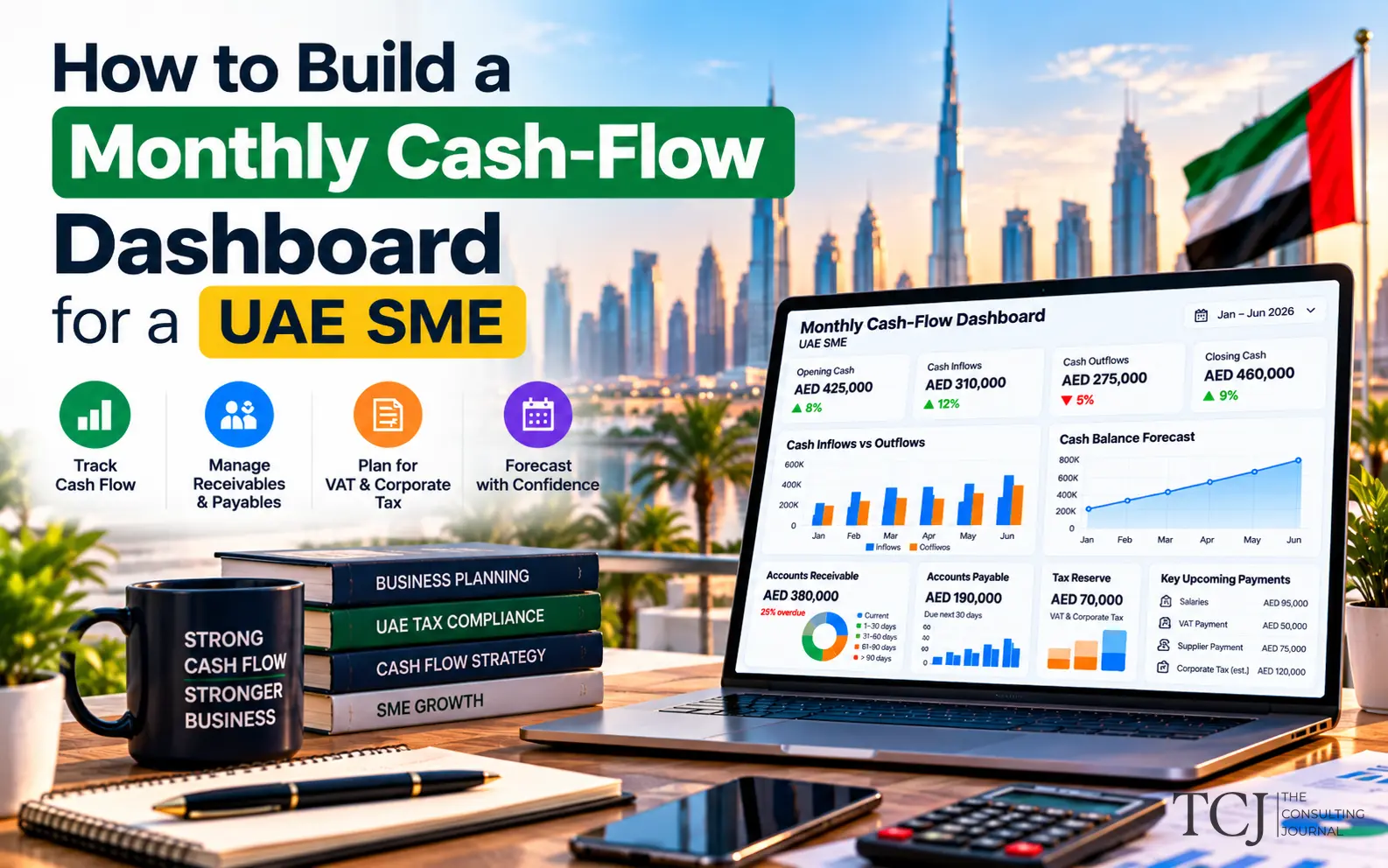
How to Build a Monthly Cash-Flow Dashboard for a UAE SME
A practical guide for UAE SME owners and finance teams on building a monthly cash-flow dashboard that tracks liquidity, collections, payments, tax obligations, forecasts, and working capital.

How UAE Companies Can Build a Faster, More Reliable Month-End Close
A practical UAE finance guide to shortening the month-end close through better reconciliations, cut-off controls, automation, tax readiness, data quality, and clear accountability.