UAE VAT Compliance Checklist for SMEs: Practical Steps to Reduce Filing Errors
A practical UAE VAT compliance checklist for SMEs covering registration, invoices, bookkeeping, VAT returns, cash flow, and audit preparation.
Key takeaways
- UAE SMEs should monitor VAT registration thresholds monthly, not only at year-end.
- Clean invoices, accurate tax codes, and proper bookkeeping reduce VAT return errors.
- VAT cash flow planning helps business owners avoid pressure near filing deadlines.
- Free zone and mainland businesses both need VAT checks based on taxable supplies.
- Audit-ready documentation makes FTA reviews easier to manage.
The first step in any VAT compliance checklist is to check whether the business should register, remain unregistered, or consider voluntary registration.
In practice, SMEs often make one of two mistakes. Some wait until the annual accounts are prepared, which may be too late. Others register voluntarily without checking whether their customer base, input VAT position, and compliance capacity justify the decision.
A better approach is to review taxable turnover every month. This is especially important for growing businesses, seasonal traders, event companies, agencies, and startups that receive a few large contracts in a short period.
For UAE-resident businesses, the FTA service guidance confirms that VAT registration is mandatory when taxable supplies and imports exceed AED 375,000 over the past 12 months, or are expected to exceed that threshold within the next 30 days. It also states that a person required to register must submit the VAT registration application within 30 days of becoming required to register.
Understand what counts as taxable activity
Business owners should not look only at profit. VAT registration is based on taxable supplies and imports, not net income.
For example, a small UAE marketing agency may earn AED 410,000 in annual taxable service income but only AED 90,000 in profit after salaries, rent, software, and freelancer costs. The low profit does not remove the VAT registration obligation if taxable turnover exceeds the mandatory threshold.
A free zone company should also be careful. Some owners assume free zone status means VAT does not apply. That is not a safe assumption. VAT treatment depends on the nature of the supply, customer location, place of supply, designated zone considerations where relevant, and supporting documentation.
Build proper VAT invoices from day one
VAT invoices are not only customer documents. They are the foundation of the VAT return.
A UAE VAT-registered business should make sure its invoices are numbered properly, show the correct business details, include the Tax Registration Number where required, describe the goods or services clearly, and apply the correct VAT treatment. The FTA maintains dedicated VAT invoice guidance and public clarifications for businesses that need to understand invoicing and related output tax issues.
From a consulting perspective, invoice quality often reveals the health of the finance function. If invoice numbers are duplicated, credit notes are not linked to original invoices, or descriptions are vague, VAT review becomes slower and riskier.
Example 1:
A Dubai-based IT services startup crossed the voluntary VAT registration threshold after signing two annual support contracts. The founder wanted to register quickly, but the invoices were still being prepared manually in different formats. Before filing the VAT application, the company standardised invoice numbering, updated customer master data, separated taxable and zero-rated services, and created a shared folder for contracts. This reduced confusion when the first VAT return was prepared.
Keep accounting records that support every VAT return
VAT compliance depends on records that connect the return to real business activity.
A practical SME VAT file should normally include sales invoices, purchase invoices, credit notes, debit notes, bank statements, import documents, export proof, contracts, payment confirmations, and VAT return workings. Where the business claims input VAT, the supporting supplier invoice should be available and easy to retrieve.
The FTA VAT guides and public clarifications page is regularly updated and remains a useful starting point for checking VAT positions, sector guidance, and technical issues.
A VAT return should not be treated as a form-filling task; it should be the final output of clean bookkeeping, reviewed invoices, and sensible tax coding. — Consulting Journal Editorial Desk
Check VAT rates, tax codes, and exemptions carefully
Many VAT errors begin inside the accounting software.
A business may use the correct software but the wrong tax code. A bookkeeper may select 5% VAT by habit, even where a transaction needs special review. Another business may treat all international sales as zero-rated without checking documents and place of supply rules.
For UAE SMEs, the most practical control is to maintain a short internal VAT treatment list. This list should cover common sales, recurring purchases, imports, exports, intercompany charges, refunds, discounts, and credit notes.
It does not need to be complicated. It simply needs to be reviewed when the business changes its activity, enters a new market, launches online sales, or signs a contract with a non-UAE customer.
File VAT returns and payments on time
A VAT return should not be prepared on the final day. By then, missing invoices, unreconciled bank entries, and unexplained supplier balances can create avoidable pressure.
The FTA states that once registered for VAT in the UAE, businesses are required to file VAT returns and make related VAT payments within 28 days from the end of the tax period.
In practice, SMEs should close their accounting records shortly after the tax period ends, review the VAT control account, confirm output VAT, check input VAT claims, and reconcile the return with the general ledger before submission.
Manage VAT cash flow separately from revenue
VAT collected from customers is not business income. It is an amount collected and later paid to the tax authority, subject to the business’s VAT return position.
This distinction is simple, but many SMEs feel cash flow pressure because VAT money is used for salaries, rent, supplier payments, or owner withdrawals. The problem usually appears near the filing deadline.
A practical approach is to estimate VAT exposure weekly or monthly and keep a reserve. This is particularly useful for trading businesses, restaurants, e-commerce sellers, and service companies with high monthly collections.
Cross-border VAT needs extra attention
Cross-border transactions can create VAT complexity for UAE SMEs.
Imports may involve customs documents and import VAT. Exports may require proof. Digital services, online sales, and marketplace activity can involve additional checks. Businesses with customers in the GCC, Europe, India, or other markets should avoid applying a single VAT treatment to every international transaction.
The key question is not only “Where is the customer?” It is also “What is being supplied, where is the place of supply, what evidence is available, and how is the transaction reflected in the accounting system?”
Example 2:
A Sharjah trading company imported goods, sold locally, and also shipped products to overseas customers. The business had sales invoices but weak export documentation. During an internal VAT review, management realised that the sales team and accounts team were not sharing shipping records consistently. A monthly export documentation checklist was introduced before the next VAT return cycle.
Common mistakes business owners make
The most common VAT mistakes are usually operational, not technical.
- Checking VAT registration thresholds only once a year
- Issuing invoices without consistent numbering or required details
- Claiming input VAT without proper supplier invoices
- Using one tax code for different types of transactions
- Forgetting credit notes, discounts, refunds, or cancelled invoices
- Mixing personal expenses with business expenses
- Filing VAT returns without reconciling the VAT control account
- Treating free zone status as automatic VAT exemption
- Waiting until an FTA query to organise records
- Relying fully on software without reviewing the data
Practical checklist for UAE VAT compliance
Use this checklist before every VAT return period.
- Review taxable turnover for the past 12 months and expected next 30 days.
- Confirm whether VAT registration status remains appropriate.
- Check sales invoices for numbering, TRN, dates, customer details, VAT amount, and description.
- Review purchase invoices before claiming input VAT.
- Reconcile bank receipts with sales invoices.
- Reconcile supplier payments with purchase records.
- Review imports, exports, and customs documents.
- Check credit notes and debit notes against original invoices.
- Review VAT tax codes in the accounting system.
- Compare VAT return figures with the general ledger.
- Keep return copies, payment proof, and working papers in a VAT period folder.
Documents and preparation checklist
A UAE SME should keep a clean VAT documentation file that is easy to access. This is helpful for internal review, year-end accounting, corporate tax support, and possible FTA queries.
- Trade licence and ownership documents
- VAT registration certificate
- Tax Registration Number records
- Customer invoices and credit notes
- Supplier invoices and receipts
- Import and export documents
- Bank statements and payment confirmations
- Contracts and purchase orders
- VAT return workings
- Filed VAT returns and payment confirmations
- Accounting software reports
- Reconciliation schedules
Using accounting software without losing control
Accounting software can improve VAT compliance, but it does not replace review.
The FTA maintains information on accredited tax accounting software vendors, which can help businesses consider suitable systems for tax record management.
Still, software settings should be checked carefully. Tax codes, chart of accounts, customer locations, supplier classifications, and invoice templates all affect the VAT return. A business should review these settings whenever it changes activity, adds a new revenue stream, or starts cross-border sales.
How KPM Global Services UAE can assist
KPM Global Services UAE can support SMEs with practical VAT compliance reviews, bookkeeping checks, VAT registration preparation, return review, accounting system setup, and documentation readiness.
The aim is not to overcomplicate VAT. The aim is to help business owners create a reliable monthly process. For many SMEs, the biggest improvement comes from simple controls: cleaner invoices, better records, timely reconciliations, and a clear review before filing.
KPM Global Services UAE can also help businesses identify where VAT connects with wider financial management, including accounting records, corporate tax readiness, cash flow planning, payroll documentation, and management reporting.
Advisory note for UAE SMEs
VAT compliance works best when it is built into daily finance operations. A business that keeps proper invoices, reconciles accounts monthly, monitors thresholds, and reviews VAT treatment early is usually in a stronger position than one that reacts only at filing time.
This article is for informational purposes and does not constitute legal, tax, accounting, or financial advice.
Questions and answers
When should an SME register for VAT in the UAE?
A UAE-resident business should monitor whether its taxable supplies and imports exceed the mandatory VAT registration threshold. Registration may also be considered voluntarily when the voluntary threshold is met, depending on the business model and input VAT position.
Do free zone companies in the UAE need to register for VAT?
Free zone status does not automatically remove VAT obligations. A free zone company should review its taxable supplies, imports, customer location, activity type, and applicable VAT rules before deciding its registration and filing position.
What is the most common VAT compliance problem for SMEs?
Poor documentation is one of the most common issues. Missing supplier invoices, weak export proof, unreconciled bank entries, and inconsistent credit notes can all create problems when preparing a VAT return or responding to an FTA query.
Can an SME reclaim VAT on all business expenses?
Not always. Input VAT recovery depends on the nature of the expense, the business activity, the VAT treatment, and whether valid supporting documents are available. Businesses should review expenses carefully before claiming VAT.
How often should a UAE SME review VAT compliance?
VAT compliance should be reviewed monthly, even if the VAT return is filed quarterly. Monthly reviews help the business identify errors early, protect cash flow, and avoid rushed corrections near the filing deadline.
More in Finance
View all Finance →
Customer Acquisition Payback: How to Calculate It Before Increasing Marketing Spend
Learn how to calculate customer acquisition payback, evaluate CAC efficiency, and assess whether increasing marketing spending makes financial sense. Includes practical formulas, worked examples, cash flow considerations, and a scaling checklist.
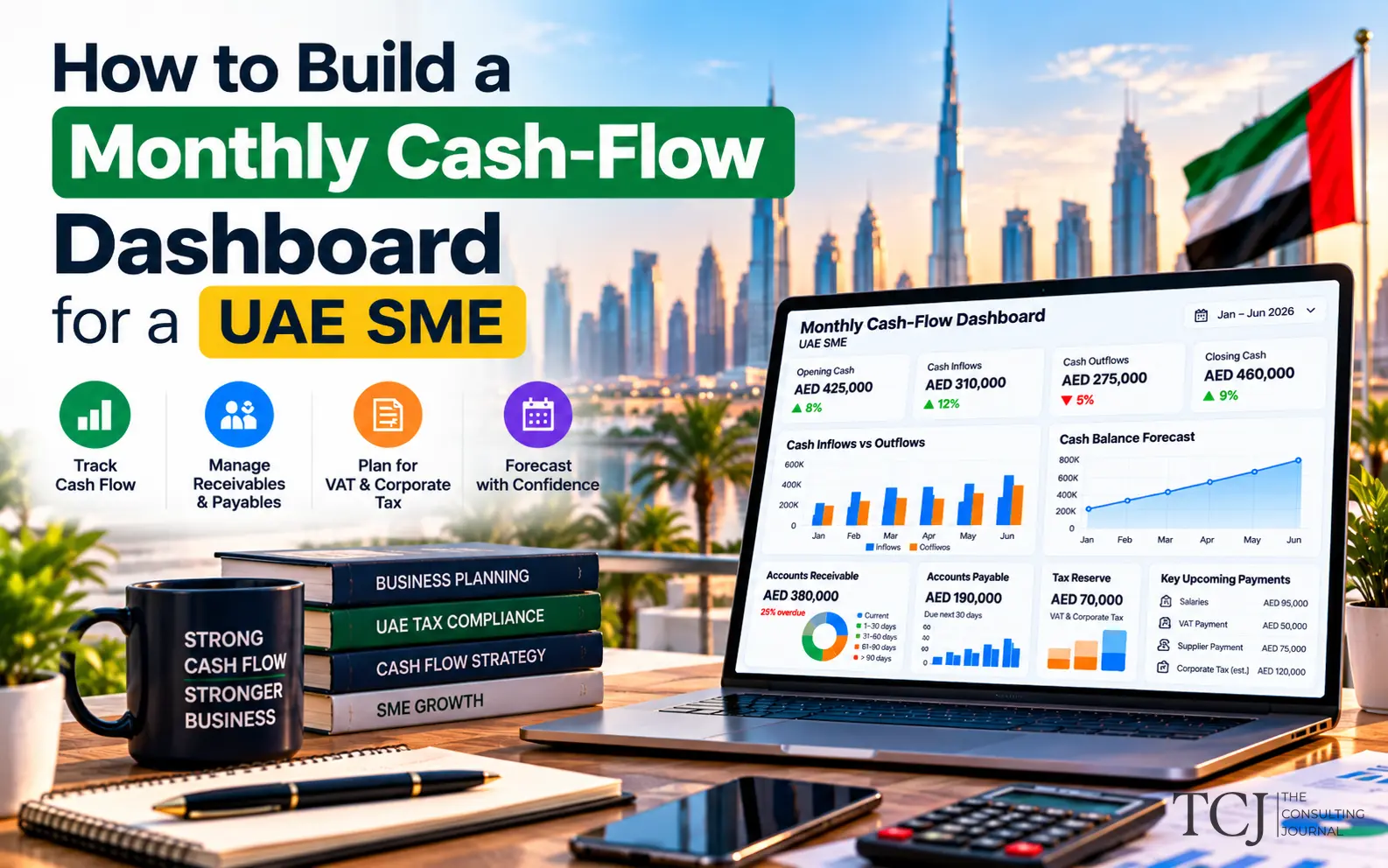
How to Build a Monthly Cash-Flow Dashboard for a UAE SME
A practical guide for UAE SME owners and finance teams on building a monthly cash-flow dashboard that tracks liquidity, collections, payments, tax obligations, forecasts, and working capital.

How UAE Companies Can Build a Faster, More Reliable Month-End Close
A practical UAE finance guide to shortening the month-end close through better reconciliations, cut-off controls, automation, tax readiness, data quality, and clear accountability.