Customer Acquisition Payback: How to Calculate It Before Increasing Marketing Spend
Learn how to calculate customer acquisition payback, evaluate CAC efficiency, and assess whether increasing marketing spending makes financial sense. Includes practical formulas, worked examples, cash flow considerations, and a scaling checklist.
Key takeaways
- Customer acquisition payback measures the time required to recover customer acquisition costs through customer gross profit.
- CAC payback is calculated by dividing customer acquisition cost by monthly gross profit per customer.
- Incremental CAC helps businesses evaluate the financial efficiency of additional marketing spending.
- Customer retention, gross margin, and cash collection timing can materially affect acquisition economics.
- Marketing budgets should be increased based on realistic forecasts, customer profitability, and available working capital.
- Consistent accounting records and cohort analysis help management make more reliable acquisition investment decisions.
Customer Acquisition Payback: How to Calculate It Before Increasing Marketing Spend
Growing a business often requires investment in marketing. Whether a company is expanding its paid advertising, recruiting salespeople, or entering a new market, customer acquisition usually involves spending money before receiving sufficient returns.
The challenge is determining whether those additional customers will generate enough profit to justify the investment.
A business can report rising revenue and stronger customer numbers while experiencing pressure on its cash reserves. This happens when acquiring customers becomes expensive or when customers take too long to recover their acquisition costs.
Customer acquisition payback helps management understand how long it takes to recover the cost of winning a customer through the gross profit that customer generates.
For example, if acquiring a customer costs $600 and the customer contributes $100 in monthly gross profit, the simplified payback period is six months.
This calculation is particularly useful for SaaS companies, subscription businesses, digital service providers, startups, and businesses investing heavily in sales and marketing.
However, a favorable payback period alone does not justify increasing marketing expenditure. Business owners and financial managers should also consider customer retention, acquisition efficiency, gross margins, and available working capital.
What Is Customer Acquisition Payback?
Customer acquisition payback, commonly called the CAC payback period, measures the time required for a business to recover its investment in acquiring a customer. It compares customer acquisition cost with the gross profit generated by that customer and is generally expressed in months.
Two financial measures form the basis of this calculation:
- Customer Acquisition Cost (CAC): The average amount spent to attract and convert a new paying customer.
- Monthly Gross Profit per Customer: The revenue earned from a customer after deducting the direct costs of delivering the product or service.
A shorter payback period generally means that a company can recover its acquisition investment sooner.
A longer period means more funding may be tied up in acquiring customers.
Neither outcome should be assessed in isolation. A business with longer customer relationships and predictable recurring revenue may reasonably accept a longer payback period than a business with irregular sales or frequent cancellations.
Why Should Businesses Calculate CAC Payback Before Increasing Marketing Spend?
Calculating CAC payback before increasing marketing spend helps businesses assess whether customer growth is financially sustainable. It reveals how long acquisition investments remain unrecovered, how additional spending may affect working capital, and whether expected customer profitability supports the proposed marketing budget.
1. Understand the pressure on cash flow
Marketing expenses often become payable before new customers generate meaningful financial returns.
Advertising platforms, marketing agencies, sales teams, and software providers may require monthly payments regardless of customer profitability.
If a company increases acquisition spending significantly, it may need additional working capital to finance several overlapping customer groups.
2. Distinguish revenue growth from acquisition efficiency
Increasing sales does not necessarily mean that marketing performance has improved.
For instance, a company might increase its marketing expenditure by 50% but acquire only 20% more customers.
Unless customer profitability improves, the cost of acquiring each customer rises.
Management should examine whether new revenue justifies the increased acquisition expense.
3. Improve marketing budget allocation
Different marketing channels frequently produce different acquisition costs.
Organic search, paid advertising, referrals, and outbound sales may attract customers with different purchasing patterns and retention characteristics.
The channel with the lowest CAC is not automatically the most attractive.
Businesses should compare customer profitability, acquisition capacity, and expected payback across channels before reallocating budgets.
What Is the Customer Acquisition Payback Formula?
The standard customer acquisition payback formula divides customer acquisition cost by monthly gross profit per customer. For recurring-revenue businesses, monthly gross profit can be calculated by multiplying average monthly customer revenue by gross margin. The resulting figure estimates the number of months needed to recover acquisition expenses.
CAC Payback Period = Customer Acquisition Cost ÷ Monthly Gross Profit per Customer
For subscription businesses:
CAC Payback Period = CAC ÷ (Monthly Revenue per Customer × Gross Margin)
The calculation requires three inputs.
Customer acquisition cost formula
CAC = Total Sales and Marketing Acquisition Costs ÷ New Paying Customers Acquired
Suppose a company spends $30,000 on customer acquisition during a reporting period and gains 60 paying customers.
CAC = $30,000 ÷ 60
CAC = $500 per customer
Monthly gross profit formula
Monthly Gross Profit per Customer = Monthly Revenue per Customer × Gross Margin
If the average customer generates $125 in monthly revenue and the business operates at an 80% gross margin:
Monthly gross profit = $125 × 80%
Monthly gross profit = $100
Calculate the payback period
CAC payback = $500 ÷ $100
CAC payback period = 5 months
Under these assumptions, the business requires approximately five months of customer gross profit to recover its acquisition investment.
This simplified approach assumes relatively stable revenue, gross margin, and customer activity. It does not automatically reflect the timing of actual cash collections.
How Do You Calculate Customer Acquisition Payback Step by Step?
To calculate customer acquisition payback accurately, businesses should identify the relevant acquisition expenses, count new paying customers, calculate average CAC, determine monthly gross profit, and divide CAC by that profit. Consistent expense classifications and reliable customer data are essential for meaningful comparisons.
Step 1: Identify total acquisition expenses
Include costs reasonably attributable to winning new customers, such as:
- Paid advertising and promotional campaigns.
- Sales salaries, incentives, and commissions.
- Marketing personnel and external agency fees.
- Customer acquisition software and tools.
- Relevant content production expenses.
- Events and sponsorships supporting new customer acquisition.
- Appropriately allocated sales and marketing overhead.
Expenses connected exclusively with servicing existing customers should not automatically be included.
Step 2: Count new paying customers
Use an established definition of a new customer.
Website visitors, sales inquiries, free trial users, and newsletter registrations should not automatically count as customers.
For subscription businesses, the relevant figure is typically the number of accounts beginning a paid relationship.
Businesses with long sales cycles should also consider matching acquisition expenses to the customer groups that those expenses generated.
Step 3: Calculate average CAC
Divide total acquisition costs by the number of new paying customers acquired.
This provides the average cost of customer acquisition for the selected reporting period.
Step 4: Calculate monthly gross profit
Determine average monthly revenue per customer and deduct direct delivery costs.
Depending on the business, these costs might include hosting, fulfilment, payment processing, or directly attributable service expenses.
Step 5: Calculate and review CAC payback
Divide average CAC by monthly gross profit per customer.
Review the result alongside customer retention, the length of the sales cycle, and the timing of customer payments.
For businesses with significant churn or irregular purchasing, cumulative cohort-level gross profit is generally more informative than a single average.
Customer Acquisition Payback Calculation: A Practical Business Example
Example 1: A subscription software business evaluating expansion
Consider a fictional subscription software company selling business management tools to small enterprises.
Its monthly acquisition performance is:
- Total acquisition spending: $60,000.
- New paying customers: 100.
- Average monthly revenue per customer: $120.
- Gross margin: 80%.
First, calculate CAC:
$60,000 ÷ 100 = $600
Next, calculate monthly gross profit:
$120 × 80% = $96
Finally, calculate CAC payback:
$600 ÷ $96 = 6.25 months
The business has an estimated acquisition payback period of 6.25 months.
Now assume management proposes increasing acquisition expenditure to $90,000, with customer acquisition expected to rise to 140 customers.
The projected blended CAC becomes:
$90,000 ÷ 140 = $642.86
With monthly gross profit remaining at $96:
$642.86 ÷ $96 = 6.70 months
The blended payback period increases from 6.25 to approximately 6.70 months.
The additional expenditure generates more customers, but average acquisition efficiency declines.
Management should therefore examine whether the extra customers justify the longer recovery period.
What Is a Good Customer Acquisition Payback Period?
A good customer acquisition payback period depends on business model, customer retention, gross margins, sales cycles, and available financing. For many smaller-customer SaaS businesses, recovering CAC within approximately 12 months is a commonly referenced benchmark, but this should not be treated as a universal financial standard.
ChartMogul's September 2026 guidance describes payback below approximately 12 months as strong for SMB-focused SaaS, while longer periods may be acceptable for enterprise software businesses.
The distinction matters because enterprise customers often involve longer negotiations and more expensive sales processes but may generate larger contracts.
Businesses should establish internal targets based on their own economics.
A six-month payback period may be attractive for one business but insufficient for another if customers frequently cancel after four months.
Similarly, a 15-month payback period may be manageable for a company with strong retention and sufficient financing.
The appropriate benchmark is the recovery period the business can finance without compromising its operations.
How Is CAC Payback Different From Customer Lifetime Value?
CAC payback measures how quickly a business recovers customer acquisition expenses, while customer lifetime value (LTV) estimates the gross profit expected over the customer relationship. Both measures are useful, but they answer different financial questions and should be assessed together.
Consider a customer with:
- Acquisition cost: $600.
- Monthly gross profit: $100.
- Expected customer relationship: 24 months.
The simplified CAC payback period is:
$600 ÷ $100 = 6 months
Estimated lifetime gross profit, assuming constant contribution and no discounting, is:
$100 × 24 = $2,400
The LTV-to-CAC ratio is:
$2,400 ÷ $600 = 4:1
This indicates an estimated $4 of lifetime gross profit for each $1 invested in customer acquisition.
However, the company still needs six months of gross profit to recover the original acquisition expense.
A strong LTV-to-CAC ratio does not eliminate short-term financing requirements.
Businesses should monitor both measures alongside churn, actual collections, and cash flow forecasts.
How Does Increasing Marketing Spend Affect CAC Payback?
Increasing marketing spend can improve or weaken acquisition efficiency depending on customer demand, advertising competition, conversion rates, and channel capacity. Historical CAC may not remain constant as campaigns expand. Businesses should therefore calculate the expected cost of acquiring additional customers rather than relying exclusively on previous averages.
When campaigns initially target highly interested prospects, conversion rates may be relatively strong.
As the marketing budget increases, campaigns may reach audiences with lower purchase intent.
This can increase acquisition costs.
However, expanded spending may also improve efficiency when better testing, brand recognition, or operational scale produces stronger results.
The outcome must be measured rather than assumed.
How Do You Calculate Incremental CAC Before Scaling?
Incremental CAC measures the additional acquisition expenditure required to gain each additional customer. It is calculated by dividing the increase in acquisition spending by the increase in customers acquired. This provides a more useful perspective when evaluating the next stage of marketing expansion.
Incremental CAC = Additional Acquisition Spending ÷ Additional Customers Acquired
Example 2: A UAE digital services business expanding paid advertising
A fictional Dubai-based digital services company currently spends AED 20,000 monthly on acquisition and attracts 100 new customers.
Its existing average CAC is:
AED 20,000 ÷ 100 = AED 200
Management considers increasing the budget to AED 30,000, expecting 140 customers.
The additional AED 10,000 is expected to generate 40 customers.
Incremental CAC becomes:
AED 10,000 ÷ 40 = AED 250
Suppose each customer generates AED 50 in monthly gross profit.
Incremental CAC payback is:
AED 250 ÷ AED 50 = 5 months
If a further budget increase generates customers at an incremental CAC of AED 350, the recovery period becomes seven months.
Although both spending levels may be commercially viable, the second expansion requires more investment per customer.
Management should consider these differences before committing to a larger advertising budget.
How Can Businesses Improve Customer Acquisition Payback?
Businesses can improve customer acquisition payback by lowering acquisition expenses, increasing customer gross profit, and retaining customers long enough to recover their acquisition costs. Improving conversion rates, pricing, customer selection, and service delivery efficiency can strengthen the financial performance of marketing investments.
Practical improvements include:
- Improve conversion rates: Reduce unnecessary steps in enquiry, registration, and purchasing processes.
- Target profitable customer segments: Evaluate customer contribution rather than acquisition volume alone.
- Review pricing: Test pricing structures and relevant premium offerings while monitoring their impact on conversion.
- Control direct service costs: Improve delivery efficiency without compromising service quality.
- Strengthen customer retention: Improve onboarding and customer experience so more customers remain active through payback.
- Review marketing channels: Compare CAC, retention, margins, and incremental acquisition efficiency across channels.
These improvements should be measured using consistent financial information.
A growing customer base only creates lasting financial value when the business can support the cost of acquiring and serving those customers. — Consulting Journal editorial observation
What Common CAC Payback Calculation Mistakes Should Businesses Avoid?
Customer acquisition payback calculations can produce misleading results when companies exclude expenses, use revenue instead of gross profit, overlook customer churn, or compare inconsistent reporting periods. Financial managers should verify the underlying assumptions before using the results to approve additional marketing investment.
Common mistakes include:
- Using revenue instead of gross profit: This makes acquisition investment appear to recover faster than it actually does.
- Excluding relevant acquisition expenses: Advertising-only CAC may overlook sales compensation and agency costs.
- Ignoring customer churn: Customers who cancel early may never recover their acquisition costs.
- Confusing average CAC with incremental CAC: Historical averages may understate the cost of acquiring additional customers.
- Ignoring collection timing: Gross-profit payback and actual cash recovery are not necessarily identical.
- Combining different customer segments: A single average may conceal customers with substantially weaker profitability.
- Assuming payback remains unchanged: Rising advertising costs and changing conversion rates can alter acquisition economics.
A calculation is useful only when the information behind it is reliable.
What Documents and Financial Information Should Be Prepared?
Before calculating CAC payback or approving a larger marketing budget, management should prepare a consistent set of financial and operational records.
Customer acquisition payback preparation checklist:
- Monthly sales and marketing expenditure reports.
- Paid advertising invoices and campaign statements.
- Sales payroll, commissions, and agency expenses.
- New paying customer records by acquisition period.
- Monthly revenue per customer or customer cohort.
- Direct service delivery cost details.
- Gross margin calculations.
- Customer retention and cancellation reports.
- Marketing channel performance data.
- Accounts receivable and payment collection records.
- Cash flow forecasts and available working capital.
- Proposed marketing budgets and growth assumptions.
These records help accounting, finance, marketing, and management teams work from a common set of figures.
When Should a Business Increase Its Marketing Budget?
A business should consider increasing marketing expenditure when expected incremental customer profitability, payback periods, retention, and cash flow capacity support the investment. Management should test reasonable assumptions and confirm that additional acquisition spending can be financed without creating unacceptable pressure on working capital.
A practical decision process includes five actions.
1. Establish a reliable baseline
Calculate current CAC, monthly gross profit, retention, and payback using consistent reporting definitions.
2. Forecast incremental acquisition costs
Estimate how customer acquisition expenses and conversion rates may change with higher spending.
3. Test customer profitability
Confirm that the new customer groups are expected to generate sufficient gross profit.
4. Prepare a cash flow forecast
Estimate the funds required while each customer cohort recovers its acquisition expense.
Use optimistic, base-case, and downside assumptions rather than relying on one growth forecast.
5. Increase spending in controlled stages
A gradual budget increase allows management to compare actual outcomes with forecasts before committing additional funds.
The objective is not simply to acquire more customers. It is to acquire customers at a cost the business can sustain.
How Can KPM Global Services UAE Assist Businesses?
Customer acquisition analysis becomes more useful when marketing performance is connected with financial reporting, management accounting, and cash flow planning.
KPM Global Services UAE can assist businesses in reviewing financial information used for management decisions, including acquisition expenses, customer profitability, budgeting, and cash flow forecasts, subject to the scope of engagement.
For businesses operating in Dubai and across the UAE, combining marketing information with reliable accounting records can help management assess whether planned growth is financially sustainable.
The objective is to support informed business decisions rather than treating advertising performance as a standalone measure of success.
Final Advisory Perspective
Customer acquisition payback provides a practical financial measure for evaluating marketing investment.
The basic formula is straightforward, but a reliable decision requires more than a favorable number.
Businesses should evaluate gross profit, retention, incremental CAC, cash collections, and working capital together.
Before approving a significant increase in acquisition spending, management should understand how much additional capital is required, when it is expected to be recovered, and what happens if customer acquisition performs below expectations.
Sustainable growth depends on balancing customer acquisition with financial capacity.
Questions and answers
Q: What is customer acquisition payback?
A: Customer acquisition payback measures the time required to recover the cost of acquiring a customer through the gross profit that customer generates. It is generally expressed in months and helps businesses understand acquisition efficiency and funding requirements.
Q: How do you calculate the CAC payback period?
A: Divide customer acquisition cost by monthly gross profit per customer. For example, if CAC is $600 and monthly gross profit is $100, the simplified payback period is six months. The calculation assumes that the customer's monthly gross profit remains stable.
Q: What is considered a healthy CAC payback period?
A: A period of approximately 12 months or less is commonly referenced as favorable for many SMB-focused SaaS businesses. However, the appropriate target depends on customer retention, gross margin, sales cycles, and financing capacity. Businesses should establish benchmarks based on their own financial models.
Q: Does increasing marketing spending always increase customer acquisition cost?
A: No. Additional spending can increase, decrease, or leave CAC unchanged depending on conversion rates, audience demand, campaign efficiency, and competition. Calculating incremental CAC helps businesses assess the actual or expected financial impact of marketing expansion.
Q: How often should businesses review customer acquisition payback?
A: Many businesses benefit from reviewing CAC payback monthly or quarterly, depending on their sales cycle and customer acquisition volume. Companies expanding their marketing budgets rapidly should monitor customer cohorts more frequently. Regular analysis helps identify changes in acquisition efficiency before they create significant financial pressure.
More in Finance
View all Finance →
How to Build a Monthly Cash-Flow Dashboard for a UAE SME
A practical guide for UAE SME owners and finance teams on building a monthly cash-flow dashboard that tracks liquidity, collections, payments, tax obligations, forecasts, and working capital.

How UAE Companies Can Build a Faster, More Reliable Month-End Close
A practical UAE finance guide to shortening the month-end close through better reconciliations, cut-off controls, automation, tax readiness, data quality, and clear accountability.
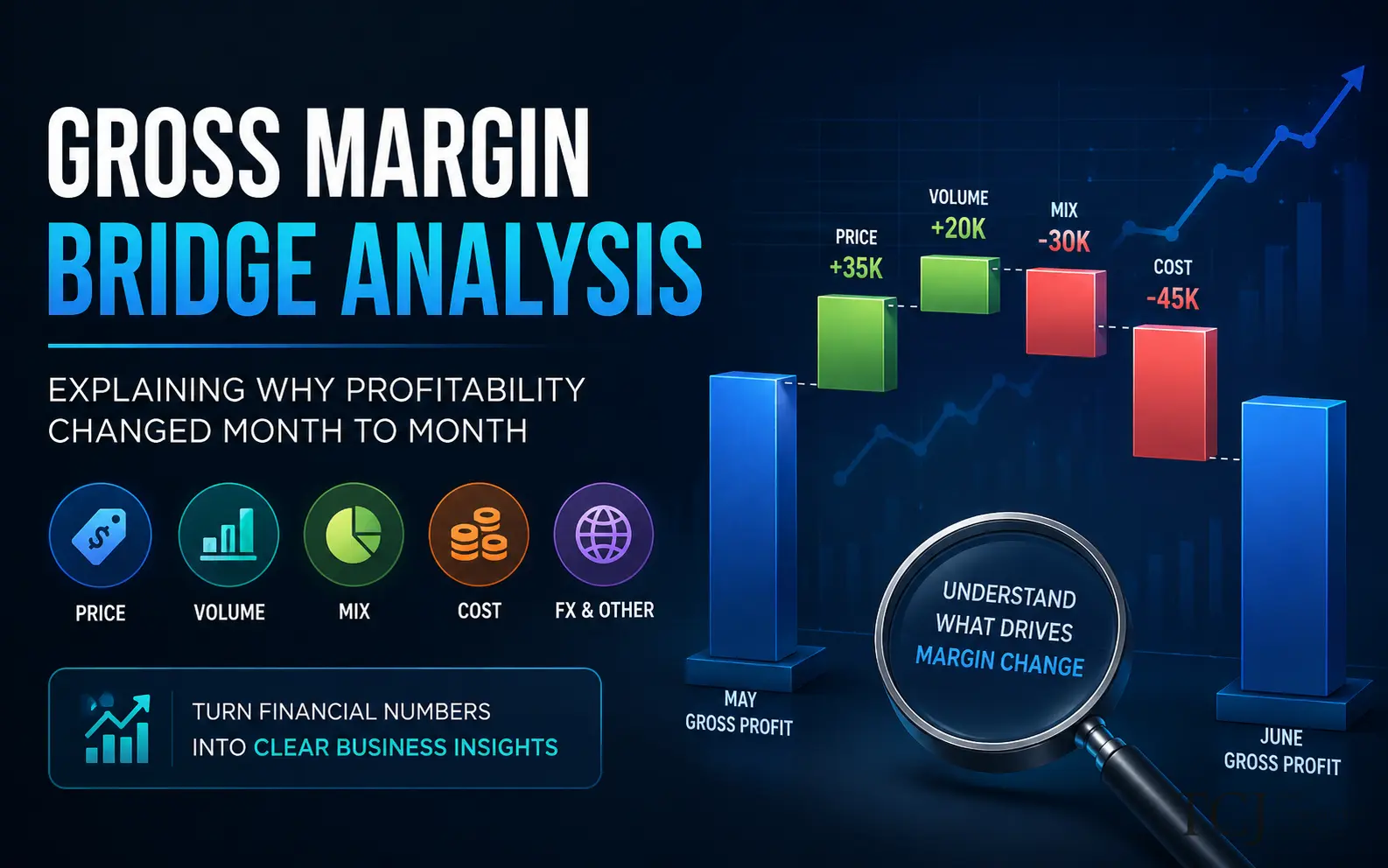
Gross Margin Bridge Analysis: Explaining Why Profitability Changed Month to Month
Gross margin bridge analysis helps finance teams explain monthly profitability changes by separating the impact of price, volume, sales mix, cost, and other operational drivers.