How to Create Financial KPIs for Your Company
Dashboards fail when they track everything and change nothing. Here is how UAE founders and finance leads choose financial KPIs tied to decisions — margin, cash, efficiency, and growth — with a practical build process.
Key takeaways
- Financial KPIs must link to decisions — if a metric does not change behaviour when it moves, remove it from the dashboard.
- Start with a short list: revenue quality, gross margin, cash runway or operating cash, working capital days, and opex discipline — then add segment-specific metrics.
- Targets should come from budget and historical variance, not benchmark envy; context beats generic industry averages.
- KPIs need owners, definitions, and consistent data sources — changing formulas mid-year destroys trust.
- Review KPIs monthly in the same meeting as P&L, balance sheet, and cash — reporting without review is decoration.
Most finance dashboards die quietly. Someone builds a twenty-tab spreadsheet, labels it “KPI pack,” and by month three only the bookkeeper opens it — usually to fix a broken formula. The problem is rarely tooling. It is selection: too many metrics, weak targets, no owners, and no connection to the decisions leadership actually makes. Financial KPIs should answer a small set of sharp questions: Are we making money on what we sell? Can we pay what we owe? Is growth funded safely? Are we spending in line with plan?
This guide explains how to create financial KPIs for your company — from choosing metrics to setting targets, building a review rhythm, and avoiding vanity numbers — in a UAE context where tax, cash, and investor scrutiny raise the cost of fuzzy definitions. Start from monthly financial reports every founder should review in the UAE if you need the baseline pack; KPIs are the distilled layer on top.
KPIs exist to change behaviour
A metric on a slide is trivia. A KPI is a metric with:
- Definition — formula, source, timing, exclusions documented.
- Target — from budget or explicit strategic choice.
- Owner — named person who explains variance and proposes action.
- Cadence — reviewed in a fixed meeting, not ad hoc.
- Threshold — when deviation triggers escalation.
If nobody would do anything different when the number moves, it is not a KPI — it is clutter.
Why finance should guide strategy, not just reporting depends on this discipline — strategy without measurable financial guardrails is opinion.
Step 1 — Anchor KPIs to business model
Before copying a SaaS dashboard for a trading business, map your model:
| Model type | Typical financial KPI emphasis | |------------|--------------------------------| | Services / agency | Utilisation, project margin, revenue per head, DSO | | Subscription | MRR/ARR, churn, gross margin, CAC payback, deferred revenue | | Trading / retail | Gross margin by category, inventory turns, stock ageing, shrinkage | | Marketplace | Take rate, net revenue, unit contribution, settlement timing | | Project / construction | WIP, milestone billing, cost overrun %, retention |
Cross-model KPIs almost always include cash, gross margin, and opex vs budget — the universal survival set from why cash flow matters more than growth claims in UAE business.
Step 2 — Core financial KPI library (start here)
Revenue and quality
- Revenue vs budget — volume and price decomposition monthly.
- Revenue concentration — top customer %; risk flag if >25–30% for SMEs.
- Recurring vs one-off mix — if relevant to valuation narrative per how to build an investor-ready financial story in the UAE.
Margin
- Gross margin % — overall and by segment if possible; tie to how to read a profit and loss statement.
- Contribution margin — after direct variable costs for key products or channels.
Profitability
- EBITDA or operating profit vs budget — consistent definition month to month.
- Net profit after tax estimate — include corporate tax provision when applicable per how to plan taxes before year-end.
Cash and liquidity
- Cash balance and runway — weeks or months at current net burn.
- Operating cash flow — from how to read a cash flow statement.
- DSO, DIO, DPO — working capital days from how to read a balance sheet like a business owner.
Efficiency and spend
- Opex as % of revenue — track trend during growth.
- Headcount vs revenue per employee — hiring discipline.
- Marketing spend vs pipeline or revenue — avoid pure activity metrics.
Pick eight to twelve from this library for leadership — not the full list.
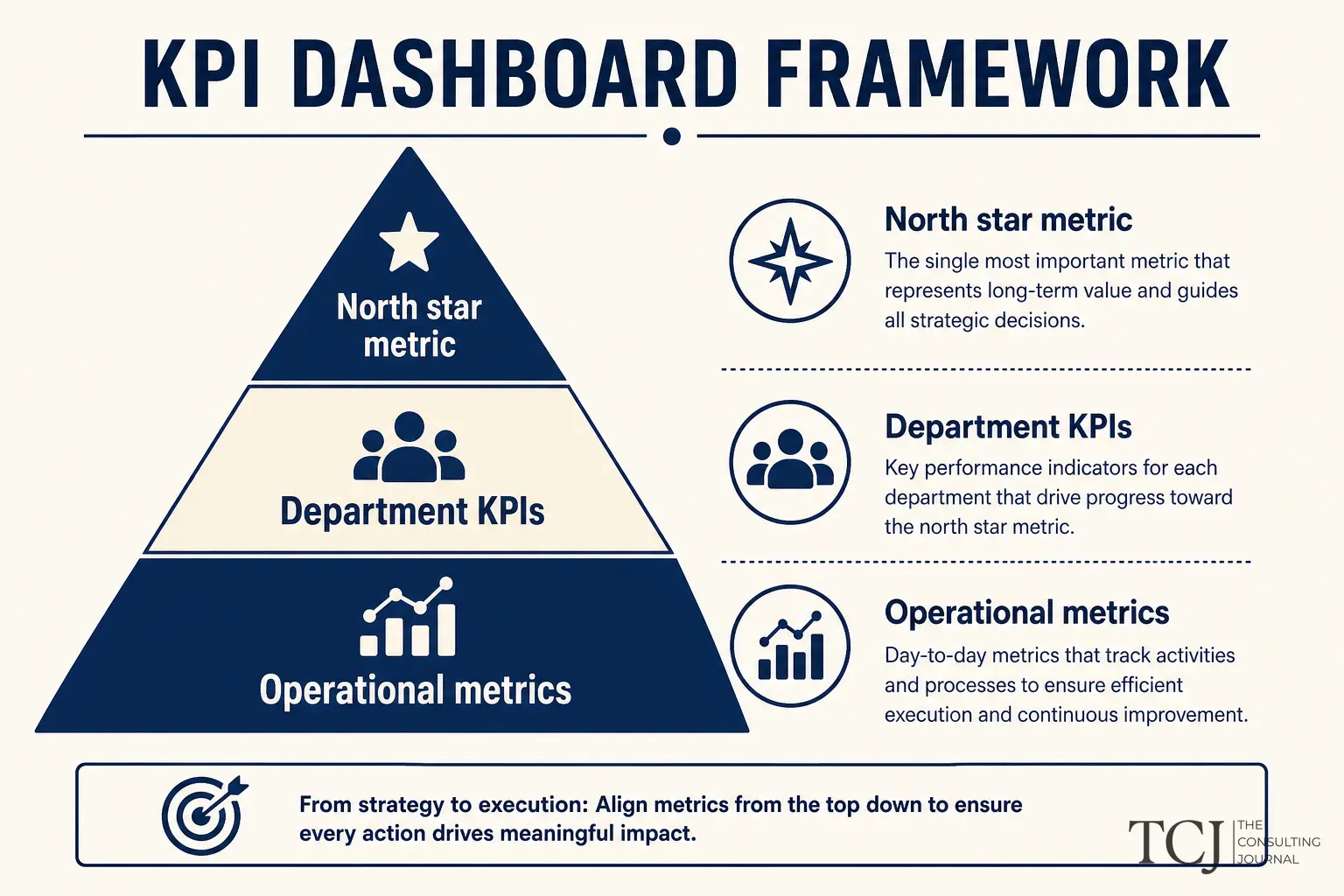
Step 3 — Write definitions before you build charts
Example definition block (internal wiki or one-pager):
Gross margin %
- Formula: (Revenue − COGS) ÷ Revenue
- Source: Ledger accounts 4xxx revenue, 5xxx COGS per chart of accounts v3
- Timing: Accrual month; closed books only
- Owner: Finance lead
- Target: 44% FY2026 budget
- Action if <41% for two months: pricing and delivery cost review with ops
Ambiguous KPIs destroy meetings. “Revenue” must match investor and tax definitions — why revenue alone does not impress investors when definitions shift.
Step 4 — Set targets from budget, not benchmarks alone
How to build a practical business budget for a growing company supplies targets:
- Revenue drivers (units, price, utilisation).
- Cost inflation and hire plan.
- Marketing as % of revenue or CAC model.
- Tax and VAT cash lines.
Industry benchmarks help sense-check — they do not replace your model. A 40% gross margin target means nothing if your cost structure requires 55% to fund UAE operating reality.
During growth, stress-test KPI targets against why businesses fail during growth phases — cash and margin KPIs should tighten, not loosen, when headcount accelerates.
Step 5 — Build the dashboard — minimum viable
Options:
- Ledger reports + one Google Sheet — fine for early stage if reconciled monthly.
- BI tool on ledger export — when volume justifies.
- Accountant-prepared management pack — outsourced CFO services in the UAE often deliver this layer.
Rules:
- One screen for leadership KPIs; detail tabs optional.
- Same format every month — comparability beats novelty.
- Flag manual adjustments — automation from AI in accounting for UAE businesses reduces error, not definition drift.
Build financial systems before scaling includes reporting cadence as infrastructure — KPIs are the output.
Step 6 — Install the review meeting
Monthly, after close (within 5–10 business days):
- KPI scorecard vs target — red/amber/green.
- Three-minute narrative per red KPI — cause and action.
- P&L, balance sheet, cash cross-check — no KPI contradicts statements unexplained.
- Decisions logged — hire hold, pricing change, collection push, spend cut.
Why every business needs CFO thinking for smarter growth — someone runs this meeting even if part-time.
KPIs for fundraising and banking
Investors pattern-match KPI trends — what investors check before funding a business. Align internal KPIs with external narrative before the data room:
- Same revenue definition as deck.
- Gross margin bridge documented.
- CAC/LTV if claimed — reproducible from CRM + ledger.
- Cash runway matches bank balance and forecast.
investor pitch deck mistakes founders make often trace to KPI-deck divergence.
increase business valuation strategies work when KPI history proves improvement — not when metrics appear for the first time in diligence.
UAE compliance-linked KPIs
Optional but valuable once corporate tax applies:
- Effective tax rate estimate vs plan.
- VAT recoverable ageing — refunds delayed?
- Related-party balance sheet items — documented?
Tie to corporate tax in UAE mistakes businesses must avoid in 2026 and keeping UAE accounting records ready for tax filing and audit.
Small business relief eligibility may be a KPI gate — revenue threshold tracking with evidence.
KPIs when systems are still maturing
Early-stage companies can track KPIs manually if definitions are written — but migrate to ledger-backed metrics as volume grows. Why small businesses need systems early prevents KPI spreadsheets from diverging from statutory books — a common failure when “management numbers” use different revenue rules than tax filings.
When you cross corporate tax or VAT registration thresholds, add compliance-linked KPIs to the same dashboard — registration timing guidance in VAT registration in the UAE: when your business should act and post-registration operations in corporate tax registration is done: what UAE businesses should do next both imply new metrics: VAT payable balance, tax provision estimate, documentation backlog count.
Forward tax estimates belong in KPI review alongside margin — connect to tax planning vs tax avoidance for UAE business owners so targets reflect legitimate planning, not year-end surprises.
Anti-patterns — KPIs that mislead
- Vanity revenue — gross merchandise volume without net take.
- Blended CAC — hides channel rot.
- Adjusted EBITDA — endless add-backs investors ignore.
- Cash ignoring VAT/tax — runway fantasy.
- Forty-metric dashboards — nobody accountable.
- Spreadsheet off-ledger — diverges under due diligence.
Why accounting is business intelligence for UAE businesses — intelligence requires integrity of source data.
Evolving KPIs as you scale
Stage triggers:
- First hire in finance — formalise definitions and close calendar.
- Inventory or WIP — add turns and ageing KPIs.
- Bank facility — covenant KPIs mandatory.
- Multi-entity — consolidation and intercompany KPIs.
- Fundraise — investor KPI set matches internal set.
How to choose accounting software for your business when reporting breaks under new complexity.
Connect KPIs to the three statements
Every KPI should map somewhere:
- P&L KPIs — margin, opex, profit.
- Balance sheet KPIs — working capital days, leverage.
- Cash KPIs — runway, operating cash.
Read the trilogy together: P&L, balance sheet, cash flow.
The future of finance is advisory, automation, and control — KPIs become live with automation; judgment stays human.
90-day KPI implementation plan
Days 1–30: Select 8–12 KPIs; write definitions; assign owners; extract three months history from ledger.
Days 31–60: Build one-page dashboard; align with budget targets; first monthly review with variance actions logged.
Days 61–90: Cut unused metrics; add segment views if margin problems unresolved; align investor-facing metrics if fundraising within twelve months.
Worked example — KPI set for a UAE services SME
Core leadership KPIs (illustrative):
| KPI | Target | Owner | |-----|--------|-------| | Revenue vs budget | 100% ± 3% | CEO | | Gross margin % | ≥ 52% | Delivery lead | | Opex vs budget | ≤ 102% | Finance lead | | Cash runway | ≥ 6 months | CEO | | DSO | ≤ 45 days | Finance lead | | Utilisation | ≥ 75% | Ops |
Eight metrics, each with action thresholds. Expand with segment margin if one client exceeds 25% of revenue — concentration risk KPI.
Review in the same session as how to read a profit and loss statement and how to read a cash flow statement — KPIs without statement context drift into abstraction.
Cascading KPIs without overwhelming teams
Not every metric belongs company-wide. Sales may see pipeline and conversion; delivery sees utilisation and rework rate; finance owns cash and tax estimates. Cascade from the leadership eight-to-twelve set — do not dump forty metrics on every Slack channel. Transparency is strategic, not performative.
Why finance should guide strategy, not just reporting uses KPIs as the language between functions — defined, owned, reviewed.
Reporting cadence — when to add weekly flash metrics
High-velocity businesses — e-commerce spikes, project shops with lumpy billing — may add weekly flash KPIs: cash balance, week-to-date revenue, gross margin estimate, pipeline coverage. Keep the flash set to four or five lines maximum; full KPI pack remains monthly on closed books.
Weekly flash is operational, not statutory — reconcile flash revenue definitions to month-end ledger to avoid two truths. Monthly financial reports every founder should review in the UAE remains the authoritative pack; flash supports timing decisions between closes.
KPI review facilitation — run the meeting well
Monthly KPI meetings fail when they become read-aloud sessions. Better format:
- Red metrics first — owner explains variance and proposed action.
- Decisions required today — hire, spend, pricing — with memo if above threshold.
- Green metrics last — brief confirmation only.
- Log actions with names and dates — not “we will look at it.”
Why finance should guide strategy, not just reporting depends on meeting design, not only metric selection.
The bottom line
Creating financial KPIs means choosing few metrics tied to decisions, documenting definitions, setting targets from budget, naming owners, and reviewing monthly alongside the three financial statements. Cut vanity numbers. Reconcile to the ledger. Let KPIs drive strategy — not slide decoration.
Review your KPI set after every major strategic pivot — new product, market, or funding round — because the metrics that mattered at AED 5M revenue may mislead at AED 15M without a deliberate refresh tied to how to build a practical business budget.
Document KPI definition changes in a changelog — when investors or bankers compare periods, they need to know if the metric moved because the business changed or because the formula changed. Transparency builds credibility faster than cosmetic consistency.
Good KPIs age gracefully — revisit targets when your model shifts, but keep definitions stable enough that twelve months of history still teaches you something. That balance is how operators graduate from reactive firefighting to strategic finance that guides hiring, pricing, and capital allocation with evidence over time.
For help designing a KPI pack for your entity, book a free consultation. Browse the Finance desk for reporting, tax, and systems guides.
This article is general information for UAE-based businesses and is not legal, tax, or financial advice. Confirm your specific obligations with a qualified adviser.
Questions and answers
How many financial KPIs should a SME track?
Most UAE SMEs thrive with eight to twelve active KPIs at leadership level — not forty. Split into a core six (revenue, gross margin, net profit or EBITDA, cash, AR days, opex vs budget) plus two to four specific to your model (project margin, inventory turns, CAC payback, utilisation). If the dashboard exceeds one screen, cut it.
What is the difference between a KPI and a metric?
A metric is anything you measure. A KPI is a metric tied to a target and a decision owner — when it deviates, someone acts. Revenue is a metric; gross margin vs 42% target with a product lead accountable is a KPI.
Where do financial KPIs come from technically?
Ideally your accounting ledger plus operational systems (CRM, payroll, inventory). Avoid parallel spreadsheets when possible — how to choose accounting software for your business should support exports or dashboards. Manual KPIs are fine short-term if definitions are written and reconciled monthly to the ledger.
Should founders share financial KPIs with the whole team?
Share selectively. Company-wide visibility on mission-critical metrics (cash runway, delivery margin, customer retention) can align behaviour — but undisciplined sharing of half-understood numbers creates noise. Match transparency to maturity and role relevance.
How often should KPI targets be updated?
Set annually with quarterly refreshes during budget cycles — how to build a practical business budget. Change definitions rarely; when you must, restate prior periods or flag breaks explicitly. Mid-quarter target chasing every week usually means the KPI was wrong, not that the team failed.
More in Finance
View all Finance →
Customer Acquisition Payback: How to Calculate It Before Increasing Marketing Spend
Learn how to calculate customer acquisition payback, evaluate CAC efficiency, and assess whether increasing marketing spending makes financial sense. Includes practical formulas, worked examples, cash flow considerations, and a scaling checklist.

How to Build a Monthly Cash-Flow Dashboard for a UAE SME
A practical guide for UAE SME owners and finance teams on building a monthly cash-flow dashboard that tracks liquidity, collections, payments, tax obligations, forecasts, and working capital.

How UAE Companies Can Build a Faster, More Reliable Month-End Close
A practical UAE finance guide to shortening the month-end close through better reconciliations, cut-off controls, automation, tax readiness, data quality, and clear accountability.