Why Businesses Fail During Growth Phases
Growth exposes weak cash discipline, informal controls, and reporting nobody trusts. Here is why UAE businesses stall or break during expansion — and the finance-led fixes that keep momentum without burning the balance sheet.
Key takeaways
- Growth phases fail more often from cash and control gaps than from lack of demand — revenue can rise while liquidity falls.
- Scale multiplies small weaknesses: delayed invoicing, founder-only approvals, and informal hiring become crises when volume doubles.
- Profitable on paper is not the same as survivable in practice — timing gaps between cost and collection kill otherwise healthy UAE businesses.
- Tax and compliance debt compounds during fast growth; VAT and corporate tax problems ignored in year one become expensive in year three.
- Sustainable growth requires financial systems, named owners, and monthly decisions tied to cash, margin, and capital — not heroics.
Growth is the narrative every founder sells — to themselves, their team, investors, and the market. But the businesses that break during expansion rarely die from lack of customers. They die from cash timing, weak controls, reporting nobody trusts, and compliance debt that arrives when management bandwidth is already gone. In the UAE, where VAT and corporate tax sit alongside banking scrutiny and investor due diligence, growth without finance discipline is not ambition. It is leverage without a safety rail.
This article explains why growth phases fail, the patterns we see repeatedly in SMEs and scale-ups, and the finance-led fixes that keep momentum without burning the balance sheet. Start with why cash flow matters more than growth claims in UAE business if you need the cash-versus-narrative frame — everything below builds on it.
Growth does not fix weak foundations — it stress-tests them
At low volume, founders see every dirham. Approvals live in one head. Invoices go out “when we remember.” Tax records accumulate in email. That informality feels fast. Scale removes visibility. New hires do not inherit tribal knowledge. Customers pay slower at higher ticket sizes. Suppliers demand better terms. Banks ask for statements that reconcile.
Why small businesses need systems early is not pessimism — it is physics. Systems are how you compress complexity back into decisions a leadership team can make weekly.
Revenue is the scoreboard. Cash, margin, and controls are the pitch. You can win on the scoreboard and still lose the match.
Build financial systems before scaling maps the minimum stack: clean books, controls, monthly reporting, compliance evidence. Growth without that stack is the most common prelude to failure we see on the Finance desk.
Five failure modes during growth phases
1. Cash timing — the profitable trap
The classic pattern: costs front-load, revenue lags. You win contracts, hire delivery staff, rent space, buy inventory — then wait sixty or ninety days for payment while payroll runs monthly. Accrual profit looks fine. The bank account does not.
This is why how to read a cash flow statement belongs in every founder’s toolkit alongside the P&L. Profit answers performance; cash answers survival. During growth, study operating cash flow every month — not only at year-end.
Fixes that work:
- Rolling thirteen-week cash forecast updated weekly.
- Invoicing within forty-eight hours of delivery or milestone; penalties for internal delay.
- AR ageing reviewed weekly with chase rules at 30/60/90 days.
- Deposits or milestone billing on large projects.
- Separate view of committed vs discretionary spend.
Pair operational rhythm with monthly financial reports every founder should review in the UAE so cash is a leadership habit, not a finance surprise.
2. Hiring and fixed cost ahead of revenue
Headcount is the most irreversible growth cost. Founders hire for the organisation they pitch — sales leaders before pipeline converts, operations before processes exist, finance admin without an owner for month-end.
How to build a practical business budget for a growing company forces hiring into a forward view tied to drivers, not optimism. Tie offers to contracted revenue, gross margin coverage, or explicit runway extension from funding — not “we will grow into it.”
When judgement on headcount and capital allocation outpaces bookkeeping, outsourced CFO services in the UAE often bridges the gap cheaper than a bad full-time hire or a founder guessing alone. Why every business needs CFO thinking for smarter growth is about that ownership, not a title.
3. Margin erosion hidden by top-line growth
Revenue up, profit flat or down — usually pricing, mix, discounting, delivery overrun, or unallocated overhead. Founders celebrate GMV while unit economics decay.
Why revenue alone does not impress investors states what operators learn painfully: top line without margin trajectory is a warning. During growth, track contribution margin by product or segment, not consolidated revenue alone. How to read a profit and loss statement and how to create financial KPIs for your company give the vocabulary and metrics to catch erosion early.
4. Controls and fraud surface area expand
More people, more vendors, more payments, more refunds — more ways for error and fraud to hide. Founder-only approvals become bottlenecks; loosened approvals become losses.
Minimum controls for growth:
- Spend policy with limits by role.
- Dual approval on new vendors and bank detail changes.
- Payment runs on schedule — no ad-hoc transfers.
- Segregation between who records and who reconciles bank.
- Documented revenue recognition rules — when a sale counts.
Software helps only with ownership. How to choose accounting software for your business covers tools; culture and named owners make them work.
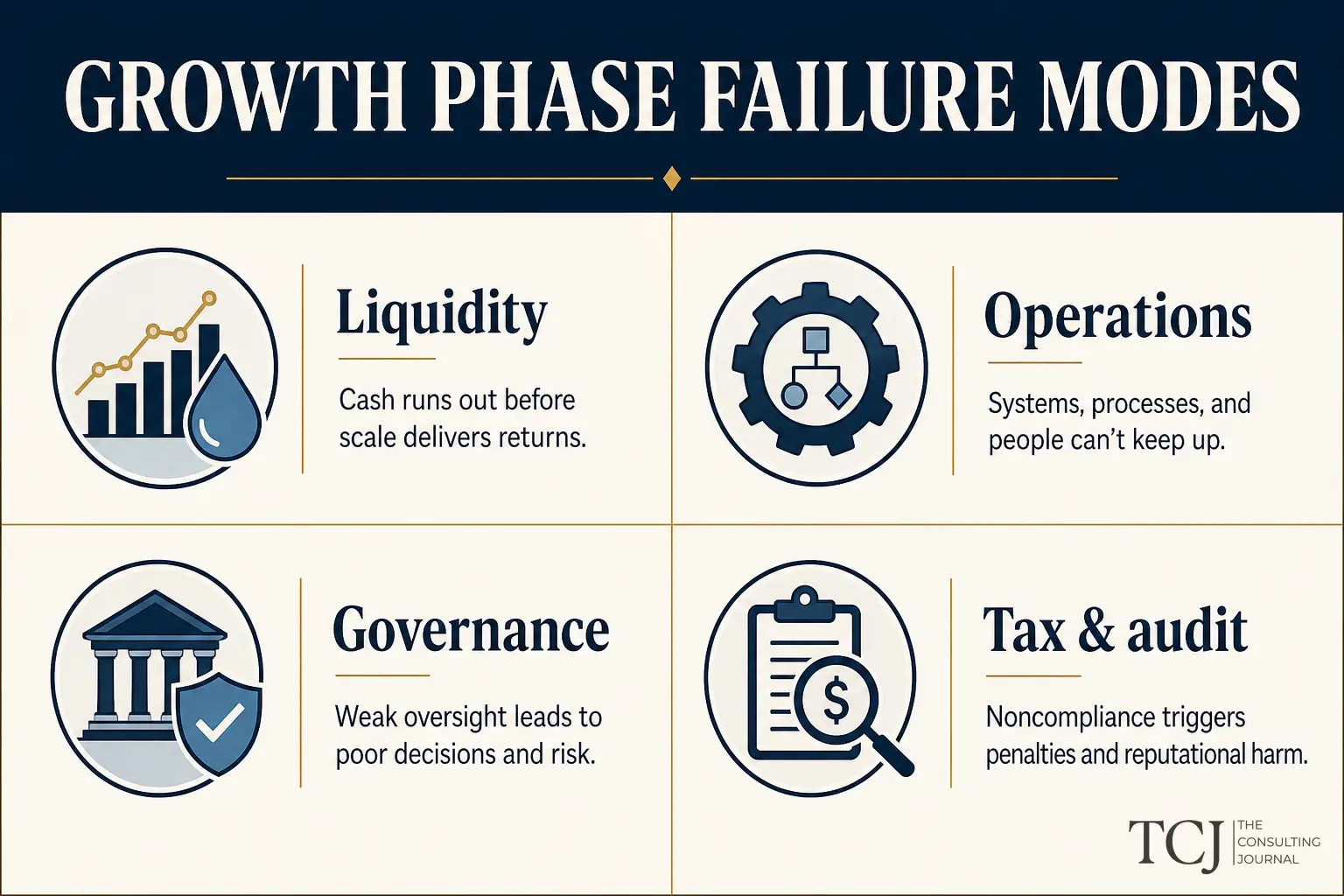
5. Compliance and tax debt compound quietly
VAT misclassification, missing tax invoices, weak related-party documentation, corporate tax estimates without working papers — small errors at low volume become material under audit or due diligence. Corporate tax in UAE mistakes businesses must avoid in 2026 reads like a post-mortem list because teams defer hygiene until filing pressure.
During growth:
- Reconcile VAT ledger to returns quarterly at minimum.
- Store evidence as you go — keeping UAE accounting records ready for tax filing and audit.
- Plan year-end before year-end — how to plan taxes before year-end.
- Confirm relief eligibility with evidence — small business relief in UAE corporate tax.
Tax planning vs tax avoidance for UAE business owners reminds you that legitimate planning requires substance and records — growth is not an excuse to defer both.
The reporting trust collapse
When numbers are rebuilt before each board pack, leadership stops using them. Strategy becomes gut feel. Pricing, market entry, and acquisition debates happen without a shared factual base — the opposite of why finance should guide strategy, not just reporting.
Symptoms:
- Frequent adjustment journals with vague descriptions.
- Different revenue definitions in deck vs ledger.
- Nobody can explain month-on-month margin in plain language.
- Close calendar slips every month.
Fix: monthly close within 5–10 business days, standard pack, three to five bullet variance notes. Why accounting is business intelligence for UAE businesses is the mindset shift — numbers are for decisions, not filing only.
Fundraising and banking friction during growth
Growth often triggers external capital — bank facilities, equity, strategic partners. Both pattern-match on reproducibility. What investors check before funding a business and investor pitch deck mistakes founders make assume clean history — not reconstruction under a data-room deadline.
Weak growth-phase finance produces:
- Discounted valuations and earn-outs.
- Covenant breaches on facilities.
- Delayed draws until “books are cleaned.”
- Walkaways when AR or VAT exposure surfaces.
How to build an investor-ready financial story in the UAE is easier when growth did not erode the ledger. Increase business valuation strategies depend on inputs you can defend — not narrative alone.
Balance sheet blind spots during expansion
Founders obsessed with revenue often ignore the balance sheet until debt, inventory, or deferred revenue matter. Growth into trading or project businesses loads working capital onto the balance sheet — inventory, WIP, customer deposits, loan covenants.
How to read a balance sheet like a business owner is essential when growth adds assets and liabilities faster than P&L complexity. Liquidity ratios, working capital days, and leverage headroom belong in the same meeting as sales pipeline.
A growth-phase finance playbook
Weekly
- Cash forecast update — in, out, committed.
- AR chase on overdue accounts.
- Approval queue cleared — no payment bottlenecks hiding in founder inbox.
Monthly
- Close on schedule; leadership pack with P&L, cash, AR/AP.
- Margin review by segment or product line.
- KPI dashboard — see how to create financial KPIs for your company.
- Narrative: what moved, what we are doing, what we stopped.
Quarterly
- VAT reconciliation and tax planning checkpoint.
- Budget vs actual reset — how to build a practical business budget.
- Control review — new vendors, new roles, new failure modes.
- Tooling check — does accounting software still fit transaction volume?
Before major commitments
- Hire class: runway impact and margin coverage.
- New market or product line: unit economics model.
- Capex or lease: balance sheet and covenant impact.
- Fundraise: three-way model reconciled to ledger definitions.
Registration is not the same as readiness
Growth-phase failures often include tax timing shocks — not because founders ignored tax entirely, but because registration was treated as completion. Corporate tax registration is done: what UAE businesses should do next maps the operating work that follows: chart of accounts mapping, provisional estimates, documentation routines, and cash provisioning. Similarly, VAT registration in the UAE: when your business should act is a decision point — but post-registration reconciliation discipline determines whether VAT helps or hurts cash during expansion.
Businesses that cross registration thresholds mid-growth without updating systems discover filing backlogs exactly when AR and headcount also spike — a compound failure mode. Build tax into weekly cash and monthly close, not as a parallel universe.
Scenario planning when pipeline accelerates
When sales pipeline doubles, finance should model three scenarios before leadership approves matching cost:
- Base — historical conversion and collection patterns continue.
- Stress — collections slip two to four weeks; one key customer delays.
- Upside — conversion improves but requires upfront delivery hire.
Compare scenarios to runway and covenant headroom. This is basic strategic finance — not pessimism. Teams that scenario-plan avoid the heroic hiring sprint that why every business needs CFO thinking for smarter growth warns against when nobody owns the forward view.
Document assumptions in writing so month-three variance reviews improve forecast accuracy instead of repeating the same surprise.
Warning signs you are entering the danger zone
Act before the crisis:
- Cash forecast miss two months running — widen scenario bands and cut discretionary burn.
- AR days sales outstanding rising while sales rise — billing or customer quality problem.
- Gross margin down two consecutive quarters without strategic explanation.
- Month-end close beyond ten business days — capacity or data problem.
- VAT or tax correspondence unanswered — compliance bandwidth failure.
- Key finance knowledge in one person’s head — document and cross-train now.
Why businesses fail during growth phases is the headline; the remedy is predictable routines, not panic hiring.
How automation fits — without losing control
AI in accounting for UAE businesses helps match transactions and flag anomalies when data is clean. It does not replace approval discipline or strategic trade-offs. The future model — advisory plus automation plus control — is laid out in the future of finance is advisory, automation, and control. Use tools to speed reporting during growth; do not automate around broken process.
Banking, facilities, and growth-phase covenants
When growth triggers a bank facility or overdraft review, covenants often reference debt service coverage, minimum liquidity, or AR quality — balance sheet and cash metrics, not pitch-deck revenue. Founders who only optimise P&L discover covenants late. Model facility headroom in the same forecast you use for hiring.
Facilities also interact with tax cash — a business can breach liquidity covenants in a VAT payment month even with “good” profit. Integrate tax calendar into treasury from the start per how to plan taxes before year-end.
Post-mortem discipline — learn without repeating
When a growth initiative fails — new market, product line, campaign — finance should produce a short post-mortem: budget vs actual, cash consumed, margin outcome, working capital impact. Not to assign blame; to improve the next decision. Teams that skip post-mortems repeat the same failure mode with higher stakes.
Link learnings to KPI updates — if DSO spiked during the initiative, tighten collection KPI thresholds before the next push. How to create financial KPIs for your company includes revising targets when evidence shows the old assumption was wrong.
The bottom line
Businesses fail during growth phases because scale amplifies cash gaps, fixed-cost commitments, margin blindness, control weaknesses, and compliance debt — not because ambition was too high. Sustainable expansion requires the same finance discipline investors and banks expect: trustworthy monthly numbers, cash visibility, documented controls, and tax evidence stored as you go.
Build systems before volume makes gaps expensive. Name owners. Tie hiring and marketing to cash and margin — not hope. Read cash flow alongside profit. Let finance guide strategy, not only history.
The growth-phase playbook above is preventative — operators who implement it before pipeline spikes avoid the classic pattern where success creates its own liquidity crisis. Review it quarterly as part of monthly financial reports every founder should review in the UAE cadence even when times feel calm; calm is when you fix AR rules and forecast assumptions, not when you discover they never existed.
For help stress-testing your growth plan against cash and compliance, book a free consultation. Browse the Finance desk for more on reporting, tax, and systems.
This article is general information for UAE-based businesses and is not legal, tax, or financial advice. Confirm your specific obligations with a qualified adviser before relying on any framework described here.
Questions and answers
Can a profitable business still fail during growth?
Yes — frequently. Profit is an accounting measure spread across a period; survival depends on cash timing. If you hire, buy inventory, or prepay marketing before customers pay you, you can show profit on accrual accounts while running out of money to make payroll. Growth accelerates that mismatch unless you forecast cash and manage receivables actively.
What is the most common financial mistake during rapid expansion?
Treating revenue growth as proof that spending can scale at the same pace. Founders increase headcount, office space, and marketing before unit economics and collection patterns are stable. The fix is a rolling cash forecast, hiring tied to confirmed revenue or contracted backlog, and weekly AR discipline — not quarterly panic.
How do I know if we are growing too fast?
Warning signs include: cash forecast errors widening, AR over 60 days growing faster than sales, margin falling without a clear strategy, month-end close slipping repeatedly, key person dependency in finance, and leadership making spend decisions without current numbers. If you cannot explain variance in one paragraph, pause hiring and marketing until reporting catches up.
Does UAE corporate tax make growth failures worse?
It can. Fast growth without clean categorisation and documentation creates tax positions you cannot defend, surprises on taxable income, and missed planning opportunities such as small business relief where eligible. Tax problems rarely cause overnight collapse alone — but they drain cash and management attention when you should be fixing operations.
When should a growing UAE business bring in external finance help?
When transaction complexity exceeds bookkeeping — multi-entity structures, inventory, intercompany charges, payroll across visas, or fundraising due diligence. Many SMEs use outsourced CFO or accountant review quarterly before a full hire. The trigger is judgement volume, not headcount alone.
More in Finance
View all Finance →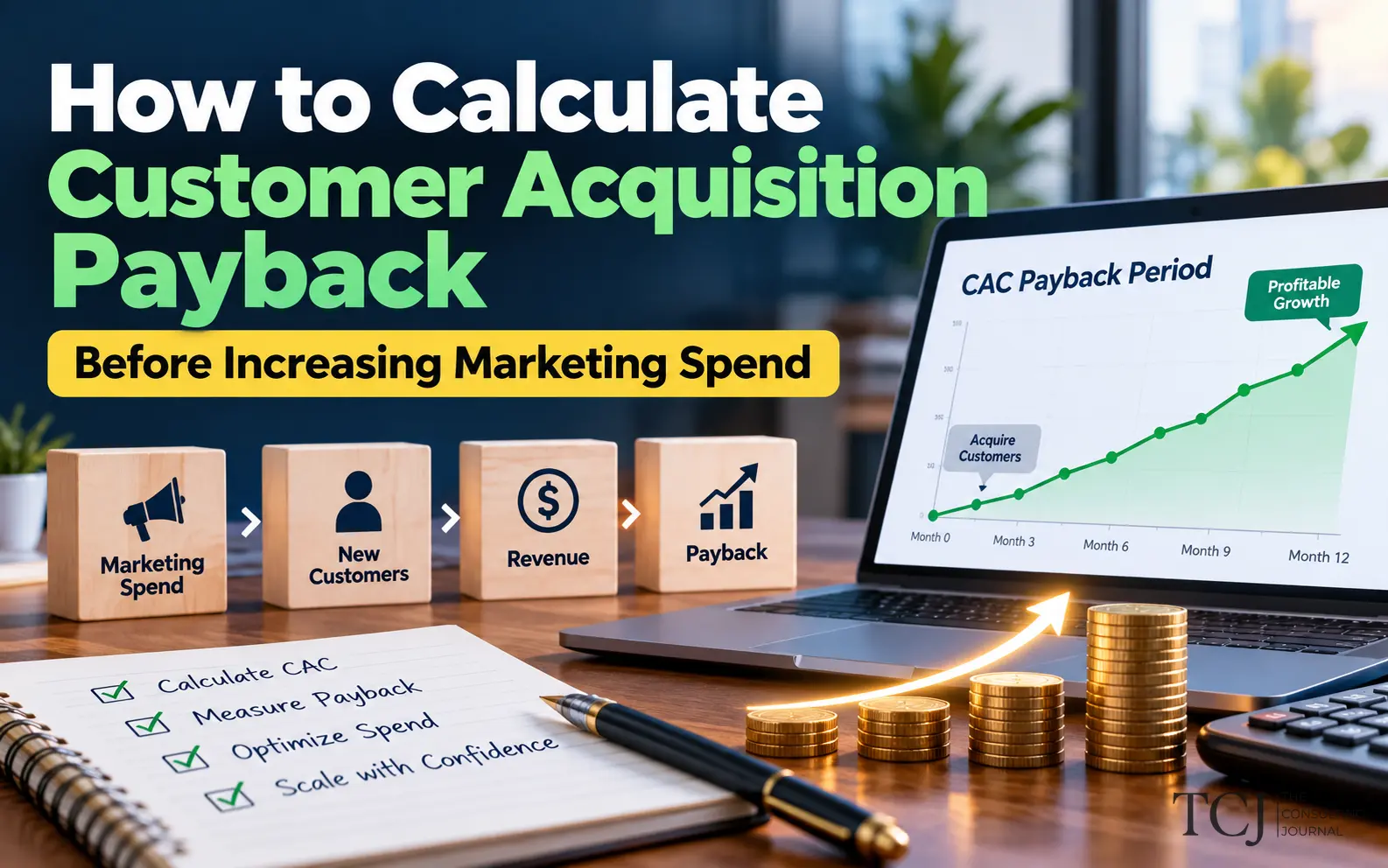
Customer Acquisition Payback: How to Calculate It Before Increasing Marketing Spend
Learn how to calculate customer acquisition payback, evaluate CAC efficiency, and assess whether increasing marketing spending makes financial sense. Includes practical formulas, worked examples, cash flow considerations, and a scaling checklist.

How to Build a Monthly Cash-Flow Dashboard for a UAE SME
A practical guide for UAE SME owners and finance teams on building a monthly cash-flow dashboard that tracks liquidity, collections, payments, tax obligations, forecasts, and working capital.

How UAE Companies Can Build a Faster, More Reliable Month-End Close
A practical UAE finance guide to shortening the month-end close through better reconciliations, cut-off controls, automation, tax readiness, data quality, and clear accountability.